Thursday, March 8, 2012

What the First Amendment Doesn’t Mean

Congress shall make no law respecting an establishment of religion, or prohibiting the free exercise thereof; or abridging the freedom of speech, or of the press; or the right of the people peaceably to assemble, and to petition the Government for a redress of grievances.

I want to talk briefly (I hope) about the portion of the First Amendment that I’ve highlighted above. Why? Because, of late (and yet again), there seems to be quite a bit of confusion.

In essence, the freedom of speech clause of the First Amendment prohibits the government (and, based on rulings from the Supreme Court, that means both federal and state governments) from abridging a person’s right to speak freely. But that right isn’t absolute. Thus, for example, you have the right to defame me — but I have the right to to sue you and to recover damages from you for the defamatory statement. Similarly, the government can limit speech using what are often referred to as “reasonable time, place, and manner restrictions”. Thus, for example, the government can pass a noise ordinance prohibiting noise above a certain volume at certain hours. But what is important to understand about this type of restriction is that it needs to be “content neutral”; thus, the government could pass a noise ordinance that applied to all noise but it couldn’t pass a noise ordinance that only applied to politicians standing on a corner; it could pass an ordinance regarding signs placed along streets, but it couldn’t limit the ordinance to political signs. Similarly, the government could pass an ordinance limiting the allowable decibel level for a car stereo but couldn’t have that ordinance only apply to rap music. Of course, the law is far more complex and there are exceptions to every rule…

And the government can ban certain types of speech, but those instances are very, very rare and limited, the most obvious being speech that serves as an incitement to violence.

Some of the current interesting or “hot” issues involve some of the following questions:

  • Can a school (part of the government) prohibit students from speaking online on certain subjects if the speech is not done on school computers or from school grounds (or punish kids who do so)?
  • Can a government ban speech that instructs someone in how to break a law, so long as no violence is involved (for example, there is a law that makes it illegal to provide information on how to crack a computer password)?
  • Can the government ban people from lying about military medals and honors that they claim to have received?
  • Can the government require certain types of warnings (think of cigarette packaging, for example)?

Obviously, there are numerous speech-related First Amendment issues before the courts, but those offer a highlight of some of the current issues. One thing to keep in mind, however, is that there are varying “levels” of speech, with political speech being deemed the most important and thus entitled to the most protection down to commercial speech (i.e., advertising) being entitled to some protection but not the same degree of protection as political speech and on down to obscenity which is entitled to little, if any, protection.

But the problem is that far too many people don’t seem to really understand some of the core concepts of this provision of the First Amendment. The recent flap over Rush Limbaugh’s outrageous comments offers a prime example.

I’ve heard or read more than a few commentators or individuals remark that Limbaugh was simply exercising his First Amendment rights. And that’s true. He was. The First Amendment gives people the right to say really stupid, really hurtful things. It even gives them a (limited) right to lie. But many of the people who have noted that he was exercising his First Amendment rights have either explicitly argued or implicitly suggested that, because he was exercising his First Amendment rights, criticism of Limbaugh is inappropriate. And that is wrong. Let me repeat something that I said last time I wrote on this very subject (Freedom of Speech Just Isn’t That Complicated (and other notes about Hank Williams Jr.)):

The First Amendment means that I can stand on a tree stump and shout my ideas to the world; but it does not mean that anybody has to come listen. The First Amendment means that I can write a book with crazy ideas; but it does not mean that anybody has to read it. And the First Amendment means that I can tell a newspaper reporter what I really think; but it doesn’t mean that he has to print it.

The other thing worth noting (and which seems to confuse many people) is that Limbaugh certainly has the right to say those hurtful things, but he doesn’t have a right to a $400 million radio contract or the right to say those things over the radio and on a station opened by a private corporation. Think of it this way: If you walk over to the local TV or radio station and tell them that you want to exercise your First Amendment rights and to please show you to the studio so that you can tell the world what you think, what do you think will happen? Exactly. Limbaugh has the same rights that you do. He can put up a soap box on a street corner or find a nice tree stump from which to spout his ideas (if the hate- and fear-mongering that he spews can properly be called “ideas”); but he has no First Amendment right to say what he wants on the radio. Now that doesn’t mean that the government can force him off of the radio for his comments — but the owner of the radio station can (subject to the terms of their contract). And there is no constitutional mandate for anyone to advertise on Limbaugh’s show.

Furthermore, and I can’t quite figure out why people have a hard time with this, criticism of Limbaugh is, itself, speech protected by the First Amendment.

And remember what I said about the intersection between the First Amendment and defamation? Right. Limbaugh had the right to call Sandra Fluke a slut and a prostitute. And she, most likely, has the right to sue him for defaming her and, again most likely, all she will have to prove is that he said it and that she isn’t. I don’t know about you, but I think that I would feel entitled to reasonable compensation from someone who told 20 million listeners that I was a prostitute.

So, when people call or write to Limbaugh’s sponsors and ask them to stop advertising on Limbaugh’s program, they are exercising their First Amendment rights. When people call or write to Limbaugh’s employer and ask them to take his program off the air, they are exercising their First Amendment rights. And when advertisers choose whether to continue their advertisements on Limbaugh’s show, they are, in essence, exercising their own First Amendment rights, too.

One central goal of the First Amendment was to allow ideas to be expressed and for those ideas to complete in the “marketplace of ideas”. Republicans are supposed to love free markets, right? Well, Limbaugh threw his thoughts into the marketplace of ideas and others are responding with their own views on Limbaugh’s thoughts. And the marketplace of ideas is choosing which of those competing views is the “winner”. Given that 30 or more advertisers have pulled advertising from Limbaugh’s program, it would appear that calling someone a slut and prostitute as a part of a three-day long all out personal attack is not a viewpoint that the marketplace supports.

Finally, as long as I’m talking about Limbaugh, I really ought to mention my own personal involvement and how I know, first hand, just how casually he lies. Some of you may remember how I led a social media effort (through Facebook) in April and May 2011 to get the Indianapolis Motor Speedway to rescind their invitation to Donald Trump to drive the pace car for the 100th Anniversary running of the Indianapolis 500 (I wrote about the effort and its result in my posts We Don’t Want Donald Trump to Drive the Indy 500 Pace Car and We Don’t Want Donald Trump to Drive the Indy 500 Pace Car (update); the Facebook page is still online … and still has over 17,000 “likes”). But apparently, I never got around to posting about Rush Limbaugh’s reaction to those efforts, including calling me a "Democrat fundraiser, operative, hack, or what have you" and a "wacko". I took those comments — especially being called a “wacko” — as a sort of badge of honor. But the primary reason that I raise this is the fact that Limbaugh, based on who knows what, but certainly not from talking to me, referred to me as a “Democratic fundraiser”. I’m not and never have been. Yes, I’ve given tiny amounts of money on a handful of occasions (I think I gave $25 to the Obama campaign and $50 to Vi Simpson when she was thinking of running for Governor of Indiana). I’ve never fundraised for a Democratic candidate or the party (at least I certainly don’t recall doing so). But you see, when it comes to Limbaugh, despite his claims to “integrity” and whatever else, truth just doesn’t seem to be that important. If he lied, so casually, about little ol’ me and on such a relatively trivial matter, then what might he do when the subject is far more important and the stakes are far higher?

So, yes, the First Amendment gives Limbaugh the right to lie all he wants (well, to a point) and to say mean and hurtful things. And the First Amendment also gives people — like you and me — the right to criticism him for his lies and hurtful statements.

Labels:

Bookmark and Share


Thursday, March 1, 2012

Yet More on the Birth Control Brouhaha

I know that the horse is dead (and the amendment defeated) but I want to jump back into the breach yet again to talk about the issue of requiring the inclusion of birth control in insurance benefits. Just a short while ago, an amendment (to a transportation bill!) was defeated in the United States Senate. The amendment offered by Sen. Roy Blunt (R-Missouri) would have allowed any employer to opt out of the requirement to cover birth control in order to respect that employer’s religious views. At least that’s how the Blunt Amendment has been repeatedly described over the last few days. But guess what? The Blunt Amendment went much further than that. Much further.

Let’s look at some of the operative language from the Blunt Amendment (I’ve pulled the relevant text out of the longer amendment and put it in bullet points to try to make it easier to read):

  • A health plan shall not be considered to have failed to provide the essential health benefits package described in [the Public Health Service Act] … on the basis that it declines to provide coverage for specific items or services because (i) providing coverage (or, in the case of a sponsor of a group health plan, paying for coverage) of such specific items or services is contrary to the religious beliefs or moral convictions of the sponsor, issuer [et al]; or (ii) such coverage (in the case of individual coverage) is contrary to the religious beliefs or moral convictions of the purchaser or beneficiary of the coverage.
  • Nothing … shall be construed to require an individual or institutional health care provider, or authorize a health plan to require a provider, to provide, participate in, or refer for a specific item or service contrary to the provider’s religious beliefs or moral convictions. … [A] health plan shall not be considered to have failed to provide timely or other access to items or services … or to fulfill any other requirement … because it has respected the rights of conscience of such provider….

Yeah, I know that is quite a mouthful. Welcome to the world of federal statutes.

So let’s break the problems with this language up into some bite-sized chunks, shall we. First, did you notice anything interesting about the exemption for religious beliefs? Right. It’s not just religious beliefs that are exempted. “Moral convictions” are also reasons for which coverage can be exempted. Thus, query whether an employer who is also a Tea Party activist can exempt all coverage because of the employer’s “moral convictions” that the government has overstepped the bounds of the 10th Amendment? Or what if the employer’s “moral convictions” tell him that sex outside of wedlock is immoral and therefore refuses to provide coverage for any matter relating to sex (or … gasp! … pregnancy and childcare) for a woman who is not married? Might an atheist have “moral convictions” against paying for treatment in a religious-affiliated hospital? And dare I ask whether coverage could be denied to someone on the basis of adherence to a certain religion if the employer views that religion as “immoral”?

Note also that the Blunt Amendment never mentions birth control, contraception, or even abortion. It would have applied to any “specific item or service”.

I think that I’ve already discussed the issue of religious-based exemptions in my prior posts (The Birth Control Brouhaha, More on the Birth Control Brouhaha, and Still More on the Birth Control Brouhaha), so I’m not going to rehash those arguments here. But I did think of one other point worth making. I remember when my grandfather was in the hospital. It was a Catholic hospital. There was a crucifix on the wall with Jesus looking down at my grandfather 24/7. He expressed discomfort at this. My own religious beliefs (and certainly those that my grandfather held) don’t include Jesus. So query: As an employer, could I refuse to pay for services provided by Catholic or other religious-affiliated hospitals if they have crucifixes in the rooms?

Furthermore, if we’re now opening up adherence to laws of general applicability to the question of a person’s “moral convictions”, down which slippery slopes might that lead? What if I’m morally opposed to war? The death penalty? If my moral convictions tell me that abortion is evil, does that give me the right to “opt out” of laws that prevent me from doing harm to an abortion provider? The possibilities are endless … endlessly complicated … and endlessly horrifying.

I also want to note one other thing about the Blunt Amendment: It doesn’t just speak to a health plan not covering a service. It also allows a health care provider to not participate in or refer for a specific service. Thus, if a OB/GYN who is opposed to an abortion knows that a pregnant woman may die if she doesn’t get an abortion, he may nevertheless refuse to refer her to a doctor that might perform the procedure. And a doctor who has a religious belief or moral conviction opposed to birth control could “opt out” of prescribing birth control. Or query a doctor who believes that obesity is a sign of moral failing; could that doctor opt out of giving proper treatment to an obese patient? Could a doctor who happens to be a Scientologist refuse to refer a patient for necessary mental health treatment?

Could a religious hospital opt-out of treating a patient that didn’t share that hospital’s religious beliefs or moral convictions (i.e., could a Catholic hospital decide to only treat Catholic or Christian patients?) Could a hospital opt-out of treating a patient accused of a crime that included a component of perceived immorality?

And, though I’ve said it before, I think that it’s worth remembering the most critical point of all with regard to this discussion: The proposed regulations do not require anyone to use birth control.

Oh, and before I quit, I did want to mention briefly just how far … um … right … the right has gone on this issue. Yesterday, the titular leader of the American right, Rush Limbaugh, referred to a law student who wants birth control as a slut. That’s right. A woman who wants to have sex and not get pregnant is a slut. So says Rush.

And one final thought: Can I, as an employer elect to exclude coverage for Viagra and similar drugs because it is against my moral convictions to help a man get an erection but not help a woman keep from getting pregnant?

Labels: , ,

Bookmark and Share


Wednesday, February 29, 2012

Stupidity With Bonus Bigotry (or at Least the Suggestion of Bigotry)

Somehow, I’ve largely managed to avoid writing about a blogger named Jim Hoft who writes under the handle Gateway Pundit (please don’t bother clicking the link; I’m afraid that you’ll lose IQ points just by doing so). I’ve often seen other bloggers refer to Hoft by such lovely sobriquets as “the dumbest blogger alive” or “Jim ‘Dim’ Hoft”. I’m not ready to go quite that far, but I couldn’t resist addressing the article Obama Holds Lunch with Congressional Leaders But Excludes (Jewish) Majority Leader Eric Cantor that he posted today:
Barack Obama asked Congressional leaders to the White House today for lunch. He did not send an invitation to Majority leader Eric Cantor, who is Jewish.
Obama doesn’t much like Eric Cantor. He chided Cantor in 2010 for bringing a copy of Obama’s health care plan to Obama’s health care talks.
Hoft then includes a video of President Obama “chiding” Rep. Cantor followed by an embedded article from Politico that includes the following:
The group was limited to only the top congressional leaders: Senate Majority Leader Harry Reid and Minority Leader Mitch McConnell, House Speaker John Boehner and Minority Leader Nancy Pelosi.
That left out House Majority Leader Eric Cantor. The president and Cantor had a famously tense encounter during the debt ceiling talks — White House staff said Cantor repeatedly interrupted Obama toward the end of a meeting, Cantor’s staff said Obama walked out. But they have in recent days begun working together on a legislative jobs package designed to help small businesses get access to capital.
So why bother posting this? First, note the title of Hoft’s post. What’s the point of referencing the fact that Rep. Cantor is Jewish? Does that have some sort of relevancy to the story? Then Hoft repeats this fact again in the first paragraph of his article … and immediately follows that with the claim that President Obama doesn’t like Rep. Cantor. Of course, his sole basis for the claim that the President doesn’t like Rep. Cantor is the fact that President Obama “chided” Rep. Cantor back in 2010 and that they had a “famously tense” relationship. Of course he ignores the fact that the article he quotes notes that President Obama and Rep. Cantor have “begun working together”. More importantly, though, is that at least to me it appears that Hoft is suggesting that President Obama doesn’t like Rep. Cantor because he is Jewish. Why else make repeated reference to Rep. Cantor’s religion. Hoft doesn’t tell us the religions of Speaker Boehner, Sen. Reid, Sen. McConnell, or Rep. Pelosi, does he? Nope. He just singles out the Jew. Why? Why was that an important fact to mention, not once, but twice?
Now let’s look at this for a brief moment and you’ll see why some people call Hoft the “dumbest blogger alive”. Who was President Obama’s first Chief of Staff? Rahm Emanuel. Jewish. His current Chief of Staff is Jack Lew. Orthodox Jew. Who is President Obama’s top political advisor? David Axelrod. Jewish. President Obama has made two appointments to the Supreme Court. One of those was Elena Kagan. Jewish. I could go on, but it seems pointless.
But just in case you think I’m being hypersensitive or reading into Hoft’s comments something that isn’t there, it’s worth looking at what readers of Hoft’s blog have to say. Below are a handful of selected comments:
  • It’s what I would expect of a closeted Muslim.
  • Mitch McConnell is also a Quisling and traitor. I wish evil on Boehner and McConnell. They’re repeated attempts to appease this Muslim Brotherhood plant in the White House is treasonous.
  • What else would you expect a Marxist Kenyan mooslum POS Jew hating A-hole to do…that is not news…this a$$ wipe hates America and all allies…
  • Jim, Muslims don’t eat with Jews.
There are other comments simply bashing President Obama, bashing Speaker Boehner and Sen. McConnell, and even a few noting that perhaps it was appropriate to exclude Rep. Cantor because only the top two leaders from each chamber were invited. But the religious aspects and overtones of Hoft’s story don’t seem to have been missed by his readers (one of whom even notes the irony of Hoft’s suggestion: “Jewish? Yes, there are no jewish democrats, that’s well known!! sheesh.”).
In any event, I think that the post is illustrative of just how Obama Derangement Syndrome really works. This is the sort of thing that passes for discourse on the right and these sorts of invented issues are what we need to continue vigilantly fighting against.

Update (September 25, 2015): Fixed a typo.

Labels: ,

Bookmark and Share


Responding to Political Lies

One of the recurring subjects of this blog has been cognitive dissonance or the willingness of people to believe something even in the face of overwhelming evidence to the contrary. But the issue is really broader than just this. If you read, watch, and listen to enough political reporting, you will find example after example of people (whether candidate, surrogate, or voter) repeating a talking point that has already been debunked as false. I’m not talking about issues themselves, like whether abortion should remain legal or whether the United States should bomb Iran. Rather, I’m talking about the facts cited as the basis for policy decisions. As I’ve said over and over and over, we can and should have debates about policies, implementation, goals, and whatnot. But, as I’ve also repeated, probably ad nauseum, we can’t have those debates if one side (or both sides) rests its view on false evidence or lies.

And therein lies the question: What do we do to stop the proliferation of the lie as a legitimate political tool?

I think that this is actually something very important that needs to be addressed. Unfortunately, far too many of our fellow citizens have neither the time nor the inclination to really dig deep to discover if what they hear from a politician, read in the newspaper, or see on TV is accurate. When that voter goes into the voting booth having made his or her decision in whole or in part on the basis of a lie, then both our democracy and our country are the worse for it.

So let me offer several practical (I hope) suggestions for what we, as citizens, can do. And please remember, when I’m talking about lies, I’m talking about facts that are easily demonstrable, not simple alternate interpretations of a particular set of numbers, for example.

1) If you happen to attend a campaign rally or debate or political forum and you hear a candidate or the candidate’s surrogates say something that you know to be a lie, say something. Use your cellphone to try to find the evidence showing that the statement is a lie and then use the Q&A time as an opportunity to challenge the candidate or surrogate on the claim. Do so respectfully (i.e., don’t say “You lying sack of shit, that’s not right!”) but be sure to offer supporting evidence in your query. Thus, for example, you might say, “Gov. Romney: You said that President Obama has doubled the deficit. According to the Congressional Budget Office, when President Obama took office the deficit was $1.2 to $1.3 trillion. It rose to $1.4 trillion and has since returned to approximately $1.3 trillion. Your statement was thus incorrect. Will you kindly retract the statement?”

2) When you see a lie repeated in a newspaper or magazine as “fact”, write a letter to the editor. Don’t editorialize with your views on the issue (though that’s fine to do in a separate letter). Rather state with specificity what the paper got wrong and provide evidence to support your claim that the “fact” was wrong. And ask that the newspaper print a correction or a retraction.

3) When you receive a chain email restating a lie, compose a Reply (I’d recommend a Reply, not a Reply All, but if you think that the sender will just ignore you then a Reply All may be appropriate) with the correct facts. Again, I’d note that you are not trying to engage in a discussion of the underlying issue, but only trying to be sure that any discussion that people do have is based on accurate information. The more evidence that you can include in your response, the better. It may be easy for people to ignore a single comment or link, but it becomes much more difficult to ignore an overwhelming amount of evidence.

4) If a friend or acquaintance repeats one of the lies to you, I’d suggest by responding that you believe that the statement is incorrect, but that you’d like to check. Ask that the person who repeated the lie send you the information supporting the claim being asserted (“Hmm. That seems contrary to what I’ve read; I’d love to see the source for that piece of information”) and that you’ll send the information that you believe will show that the information was not accurate. If the lie is, in fact, a lie, then the person who spoke it will have a difficult time offering any sort of “proof” other than links to the original claim that they repeated. Your evidence that goes “behind” those statements should trump and debunk the lie.

I know that all of this sounds like a lot of work and a pain in the ass. But I think that the result should be worth the effort. We shouldn’t settle for a democracy and laws based on lies and deceit because we’re too lazy or afraid to call out a lie when we hear one.


Here are a sampling of some of the other posts I’ve written on the subject (some of which date back to the 2008 and 2010 elections):

When a Lie Becomes an Insult

And the Lies Keep Coming

Analysis of a Malicious Lie

Burton Repeats Debunked Energy Cost Figure

Dan Burton Parrots a Glenn Beck Lie to Smear President Obama

The Further Deterioration of Responsible Journalism

The Lie “Was Not Intended to be a Factual Statement”

Cognitive Dissonance in Action

Cognitive Dissonance in Action … Again

Labels: ,

Bookmark and Share


Tuesday, February 28, 2012

Wine Shelf-Talkers: Consumer Aid or Consumer Fraud? (update 2)

Way back in February 2010, I wrote about the use of shelf-talkers to help consumers make wine-buying decisions (Wine Shelf-Talkers: Consumer Aid or Consumer Fraud?). In that post, after some discussion of the pros and cons of the use of shelf-talkers, I discussed a highly deceptive use of a shelf-talker by my local Fresh Market grocery store. That post was followed by an update that discussed how Fresh Market responded to my complaint to set the matter right.

Anyway, the time has come to revisit the issue of wine shelf-talkers (note that I started writing this post last fall … and kept adding to it and putting off finishing it; oh well).

I continue to believe that a shelf-talker is a useful tool for consumers. There are far too many bottles of wine, encompassing an enormous number of varieties from a bewildering number of regions (and most stores, even grocery stores, will have wines from at least 11 countries — 10 points to the first reader who can identify the 11 that I’m thinking of…) for a consumer to make any sort of decision absent at least some additional information. Clearly just reading the sales puffery on the label is no more valuable (or at least not much more valuable) than reading the advertising copy on the front of a box of cereal. Even an educated wine consumer will often have a great deal of difficulty determining whether a particular Cabernet Sauvignon is going to be better than another, let alone determining the quality of a wine from a lesser-known Château in Bordeaux. So a shelf-talker that describes what a consumer can expect from a particular bottle of wine can be very useful. But only so much… Consider the following four wine reviews (chosen, more or less, at random, from 2008 Cabernet Sauvignons from Napa Valley):

  • Rich, with loamy earth, currant, black licorice and subtle cedar touches that build depth and complexity. Best from 2012 through 2020.
  • A dense, full-bodied wine with lots of creme de cassis, charcoal, licorice and forest floor, the wine is opulent and already delicious and powerful. It should continue to drink well for at least 12-15+ years.
  • Cedar, wild berry and blackberry aromas are taut and firm on the palate, appealing for its modest mix of berry flavors. Drink now through 2015.
  • This is a strongly flavored Cabernet. It has upfront blackberry and red cherry jam flavors, with some sweet spicy notes from French oak barrels. It’s not a wine you want to age, but is smooth and flattering now.

So which wine sounds best? Would it surprise you if I told you that the first two reviews were for the same wine (Hall Cabernet Sauvignon Napa Valley 2008), the first review coming from Wine Spectator and the second from Wine Advocate? And would it surprise you that the third and fourth reviews were also of the same wine (Decoy Cabernet Sauvignon Napa Valley 2008), the third from Wine Spectator and the fourth from Wine Enthusiast? Do those sorts of descriptions help you decide which wine you might want to purchase and drink?

Now, let’s add in an element found on many shelf-talkers that stirs up an enormous amount of controversy: ratings. Most wine ratings use a 100-point scale; however, in reality, you’ll never encounter a wine that received a rating lower than mid-70s (and those are really, really rare). Similarly, in a grocery or casual liquor store, you won’t find many wines with ratings above 91 or 92 (and those will be pretty rate, too). Most wines that you come across in a grocery store or casual liquor store will have “earned” a rating in the low 80s to low 90s or won’t be rated at all. And before you ask, the ratings given to the wines described above were, respectively: 91, 95, 84, 87. Make of all this what you will.

But there is a dark underside to the use of ratings (and an ongoing controversy in the wine-blogging world). First, there is the ever-present issue of how ratings are determined. Obviously, one reviewer’s palate may be strikingly different from that of another and, thus, so too may be their respective ratings. There is also the ongoing issue of whether ratings should be based on blind-tastings, blind-tastings with limited information, or more open tastings. Should tastings be done with or without food? And of course, there is the question of conflict-of-interest (i.e., whether a reviewer or publication accepts gifts or paid advertising from a particular producer). There may even be “point inflation” from year-to-year.

For my part, so long as I keep those distinctions in mind, the rating can be another useful tool, especially in the absence of other information. If a proprietor who has become familiar with my palate or whose recommendations I’ve appreciated in the past suggests a particular bottle, even though it didn’t get a great rating, I’m usually willing to take that more personalized suggestion over the available ratings. But query whether the proprietor of most wine shops (let alone the average employee in a casual liquor store or grocery) has had the opportunity to taste and evaluate every bottle in the store. When I’m confronted by an employee who clearly doesn’t have a clue about which bottle might be good, then a rating from a trusted (or semi-trusted) source is at least something that can be used to help make a decision.

(Funny story on this point: Last November, shortly after the new Beaujolais Nouveau was released, I happened to be in a grocery store that has a fairly large wine section. I walked over to see if the new inexpensive bottles had arrived. A store employee walked up, introduced himself as the store’s “wine advisor” and asked if he could help me find something. I asked if any 2011 Beaujolais Nouveau was available. He asked what that was. I patiently explained it to him and he said, “Wow! That’s really interesting. I’ll have to remember that.” Now tell me why I’d want to trust any recommendation that  “wine advisor” gave me…)

There are other issues with the use of ratings on shelf-talkers, many of which I discussed in the original Wine Shelf-Talkers: Consumer Aid or Consumer Fraud? post.

So I understand and appreciate the use of shelf-talkers with ratings to assist consumers in making a decision. Many consumers understand, at least at some level, that a wine with a good rating is (or at least should be) “better” than a wine with a lesser rating (though how they necessarily compare a particular rated wine to a wine without a rating is another interesting question). But the shelf-talkers must be accurate. And that brings me to the second part of the dark underside of the use of ratings.

There is an obvious incentive for a store to denote wines that received a high rating. I’ve often wondered why stores don’t use more shelf-talkers, especially to help sell wines that did get good ratings. And I really wonder when I see a store using a shelf-talker for a wine that received a poor rating. But what is to stop the unscrupulous proprietor from lying? Or to stop the careless proprietor from simply getting it wrong? Most consumers won’t have any means by which to determine if a posted rating is correct. As I mentioned in the original Wine Shelf-Talkers: Consumer Aid or Consumer Fraud? post, a shelf-talker will often describe a vintage other than that being sold. For example, take a look at this photo that I took last fall at that same Fresh Market store (sorry for the quality of the photo; it’s hard to take a professional looking shot on an iPhone while standing in the middle of a busy grocery without being way too obvious):

photo 3

This particular wine was being sold on Fresh Market’s “90 Points or More for $20 or Less” table (see the photo below). And so Fresh Market was pushing the Drylands Sauvignon Blanc 2010 for $15.99 and noting that the wine received a rating of 90 from Wine Spectator. But there’s one small problem. Can you spot it? Look at the battle on the left of the image. It, like all of the other bottles on the shelf, was from the 2009 vintage. [Note: When I went back to Fresh Market about two weeks after taking this photo, the bottles on the shelf were the 2010 vintage, with no 2009 vintage in sight…] Now in this case, the difference isn’t that great. Wine Spectator gave the Drylands Sauvignon Blanc 2009 a rating of 89, just one point lower than the 2010 bottling. But the 2009 bottle doesn’t meet the criteria to be included on the “90 Points or More for $20 or Less” table, does it?
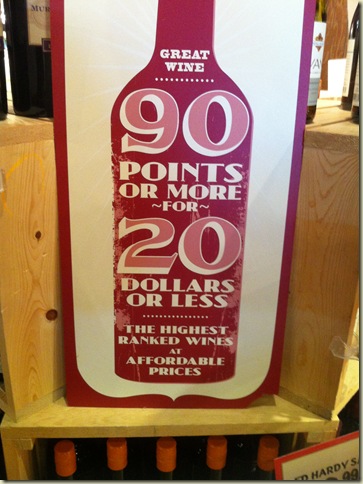
photoVintage Switcheroo (as I like to think of it) is far too common and I’m not sure if most consumers stop to notice whether a particular shelf-talker or rating accurately reflects the bottle being sold. For that matter, I don’t know if most consumers recognize the extent to which the quality of a particular wine can vary from vintage to vintage (by way of example, the 2005 Drylands Sauvignon Blanc received a rating of 91 from Wine Spectator while the 2004 bottle only received an 85). Next time you’re in a store that uses shelf-talkers, especially a grocery (my local Kroger has numerous shelf-talkers that are for vintages 3 or more years older than the vintage on the shelf), take a look and compare to see if you can spot any examples of Vintage Switcheroo. And if you do, please tell the manager.

More sinister still is the use of completely bogus ratings. For example:

photo 2

Just to be clear, this shelf-talker is telling customers that the 2009 vintage bottle of the Summation White blend by Kendall-Jackson received a 90 point rating from Wine Spectator. Only guess what? That’s right. Wine Spectator did not give the wine in question a rating of 90. To be clear: I took this photo last fall. When I searched Wine Spectator’s online wine rating database (to which I subscribe), I found no ratings at all for Kendall-Jackson’s Summation White blend. None. For that matter, there were no ratings for any Kendall-Jackson wine for after 2006! So did Fresh Market simply misattribute this rating to Wine Spectator when, in fact, it came from another publication? Perhaps. But if so, that other publication was neither Wine Advocate (which gave it a respectable 89 points) or Wine Enthusiast (which only gave it 85 points).

Similarly, consider this shelf-talker from Costco for the Glenelly Cabernet Sauvignon 2009:
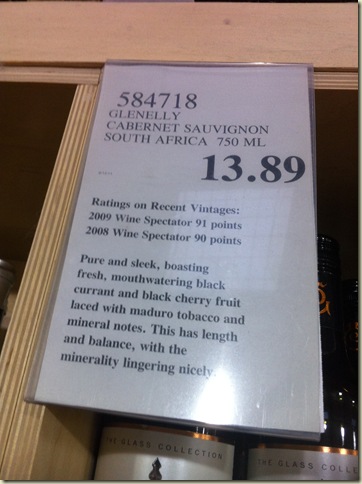
photo 1 Note that the shelf-talker tells us that Wine Spectator gave the 2008 vintage a rating of 90 and the 2009 vintage a rating of 91. The 2008 rating is correct. However, as of date I took this photo in August 2011, Wine Spectator had not rated the 2009 vintage of this wine (and the two Glenelly 2009 wines that had been rated by Wine Spectator received ratings of 87 and 84); when I checked again before writing this post, I found that Wine Spectator had (finally?) rated this bottle (in its November 2011 issue). But guess what? It only earned an 88. And once again, the rating cannot be attributed to another publication (both Wine Advocate and Wine Enthusiast gave it a 90 and Wine Enthusiast didn’t rate it until their November 2011 issue). Back in August, I pointed this problem out to Costco’s wine manager and he told me that he just posted the shelf-talkers that his corporate office gave him. He also told me that “he was sure it was right” suggesting that corporate was very careful about these sorts of things.

photo Then a month or two ago, on another visit to Costco, the shelf-talker for this bottle of Cade Cabernet Sauvignon caught my eye. It may be hard to see, but the wine received a rating of 98+. Now, I’m not in the habit of buying expensive bottles of wine, but a rating of 98+ was so unusual that I became curious, especially with a price in $50s rather than well over $100. I became even more curious when I realized that the wine had a list price of $135 and was apparently being sold at at a whopping 60% discount. You know what’s coming right? Well, you’re probably close. You see, the shelf-talker is almost correct. Wine Advocate did give a 98+ to the Cade Cabernet Sauvignon Howell Mountain 2008 — but that was for the Cade Estate bottle, not the base Cade bottle which only received a 92. And the bottle on the shelf at Costco was the base Cade bottle, not the Cade Estate bottle. Now, I understand that is a very subtle distinction that may be lost on many people. But it shouldn’t be lost on the wine department at Costco’s corporate offices that prepare these shelf-talkers. To be fair, when I contacted Costco, they made the correction very quickly and the local store manager called to thank me for pointing out the problem. But you have to wonder how many people bought the bottle after reading the misleading shelf-talker, thinking that they were getting an incredible deal on a nearly “perfect” bottle of wine.

Or consider the following photo, again from Fresh Market (you would think that they’d have learned a lesson, right?):

photo Can you guess what I’m going to tell you about this photo and display? For this one, you have to look closely. First, note that the store-produced shelf-talker claims “90 Point” but doesn’t attribute that score to a source. However, the bottle has a neck shelf-talker (presumably added by the winery or distributor) claiming 90 points from Wine Spectator. But wait… What’s that shelf-talker on the bottle to the right where it shows an 88 point rating from Wine Spectator? In point of fact, the La Joya Merlot being offered here has never received a rating of 90 from Wine Spectator; it did get in a 88 … back in 1996. More recently, the 2010 and 2009 vintages scored 86 and 85, respectively. A close look at those neck shelf-talkers (sorry, but my photo was way to blurry to be useful) reveals that they are referring to the 2008 La Joya Syrah and the 2009 La Joya Malbec, none of which were on Fresh Market’s shelves.

Or consider this in the September 14, 2011, the Recipe Exchange & Wine Review Newsletter email from The Wine Guy at Grapevine Cottage:

To really savor the Tawny Port experience, the Wine Guy recommends trying a glass of Yalumba's Antique Tawny Port from Australia (10 years - Wine Enthusiast 97, $21) in a brandy snifter on a warm fall evening after a great meal. 

photoThat 97 rating (even though from Wine Enthusiast) at a $21 price point really caught my attention. But, yes, I’m sure you know where this is headed. Now, I’ll admit that because this bottle is non-vintage, getting the precisely correct rating can sometimes be tricky. When I search Wine Enthusiast’s online ratings (free) for “Yalumba Port” or “Yalumba Tawny” I find only three entries, one of which appears to be the bottle in question (the wine reviewed has the same name and is dated February 1, 2011). That bottle received a rating of 89. Again, respectable, but certainly not a 97. Moreover, the other two bottles rated (which are clearly not the bottle in question), only received ratings of 89 and 92. So where did the 97 rating come from? Wine Spectator has reviewed several bottles of Yalumba Tawny. The best-rated was way back in 1998 (rating of 92). The rating for the bottle that is most likely the one being advertised was reviewed in 2010 and received a rating of 88. Wine Advocate rated what may be this bottle (the bottle rated by Wine Advocate may be a prior bottling because it appears to be sourced to Barossa Valley rather than just “Australia”) back in 2009 and gave it 92 points. Again, very respectable, but not a 97. To be fair, when I brought this to the attention of the store, they took it quite seriously and when I was next in, they had a new shelf-talker. And, it should also note that this particular store uses shelf-talkers for every bottle in the store, and this is the only error that I can recall seeing.

It’s worth noting that “Vintage Switcheroo” appears to be very common on non-vintage wines, especially Port. I came a cross an interesting Port recently with a shelf-talker proclaiming a 92 rating and a very inexpensive price (sorry, I forgot to take a photo). I looked up the Port and, sure enough, it did get a 92 rating — in 1995. The more recent reviews (the most recent being 2010, if I recall correctly), rated the wine in the 85-87 range.

And not to beat a dead horse, but…

photo “WA” is the shorthand for Wine Advocate. When I look up “Anwilka” I find that Wine Advocate has only rated one bottle from this winery, that being the 2008 vintage of the same wine being offered in this shelf-talker. But that bottle received a rating of 90, not 94. Wine Spectator reviewed the 2006 vintage, but only gave it an 89; Wine Enthusiast hasn’t reviewed the bottle. So again, the question becomes where did the 94 rating come from?

One of the more interesting shelf-talker problems that I’ve encountered recently was completely innocent and did not even involve a mistake.

I guess I should also mention that I have found numerous errors at one of my favorite wine shops. I’m not going to mention the name here … at least not yet. I’ve pointed out to the staff at least a dozen misleading shelf-talkers in just the last six months or so … and I can’t say that I feel as if my complaints have been taken that seriously. I’m withholding the name of that store for the moment in hopes that I can get that store to recognize the proverbial “error of its ways” so that these sorts of problems don’t continue to recur. But I am to the point that when I shop at that store (which I continue to do because I like the staff and the selection) I never rely on a shelf-talker and, instead, always look up any wine that I’m thinking of purchasing.

And quite recently I encountered one of the most egregious mis-uses of a shelf-talker since the Fresh Market shelf-talker that was the subject of my original post. The store in question only posts shelf-talkers for a tiny percentage of the wines that they stock (and I’ve never quite figured out a rhyme or reason for which wines get a shelf-talker and which don’t). Anyway, a shelf-talker for the 2005 Bodegas Murcia Sierra Carche caught my eye because of the 96 rating from Wine Advocate and the price markdown sticker on the bottle itself. The shelf-talker was a printout from the Wine Advocate website and proclaimed:

The 2005 Sierra Carche contains 50% Monastrell, 25% Malbec, and 25% Petit Verdot aged for 13 months in French and American oak. Inky purple, the wine offers an array of scents which jump from the glass. Notes of toasty oak, pencil lead, tar, black cherry, blueberry, and blackberry are followed by a full-bodied, structured wine with gobs of flavor, terrific intensity, and a powerful palate impression. The wine is well-balanced with enough stuffing to evolve for 3-4 years. It will provide pleasure through 2025.

However, the printed shelf-talker omitted the second paragraph of the Wine Advocate review (emphasis added):

(Note: Compaints [sic] based on different bottlings from what Mr. Miller tasted make us suspicious of what happened at the winery. Until further notice, readers are advised to bypass this wine.)

Think about that for a second. The store was willing to tout the 96 point rating that the wine originally received from Wine Advocate but did not include the caution from the same source to bypass the wine.

By now, I think you’ve got the picture…

I’m not suggesting that a retailer can never make an error. But, on the other hand, I don’t go around double-checking every single shelf-talker I see. Rather, I tend to check if a shelf-talker catches my eye (and isn’t that the goal of a shelf-talker?) and makes me curious. The fact that I found this many errors in such a short period of time only among shelf-talkers that caught my attention and made me curious suggests to me that this is more than just the occasional, forgivable error (and trust me: I’ve found far, far more “errors” than I’ve included here). Moreover, given that it really isn’t that hard to go online and check a rating, it would seem a minor burden to presume that wine retailers will double-check before posting any shelf-talker.

I continue to believe that a shelf-talker is a potentially valuable tool for the wine consumer. But as with any other form of advertising, the consumer must be wary. I think that wine retailers should be encouraged to provide consumers with more information upon which they can base a purchasing decision (and the “wine advisors” available at many stores don’t count…); but consumers must demand that the information provided is accurate. Would you stand for a car dealer to post the sticker for last year’s model on this year’s car? Of course not. Would you stand for a pharmacy to provide side-effect warnings for a drug that have been replaced by newer information? Of course not. Would you stand for a movie theater posting a review for the wrong movie? Of course not. So why should anyone stand for wine merchants using false or misleading information to help sell their merchandise.

Encourage wine sellers to offer more and better information. But recognize that merchants may make mistakes … or may engage in intentionally fraudulent conduct. If you visit a wine merchant and receive good help and good advice and find good and useful information, tell them. But when you visit a wine merchant that uses false or misleading shelf-talkers, they need to know that you’ve noticed. Think of it as a public service as you will be helping the next consumer who may not be aware of these issues or astute enough to examine shelf-talkers more closely.

Labels: ,

Bookmark and Share


Monday, February 27, 2012

Rick Santorum Is Against Collegiate Indoctrination or Make Sure That Your Kids Never Learn to Think for Themselves

A few days ago, Rick Santorum took some time out from prosecuting his war against women and shifted to another front in his drive to turn the United States into a theocracy:

On the president’s efforts to boost college attendance, Santorum said, “I understand why Barack Obama wants to send every kid to college, because of their indoctrination mills, absolutely … The indoctrination that is going on at the university level is a harm to our country.”

He claimed that “62 percent of kids who go into college with a faith commitment leave without it,” but declined to cite a source for the figure.

Let’s analyze this statement. First, just think about the fact that Santorum is actually criticizing President Obama* for wanting kids to go to college. Given that Republicans have criticized Mrs. Obama for wanting kids to eat healthy, this isn’t really too surprising. But still… Now it’s a bad thing to want more American kids to be educated? Yeah, that will be good for America’s ability to compete in the world marketplace.

So why does Santorum object to President Obama’s desire to see more kids go to college? Because universities “indoctrinate” students and cause them to leave without a faith commitment. Well, then. Of course, as noted, Santorum offered no support for his claim that 62% of kids lose their faith commitment in college. But, assuming for a moment that statistic is true … so what? The government should not encourage kids to get a better education because they might — might — learn or be exposed to things that could cause them to question their faith commitment? By all means, let’s leave learning to the Chinese and French and Indians; I’m sure that they’ll share with us when they discover a cure to cancer while Santorum and his followers are still praying for that cure.

But what do you think Santorum is really complaining about? That word “indoctrination” is a bit vague. Indoctrination into what? Perhaps he’s suggesting that universities make people into Democrats, but that seems a bit farfetched. He led a College Republicans group, after all. I seriously doubt he’s suggesting that college turns kids into communists or socialists or some other type of evil “ists”. No. It appears that the indoctrination that he fears is indoctrination into a group that has lost a “faith commitment” — or at least his interpretation of what a faith commitment is. For example, I suspect that Santorum would argue that a person who does share his strict religious views, including hostility to gays and opposition to abortion, does not have a true faith commitment. Remember, over the weekend, he also noted that he does not believe in a strict separation of church and state and claimed that President Kennedy’s famous 1960 speech about the role of Kennedy’s Catholicism made Santorum want to “throw up”. As a brief aside, does that mean that Santorum, a Catholic like Kennedy, would allow the Pope, Cardinals, and Bishops to have a direct influence over Santorum’s decision-making? If we elect Rick Santorum are we really electing the hierarchy of the Catholic Church? Does that scare you the way it scares me?

But back to the indoctrination that Santorum fears will occur to kids who go to college. The only thing left, really, is the indoctrination that will cause kids to lose their “faith commitment”. And what kind of indoctrination might do that? Let’s think back over the history of … well, history. What has been the constant proverbial thorn in the side of religion? Knowledge. The desire to learn more. Questioning. Doubting. Learning.

When we send kids off to school — and college, in particular — the goal is to get them to look at the world around them, try to make sense of it, ask questions, challenge, and learn. By looking at the physical world around us and wondering how and why things work as they do, new scientists and doctors are born. By looking at our world, our society, and the human condition, we foster new generations of poets, teachers, and … well, humans. We ask them to think critically about things like global warming and evolution, not just take as assumed what they’ve been told. We ask them to think about real issues, whether abortion or poverty or racism. We ask them to think, to question, and to learn.

But to Rick Santorum, that is indoctrination. Because the one thing that college students learn not to do, is to just presume that because some authority figure says “it is thus” that there is no further need to search for the truth. In the early Renaissance, the Catholic Church persecuted Galileo for daring to note that the universe was not Earth-centric. Today, Rick Santorum fears just that sort of questioning and reasoning, for what if a college student asks about global warming, or evolution, or (gasp) what’s wrong with gay marriage. Santorum doesn’t fear indoctrination; that’s just a code word. What he fears is learning and knowledge that might make more people look to his antiquated bigoted views not with favor but with revulsion.

Is that the kind of man who should be President?

Oh, and in case you’re curious, according to Wikipedia, Santorum earned a BA from Penn State, an MBA from University of Pittsburgh, and a JD from Dickinson School of Law (Penn State’s law school).

You know, on second thought, maybe Santorum has something. Perhaps if his supporters and their kids took his advice and avoided college, there will be less of a demand for those slots for my kids to fight over, more available scholarship money, and more jobs available for those kids who did brave the university indoctrination centers and learned to think and reason for themselves. Yep. That’s the ticket. If you’re a supporter of Rick Santorum, please, please, keep your kids out of college. We do need more unskilled, uneducated labor, right?

Finally, please see my post So Just How Homophobic and Scary Is Rick Santorum? (posted January 9, 2012), in which I highlight some of Santorum’s most notorious statements.

-----

*Note that Santorum, as has become common among the Republican candidates, often doesn’t include the title “President” when referring to President Obama. Instead he refers to him as “Barack Obama”; many of the other candidates simply refer to him as “Obama”. What happened to respect for the office of the Presidency? What happened to common decorum? These people hate President Obama so much that respect and decorum are no longer recognized or practiced. Though I’m not a fan of “tit-for-tat” sorts of approaches, I will follow suit and refuse to show Santorum or the other candidates any respect that they may be owed and I will endeavor to refrain from prefacing Santorum’s name with “Senator”. If he can’t show a modest amount of respect, then he does not deserve respect himself.

Labels: , ,

Bookmark and Share


Thursday, February 23, 2012

USA Today’s Somewhat Flawed Candidate Match Game

A few days ago, my mother forwarded me a link to USA Today’s Candidate Match Game. I played the game and to no great surprise, the candidate who best matched my answers to the issues was President Obama (with Jon Huntsman running a distant second). Go ahead. Click over and play the game. I’ll wait…

Done? Cool. Which candidate best matched your thoughts on the issues? Were you surprised?

So now let’s take a closer look at the “game” itself. First, let’s look at the 11 issues presented in the game:

  • Afghanistan
  • Energy
  • Health Care
  • Medicare
  • Immigration
  • Experience
  • Social Security
  • Climate Change
  • Taxes
  • Defense Spending
  • Gay Marriage

That’s certainly a decent set of issues. But do you notice any important issues missing from that list? What about job creation? That seems like a fairly important issue these days, don’t you think? What about states rights (i.e., the ability of states to opt out of federal laws or to claim that many federal laws are an unconstitutional infringement on the rights of the states). That’s something that the Republicans have been talking about quite a bit (often in terms of the 10th Amendment). What about the rights of women and other minorities (whether it be things like equal pay, access to birth control, or affirmative action)? What about Iran and whether we should continue to try to negotiate or simply begin the attack? Abortion, anyone? Financial oversight (i.e., “too big to fail” and the Consumer Financial Protection Bureau)? And what about efforts to cut government spending and reduce the debt (other than just with cuts to the military)? The Republicans talk a lot about cutting this department, that agency, or bunches of programs (like, for example, the EPA or the Department of Education). It seems to me that those are also important issues that would help people determine which candidate best matches their thoughts.

I raise these issues because it seems to me that the selection of issues included in USA Today’s game seems to skew somewhat toward the issues that Republicans are talking about. If the point of the game were just to determine which Republican most closely meets your ideas, then that’s fine. But the game also includes President Obama as a possible outcome. Think for a moment of your own answers and results. Now pretend that the game had included questions on methods to spur job creation, whether states can opt out of federal laws and mandates, minority rights, abortion, and methods to reduce the debt and cut spending (among other possible categories). We haven’t heard President Obama talk much about the 10th Amendment but we have heard him talk about job creation. Thinking broadly about how you might answer those questions, do you think you would have skewed further toward President Obama or toward one of the Republican candidates?

And let’s dig a bit deeper on a few of the questions that were asked. For example, the question on health care offers four choices (plus “none of the above”); three choices involve repealing the new health care law while the fourth choice is to simply “support” the health care law. The problem here is that many on the left of the spectrum feel that the Affordable Care Act didn’t go far enough. Many were upset that the law didn’t include a “government option” or single payer system. And many were upset that the law didn’t really address the cost of health care, including such problems as re-importation of drugs. Some who may generally support the Affordable Care Act may not click on the “support” answer because they want it to be enhanced and aren’t satisfied with how it stands at present. So the omission of that sort of answer choice may skew respondents away from President Obama.

Or take the question on immigration. Three of the four substantive answers include tighter border security (and the fourth implies it); but none of the options suggest making immigration easier or more fair. One of the answers talks about extending some privileges to illegal immigrants who have ties in the community, but none of the options makes mention of actually granting some form of amnesty or establishing a guest worker program. Thus, again, it appears that the choices seem to skew toward the Republicans … or at least what the Republicans are talking about.

The answers to the question on Social Security are really oddly worded. For example, the first two answers appear to only differ in whether or not the retirement age is raised, but the second answer adds in a suggestion of means testing. Both means testing and retirement age are important things to consider, but it seems that to really approach those issues, you’d need a matrix of four, not two, possible answers. This problem is exacerbated by the next answer which again talks about raising the retirement age and links that to private accounts with no mention of means testing.

Or consider the wording on the cap-and-trade answer to the climate change question: “Reduce greenhouse gas emissions through a cap-and-trade system that would force industries to pay for exceeding limits.” The problem with that answer is that it is one of those leading answers that suggests a response to the casual reader not well-versed in the issues; after all, who wants to make industries pay more? The answer doesn’t provide the context (the whole cap-and-trade concept) that allows industries that have reduced their pollution to trade their pollution credits to industries that are still polluting and provides a time frame for the reduction of pollution. Note further that the answers don’t really provide any real response other than “no” for those who disagree with cap-and-trade … because none of the Republican candidates have really put forth any proposals.

The answers to the question on taxation are also somewhat odd. Most notable is the omission of any reference to the Buffett Rule. Similarly, there is reference to allowing the Bush tax cuts to expire … but no mention of raising taxes on the wealthiest.

Finally, with regard to gay marriage, it seems that there should be an option for those who actually support gay marriage.

Yes, I understand that those who crafted the game tried to limit answers to things that the various candidates have proposed. However, as written, that winds up giving lots of choices within the field of Republican candidates but only a single “correct” answer on the “left”.

Thus, when you combine the issues being addressed with the types of answers offered for those issues, I can’t help but feel that the entire game skews to the right, even if not toward any particular candidate. And I do think that the omission of questions relevant to the economy, in particular (other than a single question on taxes) may tend to have more people “choosing” a Republican than otherwise would if there were more questions on these core issues. With just one more question, focusing on job creation, for example, how many people’s chosen candidate would have switched from a Republican to President Obama (or the other way, I suppose)? Given that most polling shows that the economy and job creation is at the top of almost all lists of issues important to voters, the omission of that topic is highly problematic.

And, given the recent flap over birth control and abortion (among other social issues), that gay marriage is the only social issue included is also problematic. I can see many people disagreeing with gay marriage but also disagreeing with the anti-abortion or anti-contraception stance of many of the Republicans. So the choice of one particular social issue doesn’t lead to a very useful understanding of the host of social issues that may influence a person’s vote or help someone determine which candidate best matches their views, especially if that particular voter rates social issues high on their scale of importance.

Nevertheless, the “game” does provide a useful, if limited, opportunity for people to compare their thoughts on some issues to those espoused by the candidates. As the general election draws nearer, I’d love to seem a much more detailed version of this game with far more questions and much more detailed answers and choices. Now that would be a game worth playing.

Labels: ,

Bookmark and Share


Wednesday, February 15, 2012

Still More on the Birth Control Brouhaha

In yesterday’s post More on the Birth Control Brouhaha, I spent some time looking at other possible examples of exemptions from insurance coverage on the basis of religious belief. In response to that post, reader Karin offered a comment that is really worth considering in the light of this whole discussion:

Don't forget to add a Jehovah Witness doesn't believe in blood transfusions. Try eliminating that from employer sponsored insurance plans.

I’d never heard this before and decided to do a little reading. Sure enough, Watchtower, the official site for Jehovah’s Witnesses, includes an article that states quite specifically that adherents to the faith ought not accept blood transfusions. There is even a subgroup of Jehovah’s Witnesses fighting to change this religious doctrine.

So if a Catholic-owned business should be able to exclude birth control from its insured benefits, then shouldn’t a Jehovah’s Witness-owned business be able to exclude blood transfusions from its insured benefits?

When my son was a few days old, he needed a blood transfusion. I suspect that it wasn’t inexpensive; I don’t know, though, because the insurance paid for it. I can’t begin to imagine how I would have felt if I’d been told that my insurance didn’t cover the blood transfusion necessary to save his life because employer had religious objections to blood transfusions.

Or maybe only some religions should be entitled to exemptions for their religious beliefs? Is that what opponents to the policy are saying?

I also want to take a very brief moment to look at how the right (Faux News in particular) has been deceptively spinning the issue. Yesterday, former Judge Andrew Napolitano appeared on Fox News to talk about the issue. After spending the first segment of the interview discussing how President Obama has acted unconstitutionally (without noting that Congress frequently authorizes the executive branch to issue rules and regulations, whether through the FDA, EPA, IRS, or any of a host of other departments, agencies, administrations, etc.), Napolitano states:

Can they force other religions to do things against their core beliefs because they — the secular government — think it should be done? Can they force Jewish people to eat pork? That’s ridiculous, but five years ago you would have said it’s ridiculous that they’ll make the Catholic Church pay for contraceptive devices.

(Emphasis added.) Note the deceptive spin? The new regulation does not force Catholics to use birth control. It doesn’t force a Catholic individual to violate his or her religious beliefs. Rather, it forces an employer to provide a standard set of insurance coverages. What do you think Napolitano would say if we were talking about blood transfusions and Jehovah’s Witness University (oops, Jehovah’s Witnesses apparently don’t believe in college education…). What does he say about preventing Native Americans from using peyote or Mormons from engaging in polygamy? And note further that, despite his suggestion to the contrary, this sort of policy has been in place in the states and even at the federal level for far more than five years (for example, this article from the Guttmacher Institute from 2004 notes that 20 states had a provision mandating contraception coverage and that different approaches had been taken to address religious objections);* it’s only as these policies relate to application under the new healthcare law that is bringing the issue to the fore now. Well, that, and the right’s unbridled hate for President Obama.

I hope that I’m done with this topic. Frankly, some of it has been a bit uncomfortable to write, especially as the Catholic Church seems to be the “bad guy” and, given how many of my friends are Catholic, that doesn’t make me feel good. But I do think that the issues are important. Anyway, I want to finish with a quote that I was directed to on Twitter from a writer who I don’t always see eye-to-eye with. And while the quote is incendiary, it is worth considering for the broader context of the voicing of outrage and doctrine:

I'm sorry but I find the protectors of child rapists preaching to women about contraception to be a moral obscenity. When all the implicated bishops and the Pope resign, ther [sic] replacements will have standing to preach.

-----

*From Contraceptive Coverage: A 10-Year Retrospective, The Guttmacher Report on Public Policy, June 2004, Volume 7, Number 2

A key challenge facing advocates of contraceptive coverage mandates is to ensure that any exemptions provided to employers who object to covering contraceptives on religious grounds are narrowly tailored to minimize the number of people denied such coverage. This effort received an important boost recently as the result of two court decisions in California and New York.

Of the 20 mandates now in effect, 13 have some type of exemption for employers who object to providing contraceptive coverage on religious grounds. The specific provisions of these exemptions vary widely across the states. For example, Maryland's law contains a broad exemption that simply permits religious employers to refuse to include contraceptive coverage, without defining the term “religious employers.”

The laws in California and New York are at the other end of the spectrum. Both permit an employer to refuse to cover contraceptives, even though it covers other prescription drugs, only if it has as its mission the inculcation of religious values, it primarily employs and serves people who share its religious tenets, and it falls under a U.S. tax code provision that applies to churches, church auxiliaries and religious orders.

Almost as soon as the California law went into effect, Catholic Charities of Sacramento filed suit. Interestingly, the organization readily acknowledged that it did not meet any of the tests required under the law; nonetheless, it alleged that the statute violated the establishment and free exercise clauses of the U.S. and California constitutions. In a strongly worded decision in March, the state supreme court disagreed.

One of the cornerstones of Catholic Charities' case was the allegation that the law interferes with matters of internal church governance. The court found this charge baseless: “This case does not implicate internal church governance; it implicates the relationship between a nonprofit pubic benefit corporation and its employees, most of whom do not belong to the Catholic Church. Only those who join a church impliedly consent to its religious governance on matters of faith and discipline.” Moreover, the court found the law to be narrowly tailored to serve the state’s compelling interest in eliminating gender discrimination. According to the court, a religiously affiliated organization not meeting the law’s requirements “becomes subject to the same obligations that apply to all other employers.”

In a similar ruling last year, a lower court in New York upheld a virtually identical exemption for religious employers; that ruling, in a suit brought by Catholic Charities of Albany and other organizations, is expected to be appealed to the Court of Appeals, the state’s highest court. Meanwhile, Catholic Charities of Sacramento has until the end of May to file an appeal with the U.S. Supreme Court.

Hmm. I didn’t hear Judge Napolitano talk about any of that.

Labels: , ,

Bookmark and Share


Tuesday, February 14, 2012

More on the Birth Control Brouhaha

I want to spend some time today discussing in more detail some ideas that I touched on in my post The Birth Control Brouhaha. As I understand it, the Conference of Catholic Bishops don’t think that Catholic hospitals or universities should have to pay for birth control as a component benefit in the insurance offered to employees. So, as an accommodation, the Obama administration agreed to follow the lead of several states that move the burden from the Catholic organization to the insurer. In other words, the requirement is now simply that insurers providing employer-paid healthcare must include birth control. But now, apparently, even that isn’t good enough for the Bishops. First, they apparently contend that this would still leave Catholic employers to “pay” for birth control in violation of their beliefs. Second, they also now apparently contend that it shouldn’t just be Catholic universities and hospitals that are exempt, but also Catholic-owned business the owner of which, in good conscience, objects to birth control.

So let’s tease that out a in a bit more depth than I did last week.

Fine. I get that the Bishops don’t think that Catholics should have to pay for birth control because it violates the teachings of their religion (though I did try to find the section of the New Testament when Jesus said, “Thou shalt not take the pill nor use an IUD nor include an employer-provided healthcare benefits any trappings of the same” without success; maybe Jesus was too busy talking about gays and abortions and torture and warrantless wiretaps and … oh, wait). And while I don’t want to get into a detailed discussion of Catholic theology or be accused of Catholic-bashing, I do find it interesting that the determination of what is acceptable for women to do with their own bodies is being determined exclusively by men. I mean, seriously, how many of those Bishops have a need for birth control or have had to experience the life- and body-altering affects of pregnancy?

But what about the death penalty. It’s my understanding that the Conference of Catholic Bishops also takes a strong position against capital punishment. Should Catholic-owned businesses (or I suppose Catholics in general) be able to declare that their tax dollars not be used to prosecute capital cases, house prisoners on death row, and carry out the capitol sentences given by judges or juries? Because Catholics don’t eat meat on Friday (is that just during Lent?), should they be able to opt out of having their tax dollars spent to provide meals containing meat to soldiers, prisoners, government workers, or others on Fridays? Because Catholics (along, of course, with many others) teach against premarital sex, could their healthcare exclude pre-natal, delivery, and neo-natal care if the child is conceived out of wedlock? Should they be able to demand that their tax dollars not be used to educate unmarried teens (or others) about the risks inherent in sex? Should they be able to require that the portion of their tax dollars that pays for education only be used to teach abstinence? Or maybe that those tax dollars not be used to teach evolution. Perhaps Catholic tax dollars ought to exclude paying for history classes that teach about the Inquisition or the reasons that Martin Luther posted his theses on the door of the church?

And if Catholics have the right to exempt themselves from rules that apply generally to all employers or which relate to the expenditure of their money by the government or others, then shouldn’t other religions and people of faith be given similar treatment and exemptions? For example, given that Hindus don’t eat meat (I seem to recall learning that cows are sacred, or is it all animals?), then shouldn’t Hindus be exempted from paying for things like USDA meat inspections? Think about it for a minute. Certainly paying to inspect meat to be sure that it is safe to eat must run contrary to a belief that meat ought not be eaten.

As a commenter to The Birth Control Brouhaha noted:

Should Scientology businesses be exempt from making mental health benefits available to its employees? Should businesses associated with Christian Science be exempt from all medical insurance?

Why not? Perhaps Christian Scientists really need to get into this discussion; after all, if they were suddenly exempt from needing to purchase any medical insurance for their employees, I suspect that there would be an influx of people to the embrace Christian Science (at least on the checkbox on a tax or insurance form) in order to avoid being required to offer insurance to their employees.

What about Quakers or other religions that are opposed to war? Should they be able to demand an exemption from being required to pay for the military (or at least offensive military operations)? Should they be exempt from laws requiring them to hold open jobs for reservists called off to serve in Iraq or Afghanistan? Could Muslims justifiably expect an exemption from paying for war to be conducted against their fellow Muslims in other countries?

And I think back to some of the things I heard about certain Christian dominionist sects where women are seen as being subservient to men. Should businesses owned by followers of that sort of religious tenant be exempt from paying for services that are of benefit to women, in particular women who work outside the home? Could followers of those faiths legitimately offer fewer benefits to their female employees? Could they refuse to even hire women?

The Amish are apparently opposed to the use of many modern conveniences. Should they be exempt from paying for such things as ambulances, public hospitals, and roads? What about modern healthcare? Why should any Amish tax dollars go to pay for the Internet or NASA or even subsidies to oil companies?

As I pondered previously, I wonder whether religions that believe that homosexuality is a sin or an abomination should be exempt from including AIDS/HIV drugs in the insurance benefits offered by their hospitals or universities or those of businesses owned by members of those religions?

Jewish and Muslim organizations and businesses should certainly be able to exempt drugs like glucosamine from the covered benefits of any insurance they provide as that drug is made from the shells of shrimp, crab, and lobster, all of which are prohibited. In fact, apparently drugs such as Aleeve, Benadryl, Bufferin, Claritin, Nyquil, Excedrin, and many others are made with pork containing ingredients and, as such, could also be excluded from the benefits covered by Jewish or Muslim organizations or businesses. Given that observant Orthodox Jews believe that it is inappropriate to engage in certain behaviors on the Sabbath, then shouldn’t any insurance benefits offered by those Jews exempt coverage or actions that would violate the Sabbath proscriptions on certain activities? What about health needs brought about by the use of tobacco (proscribed for Mormons) or alcohol (proscribed both for Muslims and Mormons)? As I asked the other day, could a Muslim or Mormon business exclude coverage for lung cancer caused by smoking or kidney failure caused by drinking?

Or query whether the views of atheists or adherents of polytheistic faiths should be able to opt out of paying for currency, monuments, and other governmental matters that invoke mottos like “In God We Trust” or “One Nation Under God”? After all, don’t those statements run specifically contrary to the beliefs (or lack thereof) of those who don’t come from a monotheistic faith? And why do those people have to recognize Christmas as a national holiday?

Finally, should any person who belongs to a faith that has, as a basic tenet, the notion that others must convert to that religion for “salvation” (or some similar notion), be able to object to the expenditure of any tax dollars that in any way whatsoever that could be seen as advancing or assisting any other religion or the institutions of that religion? For example, could an Evangelical Christian object to the expenditure of government funds for a Catholic or Jewish hospital?

This whole discussion also plays back into many other areas as well. For example, can a Catholic pharmacist refuse to fill a prescription for birth control (please see Don’t Allow a Pharmacist’s Religious Views to Impede on the Doctor-Patient Relationship, one of the first posts I ever published)? Should a Catholic doctor be held to the same standard as any other doctor when treating a patient or, if there is a religious reason not to prescribe a drug, is the Catholic doctor entitled to an exemption from the standard of care that would apply to other doctors? Should certain Native American tribes be permitted to use illegal hallucinogenic drugs as a part of their religious ceremonies? What about animal sacrifices? And why can’t Mormons have polygamous marriages?

In the end, the point is really quite simple and it has nothing to do with “religious liberty”. The law in question is one of general applicability, just like taxes, just like the obligation to obey other laws. The law has not been written to single out any group of people or any religious beliefs; it does not require any individual to engage in conduct that individual objects to on religious grounds. And it does not require any individual to act in furtherance of some other religious belief. And most importantly, the law does not prevent individual Catholics (or others) from acting on their religious belief; they don’t have to use the birth control. The Jewish employee doesn’t have to take glucosamine; the Muslim employee doesn’t have to take Excedrin; the Hindu employee doesn’t have to eat meat; the Scientologist doesn’t have to see a psychiatrist; the Quaker doesn’t have to pull a trigger; and a Catholic doesn’t have to push the plunger in the execution chamber. But those are choices that the individual makes with regard to his or her personal conduct. But neither the religious beliefs of those people nor the religious faiths and organizations to which they belong should exempt them from generally applicable and neutral laws that serve a broader public function and which do not, in and of themselves, have a direct impact upon the ability of individuals to worship (or not) or follow the tenants of their religious beliefs.

Labels: , ,

Bookmark and Share


Thursday, February 9, 2012

The Birth Control Brouhaha

So I thought that I’d do one of my “thinking out loud” posts on the current controversy over the Obama administration’s decision to extend the requirement that employer provided health insurance cover birth control to religious affiliated employers (other than the religious institutions themselves). First a few clarifications to address actual (though incorrect) concerns that I’ve heard. The decision does not require anyone to use birth control (I actually heard someone complain that President Obama was forcing people to use birth control … seriously). It only requires that the health insurance provided by a person’s employer include birth control as a covered benefit. Nor does the requirement apply to churches, synagogues, mosques, other houses or worship or directly to religious institutions. Thus, a convent need not provide birth control coverage to the nuns in its cloisters and a church need not provide birth control coverage to those employed by the church in its ministerial functions.

Instead of thinking of a church, we should be thinking of such employers as religious-affiliated schools and hospitals (I’m not sure where a charity might fit in…). And, rather than thinking about management-level employees who may have the financial ability to acquire birth control on their own should they choose to, let’s think instead about the janitor or lunch lady or similar employees for whom the cost of birth control may be prohibitive if not covered by insurance.

At first blush, I do have some sympathy for the argument that the government should not be requiring religious institutions to use their resources to pay for healthcare costs associated with things that are directly contrary to the beliefs of that particular religion. In some ways, this reminds me a bit of efforts to require my Jewish children to say an overtly Christian prayer in school (remember the bill here in Indiana to require school children to say The Lord’s Prayer?). But then I realize that isn’t a very good analogy. First, the birth control requirement involves the expenditure of money by an organization; it has nothing to do with requiring religious conduct by an individual. Second, the birth control requirement is neutral on its face while the school prayer is motivated by a specific religious viewpoint in the first place. The fact that it is the same people who argue against the birth control requirement advocating for things like school prayer is worth noting, too.

And as I thought about that point, I came to another realization. One of the arguments that I keep hearing is that the government shouldn’t force religious organizations to spend money on something that the religion does not believe in. But you know what? Neither religious organizations nor religions themselves have beliefs. People do. And the fact that a particular person doesn’t necessarily believe in something, whether for religious reasons or otherwise, has never been a reason to exempt that person from a generally applicable requirement. For example, Catholics are (to my understanding) also opposed to the death penalty; yet income taxes from Catholics — and all others — are used to pay for executions. Numerous creeds believe in pacifism, yet their tax dollars are used to pay for military equipment and wars. I’m sure that some people, following their religious understandings, don’t believe in public education and may choose to home school their children; but they still pay taxes that go for public education of others. Orthodox Jews don’t drive on Saturday, but their taxes still pay to keep traffic lights working and police officers on the streets.

And why is the concern being raised limited to birth control? Where does the line of reasoning really end? For example, the Catholic church doesn’t believe in divorce, either (sorry to focus on the Catholic church, but that is where the controversy seems to be emanating from and it is the religion for which I feel that I have at least a small bit of knowledge from which I can draw examples). Could a Catholic hospital refuse to hire a man who is divorced? Could a Catholic high school fire a woman who gets divorced? Could a Jewish hospital refuse to hire a person with a tattoo (tattoos are prohibited by the Bible)? Could an Islamic school refuse to hire a woman who didn’t agree to wear a hijab outside of the school?

Or let’s try this one: Say that there is a new cancer drug that will eliminate prostate cancer. But the drug is made from a combination of shellfish and pork, both of which are forbidden by Judaism and Islam. Could a Jewish hospital or Islamic school refuse to pay for that drug for their respective employees because the ingredients violate the respective beliefs of Judaism and Islam? Or what about a hospital tied to a religious organization that forbids consumption of alcohol or tobacco (I’m not sure, but aren’t alcohol and tobacco prohibited by Mormon teaching?); could that hospital refuse to provide insurance coverage for smoking-induced lung cancer or for alcohol-induced kidney failure? And can a religious institution that is opposed to homosexuality refrain from including in its package of insurance benefits drugs to help with HIV/AIDS? Remember: The point isn’t whether the employee uses the birth control or takes my hypothetical drug or needs treatment from the use of “banned” substances or because of conduct deemed an “abomination”; whether to do so or not is that person’s choice and if it violates their religious beliefs, that is something that the person has to wrestle with. But how does that impact what the employer does (or chooses not to do)?

I guess what it comes down to for me is that it shouldn’t be up to the employer to decide which types of medical care its insurance will provide. One employee should not be treated differently than another with regard to available healthcare benefits solely because of the religious affiliation of their respective employers. The decision on whether to use birth control should be up to the individual; it shouldn’t be the decision of a religious-affiliated employer. The only person whose religious beliefs are impacted by the decision to use birth control (or not) is the individual; the religious-affiliated organization, as an organization and not an individual, doesn’t really have beliefs.

Or think of it this way (and, for the purpose of this thought exercise, let’s presume Catholic theology is true): If a Catholic hospital has to include coverage for birth control in the insurance that it provides to its non-Catholic employees (or even Catholic employees) — and remember that the Catholic hospital isn’t actually dispensing or selling the birth control; that would be done by the employee’s doctor or the pharmacy frequented by the employee — who will be going to Hell? The hospital or the employee?

And as to religious liberty, we have a long history of weighing that against the harm to others and against generally applicable laws. Thus, laws prohibiting the use of hallucinogenic drugs (peyote) as a part of religious worship have been upheld. And clearly I cannot, in the practice of my religious beliefs, do harm to you. The requirement that birth control be included does not prohibit any individual from making their own decisions of what conduct they personally will engage in or refrain from and whether or not to base that decision on religious beliefs. That is religious liberty.

In the end, it’s my view that the claim that to require religious-affiliated organizations to include birth control within the package of insurance benefits offered to employees is somehow infringing on religious liberty is simply wrong. We’re not requiring the religious institution to violate a belief (and remember my suggestion about the “beliefs” of organizations); we’re requiring the religious institution to follow the same rules that apply to other employers generally and we leave the decision of what beliefs to follow or not up to the individual.

Labels: , ,

Bookmark and Share


Newer›  ‹Older