I apologize the delay since my most recent post. I’ve had … reasons. And writing this post took … way too long.
Before I discuss whether I think it is appropriate or acceptable for athletes to kneel rather than stand during the playing of the National Anthem prior to a game, I think it’s worth at least asking why we play the National Anthem prior to games. We seem to do so before virtually all sporting events (is the National Anthem played before golf tournaments?), but we don’t do so before many other large public gatherings. If I go to a high school football game on Friday night, there will be a rendition of the National Anthem, but at the high school choir performance the night before, there was neither a recital of the National Anthem nor a presentation of the flag. And if, the next night, I go to a theater performance, a TED Talk, or a beer festival in a local park, it is unlikely that there will be a recital of the National Anthem before those events. Youth soccer and baseball games don’t usually include a rendition of the National Anthem unless organized by a school. Similarly, before a group of friends gather to play a game of softball, ultimate Frisbee, flag football, HORSE, tennis, or bocce, they don’t usually stop and sing the National Anthem first. So why do we play and/or sing the National Anthem before some sporting events?* I don’t have an answer to that question but I do think that, whatever the answer may be, is at least worth considering when reflecting on the general question at hand.
It is also worth considering that playing the National Anthem before a sporting is not a universal behavior. It is my understanding that very few countries include a rendition of their respective national anthems prior to sporting events. An English friend once remarked that Europeans were often puzzled by the American practice of playing the National Anthem. Think for a moment about the Olympics, in which a national anthem is played after the event to honor the winning nation. It might be an interesting exercise to see which other countries do and do not routinely play their national anthems at public gatherings like sporting events. I’d be willing to bet (though not much…) that democratic nations (other than the United States) are much less likely to do so than totalitarian nations in which coercive patriotism (or nationalism) helps keep the ruling elite in power.
So, then, on to the propriety of an athlete protesting during the National Anthem. Sadly, I think the answer is actually much more nuanced than a simple yes/no answer, in part because the manner of protest can differ and thus the propriety may differ as well. For example, protest in the form of taking a knee is different than protest by remaining seated, turning one’s back to the flag, holding up a fist, making some other gesture or gesticulation (holding up a middle finger, for example), adding a verbal component to the protest, or other similar actions (or inactions). And, it depends on the context and the venue. Not all protests are the same and, thus, they should not necessarily be treated the same. A protest before the game is different than a protest during the game; a quiet, peaceful protest is different than a loud or violent protest; and a protest that only involves others to the extent that they become aware of, see, or hear the protest is different from one which does directly affect others (such as by physical contact, preventing them from using a public facility, preventing a speaker from speaking or game from being played, or the like). Unfortunately, when patriotism (or a perceived hostility to patriotism) becomes part of the discussion — not to mention issues like race — then it seems that the sort of nuance and careful consideration truly necessary to a proper discussion and examination of the issue becomes … unlikely.
For what it’s worth, and to eliminate the suspense: I think that … nah. You’ll just have to read to the end.
♦ ♦ ♦
When American soldiers stormed the beaches at Normandy or assaulted caves in Tora Bora, were they doing so for the flag, or were they doing so because of what the flag represents? Was their oath to defend the flag and National Anthem or the Constitution for which they stand? Maybe in our current civics-diminished culture, those differences are too subtle for some people to understand. To those who don’t readily recognize the differences, I’d strongly suggest that you put down whatever you’re doing and go read James Clavell’s short work The Children’s Story. I’ll wait.
Anyway, it seems to me that our soldiers fight — and die — for the ideal of America; they make the greatest sacrifice for the notion that all men (and women) are created equal and treated so under the law, that people are free to express their thoughts and their religious beliefs without fear, and that we are a nation of laws where no man (or woman) is above the call of justice. The flag and the National Anthem are mere symbols of that ideal, but they themselves are not the ideal and they are not what we seek to honor. Rather, we seek to honor the ideal that is America (or what American should be), that is the core of what we mean by American exceptionalism, and that sets America apart from so much of the rest of the world. Thus, when we stand for the National Anthem, we’re not honoring a song or a piece of cloth; we’re honoring what those things stand for. While I’m not a Christian — and I suppose my analogy could be off — I think it’s fair to equate honoring the flag instead of the ideal of America with honoring the cross instead of the ideal of Jesus.
Similarly, when people protest, they are (usually) not protesting the flag or the National Anthem; they are not protesting against our soldiers or veterans (Vietnam, perhaps, being the obvious exception). Rather, they are protesting what they perceive as injustice. They are protesting what they perceive as ways in which we as a society have failed to live up to and adhere to the ideals of America for which the flag and National Anthem serve as symbols. They are not protesting to tear down or to destroy; rather they are protesting in order to try to our make country better (Make America Great Again, anybody?), to help bring it closer to the ideal that the flag represents. Those who think that athletes are protesting the flag or veterans simply aren’t listening. Or perhaps they are listening, but the voices that they’re listening to are the ones opposed to the message the athletes are trying to communicate. After all, why spend so much effort discussing and railing against the protest itself and not having a substantive discussion about why athletes are protesting or whether their complaints have any merit. Wouldn’t it be more productive for us to ask whether there is racial injustice, whether young black men (in particular) are treated fairly or unfairly by the police and justice system, and whether these are systemic or isolated problems? And wouldn’t we be furthering the ideals of America if, rather than expending energy arguing about protest, we instead spent that energy trying to achieve the goals of American exceptionalism and the promise of equality?
♦ ♦ ♦
Let me address an element of the broader issue of “honor” and “respect” that has not received much attention. At many of the sporting events that I’ve attended, the formulation preceding the playing of the National Anthem goes something like this: “To honor America, please stand and remove your hats”. The precise words may change, but the request is mostly very similar as is the use of the word “honor”. That word is almost always used. Now imagine that you are an observant Jewish man who wears a kippah, an observant Muslim woman who wears a hijab, a Sikh man who wears a dastaar (turban), or any other person who wears a head covering for religious purposes. Or imagine that you’re a cancer survivor wearing a wig or scarf. Now how do you feel when the stadium announcer tells you that to “honor” America you must remove your hat? Do you choose to honor America at the expense of your religious obligations or personal health-related issues? Or do you stand, put your hand over your heart, but leave your head covering in place hoping those around you won’t think that you’re being disrespectful? Is this a choice any of your fellow Americans should be asked to make? For that matter, when and why did we decide that we “honor” America by standing and listening to a song rather than working to achieve the ideals upon which America was based? Or, why do we listen and not all join in the signing?
What about Jehovah’s Witnesses or other religious groups who, as a rule, don’t stand for the National Anthem or Pledge of Allegiance and who have fought, all the way to the United States Supreme Court, for the right not to be forced to stand (more on that at the end of this post). As we argue about the propriety of athletes standing or kneeling, what message are we sending to those who choose not to stand for religious or moral purposes other than protest? Are they “lesser” Americans or not “real” Americans? Are they disrespecting the flag, soldiers, or America? I wonder how those who object to player protests would react to a player who chose not to stand if that choice was based on religious views rather than a protest statement.
And what of a spectator or athlete at a sporting event who is not American? Is the message to that person that he or she should “honor” America by standing or … what? … get out? Go home? Really?
So what about Tim Tebow? I’ll readily acknowledge that I was critical of Tim Tebow taking a knee when he did something good on the field. I was not a fan of what I perceived as a sort of “in your face” Christianity. But there are two points worth making here. First, isn’t it interesting that kneeling is seemingly acceptable if the reason for kneeling is deemed to be acceptable. In other words, because Tebow was kneeling as an expression of faith, many of the same people who criticize players for kneeling during the National Anthem had no problem with Tebow kneeling. But more importantly, Tebow took a knee during the game when he knew the cameras would be on him because of what he did in the game. Compare that to players who are taking a knee before the game, when the cameras aren’t usually focused on players (ordinarily, television coverage only includes the National Anthem prior to Sunday night games and the Super Bowl), and when the cameras do focus on the players, it is because they are kneeling and not because of their efforts on the field. Hmm.
And of course that discussion of Tim Tebow inexorably leads to a discussion of Kim Davis. You remember Kim Davis, don’t you? She was the county clerk in Kentucky who refused to issue marriage licenses to same-sex couples because doing so “violated” her religious beliefs. Many conservatives cheered her, made her into a sort of folk hero for refusing to obey the law that required her to treat all people equally. Let me repeat: She refused to do her job. The football players? Are they refusing to do their jobs? No. Of course not. But the people who made Kim Davis a hero for refusing to recognize the Supreme Court’s decision in favor of marriage equality are criticizing athletes who are peacefully — and without directly harming others — protesting a system that they don’t believe treats all Americans equally. White Christian lady refuses to follow the law and treat people equally? Good. Black athletes protest inequality and the treatment of people of color by the law? Bad. Hmm.
♦ ♦ ♦
One person with whom I discussed this issue told me that she disagreed with players kneeling during the National Anthem, not because she disagreed with the subject of their protest, but because she found it to be “impolite”. She had essentially the same response to the cast of Hamilton making a plea to Vice President Pence about equality (alas, while I wrote a post on that episode, I never finished it…). I reminded her that people, especially white people, have been telling African-Americans when and how to protest for years. I reminded her that perhaps the most important element of a protest was a time and place when and where the protest would be visible by others, in particular those with the power to influence decisions and conduct. A protest from your living room couch or a protest in a neighborhood or park not frequented by those to whom the protester needs to address is essentially pointless. A protest needs witnesses in the same way a fire needs oxygen. Taking a knee in front of a banana at the supermarket to protest police brutality just isn’t going to have the impact that the same action will have prior to a televised football game in front of a massive audience. And I reminded her that it was not the function of a protest to make the the listener or viewer comfortable; rather, a sense of discomfort at the protest is precisely what is intended by the protest in hopes that those who are discomforted might, you know, help change things.
Don’t forget that protest is generally conducted by the minority or a group that perceives itself as being treated unfairly or poorly. The majority rarely needs to protest and popular views rarely need protest. A protest by the majority in support of a popular idea isn’t a protest at all; it’s a parade.
Oh, and how many of those who are angered at the protests have affinity for the Tea Party, a group named after perhaps the most famous protest in American history?
♦ ♦ ♦
I try (usually…) to avoid so-called “whataboutism” but in this case, I think it’s important to ask why some of those who are so offended by athletes’ decision to kneel rather than stand don’t show similar anger in other situations. Why, for example, have those who are offended by kneeling been silent when, at the end of the National Anthem, fans of the Kansas Chiefs replace “home of the brave” with “home of the Chiefs!” with that last word screamed in such a way that it drowns out “brave” by any who may be singing along with the National Anthem? In my experience at NFL games, when this happens, most people just laugh. But how is that conduct any less “disrespectful” than a player who kneels quietly? (And that query is without even touching on the idea that the Chiefs are named for the Native Americans who were displaced by the westward expanding United States; so isn’t replacing “brave” by “Chiefs” much more disrespectful of the National Anthem and flag or even of the ideal of America?)
I don’t know about you, but I’d love to see just how many of the people who are angry about African-American athletes “disrespecting” the flag have a Confederate flag on their pickup truck.
More interestingly and importantly, though, is the question of why people who are angry enough to burn their jerseys and season tickets aren’t just as angry about unarmed, innocent people, including children, being killed by police? What is it about the protest action by players that engenders such visceral anger and even hatred while the basis for the protest is barely recognized by many? I can’t help feel that for some — certainly not all, but some — their is a racist component to anger on one hand and lack of empathy or corresponding anger on the other.
♦ ♦ ♦
I want to address two further arguments that are being raised with regard to the issue of kneeling during the National Anthem: The First Amendment and the United States Flag Code. Let me be quite clear about one thing: This is not a First Amendment issue. Well, at least not directly, but see the huge caveats that I’ll discuss below. Yes, the First Amendment protects a person’s right to speech and that right includes the right to protest. Thus, the decision to take a knee is protected speech. But that doesn’t matter because the First Amendment addresses prohibitions or limitations on speech by the government. Here, the question is whether the NFL or an individual team should prohibit a player from kneeling or punish a player who does so. And that is not a First Amendment question.
The government cannot make people stand, salute, put their hand on their heart, remove their hat, or sing the National Anthem. Each of those requirements would violate the First Amendment. And the government cannot prohibit a person from kneeling during the National Anthem, either, as that would also violate the First Amendment. But an employer can do those things within the scope of the employer’s relationship with the employee and in the workplace. Now, I’ll admit that things can get a bit fuzzy around the edges (i.e., imagine an employer who says that employees can gather in the company break room for Christian prayer, but only Christian prayer, or an employer who tells employees that they must prove that they voted for candidate X or contributed a portion of their salary to charity Y), but as a general rule, so long as the employer is not engaging in certain forms of prohibited discriminatory action, the employer can adopt workplace rules that might include standing for the National Anthem if it is played in the workplace.
Now with all of that being said, there are several caveats that I’d like to offer to my general statement that this isn’t a First Amendment issue. First, I think it’s important to recognize that prior to 2009, the NFL players stayed in the locker room until after the National Anthem. Why the change? As I understand it, the United States military paid the NFL to add patriotic elements prior to games. I’m not sure what I think of the idea of paid patriotism. But more importantly, once you insert the government into the situation, then the analysis may change. Employers (the NFL and its teams) are now asking their employees (the players) to stand for the National Anthem at the paid behest of the government. That seems to be a dramatically different situation than an employer making a decision and acting on its own; the influence of the government (especially the military) cannot easily be ignored. To this point, it is probably worth adding that most of the teams play in stadiums owned and/or financed by the government. Though I haven’t researched the issue, I believe that there is some jurisprudence that limits an employer’s rights with regard to employee speech when the employer is relying upon government facilities, largesse, or funding.
Second, we can’t ignore President Trump’s decision to insert himself into this mess. Had he limited his remarks to “I disagree with the decision to kneel” or even “I think that it’s disrespectful for the players to kneel”, then the situation would simply be that of a government official offering an opinion on a matter of public debate and discussion. But Trump went beyond. He, in essence, told the NFL owners to fire players who kneeled. When the President suggests that a particular citizen or business take a certain action, that is not easy to ignore. And that form of governmental interference in business issues may bring First Amendment analysis into play.
For what it’s worth, I didn’t think that Trump violated the law with his statements suggesting or demanding that team owners fire players. Several complaints have been lodged on the basis of 18 U.S.C. § 227, but that statute requires that a government official acts “with the intent to influence … an employment decision or employment practice of any private entity” and does so “solely on the basis of partisan political affiliation” and that in so acting, the official “(1) takes or withholds, or offers or threatens to take or withhold, an official act, or (2) influences, or offers or threatens to influence, the official act of another”. Had Trump followed up his statement with any sort of threat to withhold government action or to take certain action, he might have met the second part of the statute’s requirements, but the requirement of “solely on the basis of partisan political affiliation” could be difficult to prove.
Of course after I wrote the preceding two paragraphs, Trump went even further, when he threatened to revoke the tax exempt status of the NFL (“change tax law!”) and tied that proposal to “disrespecting our Anthem, Flag and Country”. That thinly veiled threat does, I think, violate the statute cited above and, more importantly, looks an awful lot like a threat to enact legislation tied to the protected speech of individuals. Think of it this way: Would you be offended if a President said that he/she would change tax laws so that civic advocacy groups that criticized the government would lose their tax exempt status? What about religious groups that didn’t “honor” the President as a part of their religious service. What about youth groups who don’t begin their meetings with the Pledge of Allegiance or the National Anthem? What about a threat to curtail government business with a company that refuses to fire an employee who privately expresses criticism of the government?
There is yet another factor that, unfortunately, must also be considered. We all recognize that private businesses are generally allowed to make workplace rules, whether in the nature of attire, use of company property, attendance, and so forth. But those rules cannot be discriminatory toward a protected class like race or religion. So the question, when applied to professional athletes, is whether a rule prohibiting them from protesting (or from engaging in certain types of protest) might be viewed as having a racially discriminatory motive or effect. I’m sure some will argue that race would have nothing to do with the imposition of such a rule, but given that virtually all of the players protesting are black (I think only one white player has taken a knee during the National Anthem) and that the protests are about racial inequality and injustice toward the black community, I don’t think that a racial impact or motivation can be so easily discarded.
♦ ♦ ♦
Much of the criticism directed at players has focused on the allegation that kneeling, rather than standing, is disrespectful. So let’s turn our attention to the United States Flag Code and, in particular, the section on respect for the flag:
No disrespect should be shown to the flag of the United States of America; the flag should not be dipped to any person or thing. Regimental colors, State flags, and organization or institutional flags are to be dipped as a mark of honor.
(a) The flag should never be displayed with the union down, except as a signal of dire distress in instances of extreme danger to life or property.
(b) The flag should never touch anything beneath it, such as the ground, the floor, water, or merchandise.
(c) The flag should never be carried flat or horizontally, but always aloft and free.
(d) The flag should never be used as wearing apparel, bedding, or drapery. It should never be festooned, drawn back, nor up, in folds, but always allowed to fall free. Bunting of blue, white, and red, always arranged with the blue above, the white in the middle, and the red below, should be used for covering a speaker’s desk, draping the front of the platform, and for decoration in general.
(e) The flag should never be fastened, displayed, used, or stored in such a manner as to permit it to be easily torn, soiled, or damaged in any way.
(f) The flag should never be used as a covering for a ceiling.
(g) The flag should never have placed upon it, nor on any part of it, nor attached to it any mark, insignia, letter, word, figure, design, picture, or drawing of any nature.
(h) The flag should never be used as a receptacle for receiving, holding, carrying, or delivering anything.
(i) The flag should never be used for advertising purposes in any manner whatsoever. It should not be embroidered on such articles as cushions or handkerchiefs and the like, printed or otherwise impressed on paper napkins or boxes or anything that is designed for temporary use and discard. Advertising signs should not be fastened to a staff or halyard from which the flag is flown.
(j) No part of the flag should ever be used as a costume or athletic uniform. However, a flag patch may be affixed to the uniform of military personnel, firemen, policemen, and members of patriotic organizations. The flag represents a living country and is itself considered a living thing. Therefore, the lapel flag pin being a replica, should be worn on the left lapel near the heart.
(k) The flag, when it is in such condition that it is no longer a fitting emblem for display, should be destroyed in a dignified way, preferably by burning.
It’s also worth noting the statute governing conduct during the playing of the National Anthem (which largely duplicates another section from the United States Flag Code):
(b) Conduct During Playing.—During a rendition of the national anthem—
(1) when the flag is displayed—
(A) individuals in uniform should give the military salute at the first note of the anthem and maintain that position until the last note;
(B) members of the Armed Forces and veterans who are present but not in uniform may render the military salute in the manner provided for individuals in uniform; and
(C) all other persons present should face the flag and stand at attention with their right hand over the heart, and men not in uniform, if applicable, should remove their headdress with their right hand and hold it at the left shoulder, the hand being over the heart; and
(2) when the flag is not displayed, all present should face toward the music and act in the same manner they would if the flag were displayed.
The most important thing to note about both of these statutes is the repeated use of the word “should”. In almost all statutes, the words used to direct or proscribe conduct are “shall” and “shall not”. I seriously hope that I don’t need to take time to explain the difference between “should” and “shall” (or “should not” and “shall not”). The point, however, is that neither of these statutes create obligations or prohibitions; rather, they present directives of how the United States wants people to act in certain situations, sort of like saying that pregnant women should not smoke or drink alcohol. But it is not a crime to act contrary to the instructions of the Flag Code and their is no penalty for doing so.
So, OK, the Flag Code and National Anthem statute provide that people should “stand”. Thus, athletes who kneel during the National Anthem are not following these guidelines. Thus, I suppose, criticism on that basis is fair. But… (you knew there would be a but…, right?). Did you notice anything else? First, if we’re going to criticize someone for failing to follow one of these guidelines and thus being “disrespectful,” then aren’t we being unfair if we single out the “offensive” conduct of that person without noting the ways in which others fail to follow the guidelines as well? I know, I know. More “whataboutism”. But is it fair to pick one provision of these guidelines and publicly rebuke those who don’t follow that guideline as being “disrespectful” while remaining silent when others fail to follow other guidelines and are, I suppose, not being “disrespectful” because … um … their conduct didn’t violate the particular guideline that you are focused on? I don’t think so. By way of simple example, note that the Flag Code doesn’t just say that a person should stand; rather the Flag Code says that a person should “stand at attention”. Hmm. When I look around stadiums, whether on the field or in the audience, I see a lot of people standing, but almost none of them are “at attention”. Many have removed their hats and placed their right hands over their hearts, but many have not. So why aren’t those people being criticized? Isn’t their failure to stand “at attention,” to remove their hats, and to place their hand over their hearts, just as much of a violation as those who kneel instead of stand? Why is kneeling disrespectful but failure to stand at attention, remove a hat, or place a hand over a heart not equally disrespectful?
But why stop with that analysis? Let’s look at some of those other guidelines from the Flag Code. For example, the Flag Code says that the “flag should never be carried flat or horizontally, but always aloft and free”. So why aren’t NFL teams being criticized for holding large flags horizontally on the field? It seems even more outrageous that this sort of “disrespectful” display is happening at the behest of and following payment by the United States military and often with the cooperation of many military personnel. In other words, the military is paying the NFL and its teams to violate the Flag Code week in and week out and the NFL and its teams are, apparently, happy to do so if the money is right.

(This is what it looks like at most home Indianapolis Colts games during the playing of the National Anthem.)
The Flag Code says that the “flag should never be used as wearing apparel”. So why aren’t people being criticized for doing so?

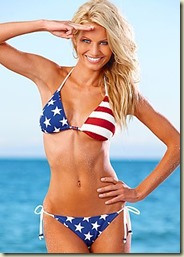


Hey, nothing says “respect for the flag” like wearing it on underwear with a bald eagle covering your dick. But at least the girl in the bikini is saluting, right? And Dolly Parton is … um … Dolly Parton! And she has a theme park! So she can wear an American flag dress, right? Just remember, though, that a man who quietly takes a knee during the playing of the National Anthem to protest injustice is being disrespectful and worthy of scorn, termination of employment, and boycott, but none of these images are worth more than a shrug. OK.
What about the Flag Code’s guideline that the flag should not be used for “bedding, or drapery”?


I presume that those who plan to boycott the NFL because some players are being disrespectful also plan to boycott the stores that carry flag bedding and draperies (I specifically chose not to include links to these products because I don’t see any problem with them and don’t think that the stores should be subject to boycott or scorn just for selling American flag bedding or drapes).
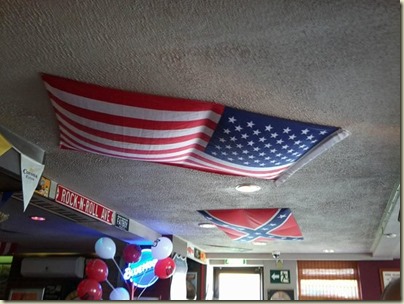
Somebody really needs to tell these soldiers that the Flag Code says that the “flag should never be used as a covering for a ceiling” (and I learned in some research that I did while writing this post that service members are not supposed to wear their hats [covers] indoors unless “under arms in an official capacity”).

I didn’t see an exception in the Flag Code for use of the flag on the ceiling if accompanied by a Confederate battle flag, but I’m sure that some “patriot” can explain why this is not being disrespectful.
“The flag should never have placed upon it, nor on any part of it, nor attached to it any mark, insignia, letter, word, figure, design, picture, or drawing of any nature”. Somebody needs to tell these Vietnam vets that they’re violating the Flag Code! (and then boycott them and demand that they be fired).

Though I do wonder whether there should be an exception in the Flag Code to permit the National Anthem or the Pledge of Allegiance to be written on the flag.


“The flag should never be used as a receptacle for receiving, holding, carrying, or delivering anything.”


Again, throwing your trash in a flag-themed trash can is apparently fine, just don’t take a knee to protest injustice.
“The flag should never be used for advertising purposes in any manner whatsoever…”.

Do I really need to provide more examples of the flag used in advertising? Yeah… thought not.
The flag “should not be embroidered on such articles as cushions or handkerchiefs…”.


A bandana is essentially a handkerchief, right? So are you going to tell this guy how disrespectful he is?

And the flag should not be “printed or otherwise impressed on paper napkins or boxes or anything that is designed for temporary use and discard”. What percentage of households that have a July 4 party use American flag napkins? Time to boycott some parties!

“No part of the flag should ever be used as a costume or athletic uniform.”


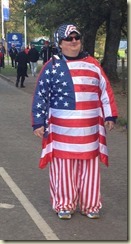

In the process of researching and writing this post and while looking for some of the images that I’ve used, I came across an interesting story that I had to include. I think that it’s probably fair to presume that many (again, many, not all) of those who object to athletes protesting by taking a knee are on the right of the political spectrum. And I also think that it’s probably fair to recognize that many of those on the right of the political spectrum get their news from Fox Faux News. Now, recall that the Flag Code states that, “No part of the flag should ever be used as a costume or athletic uniform.” So imagine my … um … surprise, to come across a story about the time during the 2012 London Olympics, when a Fox host and Tea Party commentator criticized the decision of the US women’s gymnastics team to wear pink instead of the American flag uniforms worn in previous years. In other words, it’s not OK o violate the Flag Code if the “violation” is to protest inequality, but it is OK to violate if the “violation” is to show patriotism. Clear on that?
The Flag Code never mentions certain products or uses, but you do have to wonder how those who are so worried about disrespecting the flag would feel about American flag dildos or guns.

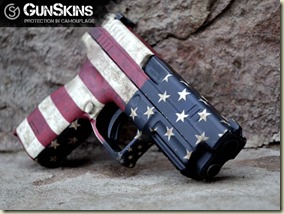
Scratch that last query. I’m sure they’d love, love, love, American flag guns. They’d probably propose legislation to require us all to carry one and to honor it daily. I think that’s what the Second Amendment requires, anyway, right? Do American flag guns use special American flag bullets?
Furthermore, I do find it striking that those who criticize a protest that, in their view “disrespects” the flag, don’t spend even a fraction of their righteous anger criticizing uses of the American flag that seem far more disrespectful than either peaceful protest or a bikini:


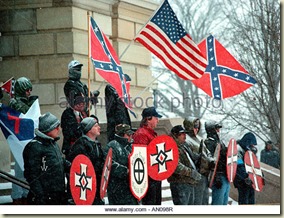

Recall that the night before Vice President (and former Indiana Governor) Pence walked out of an Indianapolis Colts game because members of the visiting team knelt, there was a second gathering of white supremacists and Nazis in Charlottesville, Virginia (sight of the white supremacist terrorist attack that killed a woman). However, Pence, who apparently had time to craft a statement against the “disrespect” shown by black athletes couldn’t be bothered to say anything about white supremacists rallying. Again.
Finally, I had to share this photo, apparently taken at or prior to an October 15, 2017, New York Jets game:
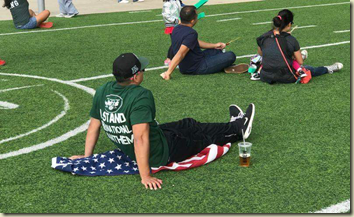 If you can’t quite make it out, his shirt says “I stand for the National Anthem” while he lounges on an American flag being used as a blanket. It would appear, then, that this Jets fan is simultaneously violating paragraphs (b), (c), (d), and (e) of the Flag Code while criticizing those who choose to kneel.
So if none of those other pictures make you want to boycott stores or criticize other “disrespectful” behavior, but you do want to boycott the NFL, then doesn’t that suggest that your problem is not so much with disrespect for the flag or National Anthem, but rather with the either the message the protestors are sending or the people sending that message?
♦ ♦ ♦
While we’re on the subject of honoring the National Anthem, I wonder how many of you can sing any stanza of The Star Spangled Banner beyond the first? I ask, not because I think you’re any less a patriot if you can’t sing the following stanzas, but rather because one of those stanzas can, in some ways, be seen to relate directly to the issues being raised by the current protests by athletes. I’m sure that many of us are familiar with the basic history of Francis Scott Key watching the British shelling Fort McHenry during the War of 1812 that prompted him to write The Star Spangled Banner. But what is less familiar (and I’ll admit to not knowing any of this before doing a bit of research) is some of the additional history that motivated his writing and that was reflected, in particular, in the rarely heard third stanza of The Star Spangled Banner:
No refuge could save the hireling and slave
From the terror of flight or the gloom of the grave,
And the star-spangled banner in triumph doth wave
O’er the land of the free and the home of the brave.
Apparently, most historians agree that with this stanza, Key was addressing and taking aim at the British Colonial Marines, a company of freed slaves fighting for Britain. Key was happy to see these freed slaves without refuge, in “terror or flight,” and with the “gloom of the grave” facing them. Think about that for a moment: Our National Anthem has lyrics celebrating the defeat and death of freed slaves. And now athletes are using the signing of the National Anthem as an opportune time to bring to attention the problem of African-Americans being killed by police officers who then suffer no punishment together with other perceived racial inequalities in the American criminal justice system.
♦ ♦ ♦
One thing that I’ve heard repeatedly, is that football games are meant to be enjoyable entertainment into which politics or other serious matters ought not intrude. And I’m sympathetic to that argument. I want to watch a football game for the action on the field; if I wanted politics, I could go to a speech or rally. But… We don’t seem to object to the NFL’s annual efforts to raise breast cancer awareness (or now, just general cancer awareness). We certainly don’t object to the NFL’s “salute” to soldiers and veterans. I don’t usually see people get upset when the teams take time to give special recognition to soldiers or vets recently returned from overseas (or their families). And if you watch a game on TV (where you usually do not see the National Anthem performed), you are very likely to see political advertisements, whether for or against a candidate or focused on a particular issue.Yet I haven’t heard the “it’s entertainment, keep politics out of it” come up to prompt people to boycott sports on TV. Don’t even get me started on the mass of advertisements, both at the games and during television broadcasts, that certainly detract from the viewing experience.
♦ ♦ ♦
So what makes you a patriot? If you stand and salute the flag does that make you a patriot? Or is there something more to patriotism? What if you oppose some action that the government (or military) take; does that make you unpatriotic? What if you speak critically about a law, your member of Congress, or the President; does that make you unpatriotic? To me, it seems that the problem is that for too many people, it appears that failing to fall in lockstep with a particular view is unpatriotic. Many of those same people would likely view any effort to change the status quo as being unpatriotic if the status quo was a position supported by that person. From this sort of view comes the “love or leave it” sentiment, which of course presupposes that the only way to “love” America is to agree with one position, to never see fault or wrongdoing on the part of America, and not to try to seek change (other than, perhaps, threatening to secede when you don’t get your way).
Let me offer this observation from Ashley Nicolas, a 2009 graduate of the United States Military Academy at West Point who served as an Army intelligence officer and female engagement team leader, completing a tour in Kandahar, Afghanistan, before being named a 2016 Pat Tillman Foundation scholar:
Patriotism is recognizing that those men are taking a knee because our country is deeply flawed and that segments of our citizenry have suffered from systemic inequality for centuries.
Patriotism is asking hard questions and demanding that America do better. It is asking Congress how we continue to be involved in conflicts around the world without any congressional mandate.
Patriotism is demanding reform within the Department of Veterans Affairs. It is fighting homelessness and the opioid crises across the nation. It is demanding criminal justice reform and asking why, in 2017, the quality of your education is determined by your Zip code.
Patriotism is nuanced.
Slapping a “support the troops” bumper sticker on your car does not make you a patriot, nor does standing for the national anthem. These are symbols — meaningless without the values that underlie their existence.
Patriots are critical thinkers who hold leaders accountable by asking tough questions and recognizing the flaws in our democracy.
Criticism is deeply patriotic. It keeps our leaders accountable and forces us to recognize that we are still on the long, hard march toward a “more perfect Union.”
Patriots do not stand idle when there is work to be done. They find partners, build coalitions and make an impact.
…
In the United States, we do not force people to engage in rote ceremonies or stand at attention for the flag by force of threat. The beauty of America is that this is a nation where every citizen has the ability to voice dissent without fear of reprisal. That conversation propels us forward.
As someone who has worn the flag on my shoulder in combat, I feel a deep pride at the sight of it. To me, the flag represents a common bond of service between myself and my sisters and brothers in uniform.
I am proud to stand and salute the flag, but my discomfort with anyone who exercises differently pales in comparison to the feelings in the hearts of those who kneel because they cannot be proud of what America has been for them.
The most patriotic thing I can do, is listen.
♦ ♦ ♦
I want to finish this (overly long, I know…) post with a quotation from the Supreme Court’s landmark 1943 ruling West Virginia State Board of Education vs. Barnette, in which the Court held in the midst of World War II, that a school could not require students to stand for the Pledge of Allegiance or salute the flag.
National unity as an end which officials may foster by persuasion and example is not in question. The problem is whether under our Constitution compulsion as here employed is a permissible means for its achievement.
Struggles to coerce uniformity of sentiment in support of some end thought essential to their time and country have been waged by many good as well as by evil men. Nationalism is a relatively recent phenomenon but at other times and places the ends have been racial or territorial security, support of a dynasty or regime, and particular plans for saving souls. As first and moderate methods to attain unity have failed, those bent on its accomplishment must resort to an ever-increasing severity. As governmental pressure toward unity becomes greater, so strife becomes more bitter as to whose unity it shall be. Probably no deeper division of our people could proceed from any provocation than from finding it necessary to choose what doctrine and whose program public educational officials shall compel youth to unite in embracing. Ultimate futility of such attempts to compel coherence is the lesson of every such effort from the Roman drive to stamp out Christianity as a disturber of its pagan unity, the Inquisition, as a means to religious and dynastic unity, the Siberian exiles as a means to Russian unity, down to the fast failing efforts of our present totalitarian enemies. Those who begin coercive elimination of dissent soon find themselves exterminating dissenters. Compulsory unification of opinion achieves only the unanimity of the graveyard.
It seems trite but necessary to say that the First Amendment to our Constitution was designed to avoid these ends by avoiding these beginnings. There is no mysticism in the American concept of the State or of the nature or origin of its authority. We set up government by consent of the governed, and the Bill of Rights denies those in power any legal opportunity to coerce that consent. Authority here is to be controlled by public opinion, not public opinion by authority.
The case is made difficult not because the principles of its decision are obscure but because the flag involved is our own. Nevertheless, we apply the limitations of the Constitution with no fear that freedom to be intellectually and spiritually diverse or even contrary will disintegrate the social organization. To believe that patriotism will not flourish if patriotic ceremonies are voluntary and spontaneous instead of a compulsory routine is to make an unflattering estimate of the appeal of our institutions to free minds. We can have intellectual individualism and the rich cultural diversities that we owe to exceptional minds only at the price of occasional eccentricity and abnormal attitudes. When they are so harmless to others or to the State as those we deal with here, the price is not too great. But freedom to differ is not limited to things that do not matter much. That would be a mere shadow of freedom. The test of its substance is the right to differ as to things that touch the heart of the existing order.
If there is any fixed star in our constitutional constellation, it is that no official, high or petty, can prescribe what shall be orthodox in politics, nationalism, religion, or other matters of opinion or force citizens to confess by word or act their faith therein. If there are any circumstances which permit an exception, they do not now occur to us.
West Virginia State Board of Education vs. Barnette, 319 U.S. 624 (1943) (emphasis added) (internal citations omitted).
♦ ♦ ♦
In conclusion, I’m not sure that kneeling during the National Anthem is the best way for athletes to voice their opinion and I’m not sure whether a similar sort of protest would be appropriate in all circumstances and for all reasons or at all times (e.g., I’m firmly against protests at the funerals of fallen soldiers, even if the protest is against the war in which the soldier was killed). But when it comes to the narrow question of whether I support the right of professional athletes to kneel during the playing of the National Anthem in order to call attention to their concerns with racial injustices within the American criminal justice system, then my answer is strongly in the affirmative. And if asked whether those same athletes should be punished for making their opinions known by kneeling or whether the NFL should be subject to repudiation or condemnation for allowing the protests or refusing to punish the protestors, then my answer is strongly in the negative.
Most importantly, I’d suggest that the best response to the protests is not to spend our time focusing on whether the protests should be allowed or the proper time and place to protest; rather, the best response to the protests is to listen to the concerns giving rise to the protests and then get down to the hard work of trying to do what is necessary to make those protests unnecessary and bring America closer to the ideals represented by the flag and the National Anthem.
That would be patriotic and respectful.
*Before Major League Baseball, NBA, and NHL games that involve one of the teams from Canada (including the All Star Games, I believe), both the American and Canadian national anthems are played. Yet before the Indianapolis 500 and other auto races, only the American National Anthem is played, even though in many racing series (other than NASCAR), many (or most) of the drivers are not American. So why do we honor Canadians in baseball, basketball, and hockey, but not in motor racing? And why don’t we honor those from other countries in all of our sports?
Labels: Censorship, Civility, Free Speech, Laws, Politics, Racism, Sports