Thursday, May 26, 2011

Goodbye to IN Touch

Beginning in late 2008, I wrote an occasional entry for The Indianapolis Star’s IN Touch blog. A number of my entries were also published in the print edition of the newspaper. While I liked writing for IN Touch, I often found it difficult to find topics for which IN Touch was an appropriate venue and on which I could articulate my thoughts in a fairly short number of words (as readers of this blog know, brevity is not exactly my strong suit). Thus, my output was never as high as I would have liked and I hadn’t written anything at all for IN Touch since last August (wow, I didn’t realize it had been that long!).

Anyway, I discovered a week or two ago, that the IN Touch blog has apparently been completely removed from The Indianapolis Star’s website. If you go to the IN Touch page, you are greeted by the message:

This user has elected to delete their account and the content is no longer available.

I emailed my contact at the paper to see why and when the IN Touch page was deleted and why the posts were not (apparently) archived. To date, I haven’t received any response. I guess that I can understand the decision to eliminate this feature (it seems that the number of posts had declined dramatically in recent months), but I don’t understand the decision not to maintain an archive of those posts, especially as many of them were included in the print edition of the paper. Oh, well.

So, I guess that my days of writing for IN Touch are now officially over. It was fun while it lasted.

Labels: ,

Bookmark and Share


Tuesday, May 17, 2011

Indiana Adopts a Ban on “Texting While Driving”. Sorta.

There has been some press about the recent passage in Indiana of a ban on “texting while driving”. It must have been the lawyer in me, but I became curious about how this ban was worded. What precisely, I wondered, has been banned? So I looked up the enrolled act.

First, we need to look at a few terms that are defined, either by this newly enacted statute, or elsewhere in the Indiana Code:

(a) “Telecommunications device” … means an electronic or digital telecommunications device. The term includes a:
        (1) wireless telephone;
        (2) personal digital assistant;
        (3) pager; or
        (4) text messaging device.

(b) The term does not include:
        (1) amateur radio equipment that is being operated by a person licensed as an amateur radio operator by the Federal Communications Commission … ; or
        (2) a communications system installed in a commercial motor vehicle weighing more than ten thousand (10,000) pounds.

Indiana Code § 9-13-2-177.3.

Is it just me, or is that definition a bit circular? “Telecommunications device” is an “electronic or digital telecommunications device”. Um. OK. And take note of two things that are not specifically included within the definition: telephones (other than wireless telephones) and computers (this omission will be relevant when we look at the definition of “text message” below). Also, why are ham radios and “big rig” communications systems excluded? (And in (b)(2), does the 10,000 pounds refer to the commercial motor vehicle or the communications system?)

“Text message” means a communication in the form of electronic text sent from a telecommunications device. Indiana Code § 9-21-8-0.5.

Note that “electronic text” is apparently undefined (a quick search of the Indiana Code found no uses of this phrase other than in this statute). Anyway, think about the definition of “text message” with reference to the definition of “telecommunications device”. Ask yourself this: Is a message sent from a laptop computer to a cell phone a “text message”? When I receive a text message from AT&T telling me that my wireless bill is now available, is that a “text message” as defined by the statute (I’m willing to bet that AT&T uses a computer to send those messages rather than a “telecommunications device”).

So, with those definitions in mind, let’s look first at the existing ban that applies to probationary driver’s licenses (i.e., licenses for drivers under 18): A person driving under a probationary license:

[M]ay not operate a motor vehicle while using a telecommunications device until the individual becomes eighteen (18) years of age unless the telecommunications device is being used to make a 911 emergency call.” Indiana Code § 9-24-11-3.3(b)(4).

Now, compare that prohibition to the newly enacted (and effective as of July 1, 2011) ban on “texting while driving” (Indiana Code § 9-21-8-59):

(a) A person may not use a telecommunications device to:
        (1) type a text message or an electronic mail message;
        (2) transmit a text message or an electronic mail message; or
        (3) read a text message or an electronic mail message;
while operating a moving motor vehicle unless the device is used in conjunction with hands free or voice operated technology, or unless the device is used to call 911 to report a bona fide emergency.

(b) A police officer may not confiscate a telecommunications device for the purpose of determining compliance with this section or confiscate a telecommunications device and retain it as evidence pending trial for a violation of this section.

Notice anything odd or any problems?

For one thing, what is the definition of “electronic mail message”? (I did another quick search in the Indiana Code and while I found a definition of “commercial electronic mail message” in Indiana Code § 24-5-22-2, the definition itself uses the term “electronic mail message” and the definition is limited to that chapter of the Indiana Code.) Nevertheless, I suspect that we can find substantial agreement on what is (and maybe more importantly, is not) an “electronic mail message”. But query whether a message posted within Facebook is an electronic mail message?

OK. So I can’t read or send a “text message” or “electronic mail message”. But can I read a webpage? Can I type a grocery list on my iPhone? Can I type an address into my dash-mounted GPS (and query whether a dash-mounted GPS is a telecommunications device) or my iPhone’s mapping utility? Can I use a location app like Around Me to find the nearest Domino’s and order a pizza? Can I read what others have posted on my Facebook wall or on Twitter? Does it matter if they posted from their cell phones (which are telecommunications devices) or their computers (which aren’t)? Can I play a game on my iPad. And what if the message that I want to send (or review) has no text at all, but is, instead, just a photo? Recall that the definition of “text message” is a “communication in the form of electronic text” (emphasis added). In fact, given that the definition of “text message” requires that the communication be “sent from” a telecommunications device, query whether (under a hyper-technical reading of the language) typing a “text message” is actually banned because that text didn’t become a “text message” until actually sent.

Note, too, that the law is limited to times when the person is “operating a moving motor vehicle”. In other words, it appears that if you’re sitting at a stop light or stuck in non-moving traffic, you can send and read text messages to your heart’s content.

One more thing: Note paragraph (b) of the statute. If a police officer cannot confiscate the telecommunications device, how will the officer ever be able to determine if the driver was sending a “text message” or using the telecommunications device for a purpose not prohibited by the law (“No, officer, I wasn’t typing a text message; I was using my address book to look up a phone number”)? And even if the officer could make that determination, at trial, it will be the word of the officer against the word of the driver given that any evidence from the telecommunications device will be long gone.

I’m not advocating reckless driving. I’m not advocating that people play technical games with the statute. We all understand the legislature’s intent. Rather, my real purpose here is to make Hoosiers aware of just how poorly some of our statutes are drafted. I suspect that most of you, even those who aren’t lawyers and who’ve never served as an elected official, could craft a better statute, with fewer proverbial loopholes, in little or no time.

Statutes like this one are designed to keep our roads safe. We ask a lot of our legislators, but I don’t think that asking them to carefully think through statutes and to be sure that they are well-drafted is asking too much. After all, isn’t creating laws to keep us safe one of the principals roles of a legislator? And next time you hear about someone being acquitted “on a technicality” just remember that there are many, many more laws just like this one.

Labels:

Bookmark and Share


Sunday, May 15, 2011

Test Post

Between Blogger’s recent crash and some of my efforts to (finally) update the format of this blog, I’ve been experiencing some odd behavior. So please ignore this test post.

Labels:

Bookmark and Share


Wednesday, May 11, 2011

I’m Losing Respect for Sen. Lugar (update)

Last fall, in my post “I’m Losing Respect for Sen. Lugar” I said this:

[T]hough I’m a Democrat, I’ve always thought very highly of, respected, and even supported Sen. Lugar. But my respect has begun to wane. In recent years, I’ve felt that Sen. Lugar lost his ability (or desire) to think independently and became just another Republican. From time to time, he’d recapture some of the spark that made him so distinguished, but those moments seem fleeting. And over the last two years, he’s been all too quiet as Congressional Republicans have become simply the party of “no” without any new ideas or direction.

Today, my respect for Sen. Lugar took another blow.

As readers of this blog (and, in particular, the post “Opposition to the DREAM Act Is a Racist “F-You” to the American Dream”) know, I’m a strong supporter of the DREAM Act. Sen. Lugar was a co-sponsor of the DREAM Act when it was originally introduced in the Senate, helped shepherd the bill through the Senate, and he was one of only three Republican Senators who voted to end the Republican filibuster in December 2010.

Following President Obama’s speech on immigration earlier this week, Sen. Richard Durbin (D-Illinois) sought to re-introduce the DREAM Act in the Senate. However, this time, just five months after standing up for his principals and voting for the bill, Sen. Lugar has pulled his name as a co-sponsor of the DREAM Act.

Lugar’s spokesman said Lugar did not join Democrats in reintroducing the federal legislation to help children of illegal immigrants — known as the DREAM Act, or Development, Relief and Education for Alien Minors — because Democrats have politicized the issue.

“President Obama's appearance in Texas yesterday framed immigration as a divisive election issue instead of attempting a legitimate debate on comprehensive reform,” said spokesman Mark Helmke. “Ridiculing Republicans was clearly a partisan push that effectively stops a productive discussion about comprehensive immigration reform and the DREAM Act before the 2012 election.”

Right. Sen. Lugar decided not to co-sponsor an issue that was important enough for him to sponsor, advocate on behalf of for 4 years, and cross party lines to support just because Democrats “politicized” and framed immigration as a “divisive election issue”. First, aren’t controversial issues, by their very nature “politicized”? And aren’t issues upon which politicians disagree, election issues? More importantly, do you think that the Tea Party-backed primary challenge that Sen. Lugar now faces had anything to do with his change of heart? I think that we all know the real reason that Sen. Lugar withdrew his support: Richard Mourdock and the ascendant Teapublicans.

To me this is just another sign that Sen. Lugar has become just another politician who will do or say whatever is necessary to keep his seat, integrity, principles, and intellectual honesty be damned. If he has to tack to the far right to fend off the primary challenge, then that’s what he’ll do, even if it means that he’s no longer the man that many people have respected (and voted for) over the past decades.

Update (May 14, 2011): Corrected corruption to Labels following Blogger crash.

Labels: , , , ,

Bookmark and Share


Thursday, May 5, 2011

We Don’t Want Donald Trump to Drive the Indy 500 Pace Car (update)

As I’m sure most have heard by now, Donald Trump will not be driving the pace car in this, the 100th anniversary running of the Indianapolis 500. I think that it is safe to say that the efforts of my We Don’t Want Donald Trump to Drive the Indy 500 Pace Car page on Facebook were instrumental in making this happen.

I hope to write more about this entire saga sometime, including my thoughts on what made the effort so successful. But that is a task for another day. I did want to take a quick moment, though, and update one item from the original post about the Bump Trump effort that I first wrote about here just after midnight on Saturday, April 30. That night I said:

Until earlier this week, the page had garnered very little attention. But then on Wednesday evening, it exploded. From 30 fans to 300 that evening and now, as I write this on Friday night, the page is up to over 1,300 fans!

If you told me then what would happened, I probably would have laughed at you. On both Saturday and Sunday, the Facebook page added about 1,000 more “likes”. By early Tuesday, it had reached about 5,000 likes and when I went to bed that night it had just reached 8,000. But as I write this post, on Thursday afternoon, the Facebook page has grown to 17,828 likes. Simply unbelievable. Since last Friday, I’ve done four TV interviews (including a telephone interview with a TV reporter who wanted to interview me at 1:00am!), a radio interview, and several newspaper interviews. My name has shown up on CNN and in Sports Illustrated. And Steve Inskeep even mentioned the effort on NPR.

And I’ve had the privilege of talking to a group of people the size of a small town, as we’ve shared our thoughts on why Trump was not the right choice, who we might like to see replace him, and how best to let sponsors and the Indianapolis Speedway hear what we thought.

The effort also gave me the platform to espouse my message of civility; a message that I believe was very well received.

Anyway, and pardon the pun, this has been a fabulous ride. My thanks to those who have supported the effort.

Labels: ,

Bookmark and Share


Saturday, April 30, 2011

We Don’t Want Donald Trump to Drive the Indy 500 Pace Car

On April 8 I started a Facebook group called We Don’t Want Donald Trump to Drive the Indy 500 Pace Car. Until earlier this week, the page had garnered very little attention. But then on Wednesday evening, it exploded. From 30 fans to 300 that evening and now, as I write this on Friday night, the page is up to over 1,300 fans!

Apparently, this caught the attention of the local news media. Here is the link to the story that aired tonight on the local ABC affiliate and here’s a link to the video (sorry, but so far I can’t embed the video).

We Don't Want Donald Trump to Drive the Indy 500 Pace Car


Come on by and say hello!

Labels: ,

Bookmark and Share


Tuesday, April 26, 2011

Addressing a Few Red Herrings (update)

According to “Prop 8 Supporters Contest Ruling On Grounds Judge Has Same-Sex Partner”, it appears that opponents of same-sex marriage in California have asked the United States District Court Judge who presided over the challenge to Prop 8 to recuse himself (and vacate his judgment) because he is gay and is in a long-term relationship. In light of this, I thought it appropriate to revisit a portion of my post “Addressing a Few Red Herrings,” written in August 2008 (shortly after Judge Walker issued his ruling on Prop 8):

Also, promptly following Judge Walker’s decision yesterday, some on the right (hey there FOX News!) started talking about the Judge’s bias because he is gay. This suggestion is not just wrong; it is patently offensive.

First, I note that those alleging bias against Judge Walker were conspicuously silent when another federal judge with extensive stock holdings in the oil industry refused to recuse himself before considering the Obama administration’s ban on offshore drilling. Those same people were silent just a few days ago when another federal judge failed to recuse himself from hearing Virginia’s lawsuit against the new health care reform legislation even though he has financial ties to Virginia’s Attorney General, the lead plaintiff in the case. And those sorts of conflicts-of-interest are prohibited by canons of judicial ethics.

More importantly, ask yourself this: Why is it that when it comes to litigation involving social issues, straight, Anglo-Protestant white males are never seen as being biased, but a judge who is black or Jewish or female or gay is biased, often for no other reason that the fact that the judge is black or Jewish or female or gay?

Or think of it this way: Must every woman judge recuse herself from a rape case? Must every Jewish judge recuse himself from a case involving church-state issues? Must every Hispanic judge recuse himself from an immigration case? Must a black judge recuse himself from every lawsuit alleging racial discrimination? And with your answer to that last query in mind, must every white judge recuse himself from a case alleging racial discrimination if one of the parties is … um … white? And, by all of that reasoning, shouldn’t any straight judge have been forced to recuse himself precisely because he wasn’t gay?

Those who argue bias of this sort are either so blinded by their own bias and bigotry or simply cannot recognize that, in order for our system to work at all, we must all have faith in the impartiality of our judiciary. That a judge disagrees with us doesn’t mean bias; it means that judge judges a particular issue differently tha[n] you or I might. It doesn’t mean bias. But if we start seeing bias in every judge solely on the basis of that judge’s color or religion or DNA, then it won’t be long before our judicial system becomes a joke and the respect for the rule of law on which the foundations of our country are supported will rot away.

One final point on this issue of bias, specifically with regard to Judge Walker: Have you noted that those who claim that Judge Walker is biased because he is gay have not bothered to mention that Judge Walker was nominated by President Reagan and then again by President George H.W. Bush or that during Judge Walker’s nomination hearings, he was opposed by gay rights groups? Hmm. Does that weigh upon the question of any perceived bias?

Going back to the new filing asking Judge Walker to recuse himself, there was one quote in the article that particularly caught my attention:

The "Yes On 8" campaign also emphasized that it's not that they'd object to every gay or lesbian judge from presiding over the case -- only those that may want to get married one day.

Let’s tease this claim out for a moment. If I understand the argument of the “Yes On 8” campaign, then I guess that not all women should be barred from hearing abortion cases, only women who might contemplate an abortion some day. Not all African-Americans (or any other minority group) should be barred from hearing race discrimination cases, only those members of the minority group that might someday want to be treated equally. Not all judges should recuse themselves before hearing a case involving a business dispute, only those judges who might someday want to buy a product or stock from one of the parties in that dispute (i.e., if Walmart is a party, only judges who never intend to shop at Walmart should be allowed to hear the case). Certainly judges who might someday want to exercise their right to vote shouldn’t be allowed to hear cases dealing with … um … well … anything that elected officials might have an involvement in … like passing laws, for example. I don’t even want to contemplate the thought of a judge who might someday want to run for elected office (like, say, state judge). And of course, no judge should be allowed to hear a case on healthcare reform if that judge might someday visit a doctor or buy health insurance or be eligible for Medicare. Finally, I presume that the judge who ruled yesterday against the NFL lockout must not ever intend to watch or attend a football game.

And back to the case at issue. I presume that the “Yes On 8” campaign would agree that a straight judge shouldn’t be eligible to hear the case because — according to opponents of same-sex marriage — permitting same-sex marriage will “destroy the institution of marriage”. Thus, that straight judge shouldn’t be allowed to hear the case because he (or she) probably wouldn’t want his or her marriage to be “destroyed”. That certainly seems to be as much or more of an impediment to justice as the fact that Judge Walker might someday want to get married.

Oh, and one more thing on that point: If marriage was that important to Judge Walker, then isn’t it likely that he and his partner would have gotten married during the period that same-sex marriage was legal in California?

Isn’t a bit funny how the logic only seems to work one way?

Labels: ,

Bookmark and Share


Monday, April 25, 2011

Can Donald Trump Win the Republican Nomination? Should He? Will He Run? Let’s Discuss

I’m going to try something new here. Very few of my posts get any comments, so it may be that this is a pointless exercise. But let’s see if we can have a discussion about Donald Trump.

Do you think that he can win the Republican nomination if he runs? Do you think that he would be a good Republican candidate in the general election? Do you think that he’ll decide to run or is this all just a publicity stunt?

Let’s discuss.

Labels: , ,

Bookmark and Share


Monday, April 11, 2011

The Lie “Was Not Intended to be a Factual Statement”

One of the themes that I’ve focused on over the years that I’ve been writing this blog is the political lie (see, for example, “When a Lie Becomes an Insult” or “Why Are Politicians So Willing to Tell Outrageous, Easily Disproven Lies?”; poke around on this blog and you’ll find plenty of other examples). Well this week, the reality espoused by the Republican party went yet further down the rabbit hole into the land of make believe, fairy tales, and absolute bullshit.

Watch this video of Sen. Jon Kyl (R-Arizona) speaking on the floor of the United States Senate last week:


In case you need it, here’s a transcript of Sen. Kyl’s remarks (provided by ThinkProgress):

Everybody goes to clinics, to doctors, to hospitals, so on. Some people go to Planned Parenthood. But you don’t have to go to Planned Parenthood to get your cholesterol or your blood pressure checked. If you want an abortion, you go to Planned Parenthood, and that’s well over 90 percent of what Planned Parenthood does.

But guess what? That claim that abortions are “well over 90 percent of what Planned Parenthood does” is false. It’s not just false, it’s not even in the ballpark. According to Planned Parenthood, the actual number is not 90% … it’s 3%. Kyl was off by a factor of 30!

Our Clients

Planned Parenthood provides sexual and reproductive health care, education, and information to more than five million women, men, and adolescents worldwide each year.

Three million women and men in the United States annually visit Planned Parenthood affiliate health centers for trusted health care services and information.

Seventy-nine percent of Planned Parenthood health care clients in the U.S. are age 20 and older.

One in five women in the U.S. has visited a Planned Parenthood health center at least once in her life.

Our Work

Planned Parenthood health centers focus on prevention: 83 percent of our clients receive services to prevent unintended pregnancy.

Planned Parenthood services help prevent more than 612,000 unintended pregnancies each year.

Planned Parenthood provides nearly one million Pap tests and more than 830,000 breast exams each year, critical services in detecting cancer.

Planned Parenthood provides nearly four million tests and treatments for sexually transmitted infections, including HIV.

Three percent of all Planned Parenthood health services are abortion services.*

(Emphasis in original.)

So when people across the country came forward to point out and denounce Sen. Kyl’s lie, what did Sen. Kyl do? If he cared about accuracy, he could have come forward and simply said, “I made a mistake”. Or he could have found some other somewhat less dubious statistic to use as some kind of backstop for his lie. But no, that’s not what he did. Because remember, as I’ve been saying for years no, to the modern Republican party, facts simply don’t matter. And as evidence of that statement, here’s the statement Sen. Kyl’s office gave to CNN’s TJ Holmes:

HOLMES: We did call [Kyl’s] office trying to ask what he was talking about there. And I just want to give it you verbatim here. It says, “his remark was not intended to be a factual statement, but rather to illustrate that Planned Parenthood, a organization that receives millions of dollars in taxpayer funding, does subsidize abortions.”

Did you get that? “His remark was not intended to be a factual statement…”. It was intended as an illustration but not a factual statement? What the hell does that even mean? “I meant to lie so that I could scare people because the facts don’t support my position?” When our policy decisions are based on the recitation of statistics that are “not intended to be … factual statement[s]” then how can those decisions possibly be knowledgably made? Or, ask it this way: What are the ramifications to our form of government and democracy if decisions are made on the basis of knowing lies and not on accurate empirical evidence?

And to follow up on this them, I want to look at how Fox & Friends (a program on FOX News) approached a similar component of the same subject a few days ago:


Once again, in case you need it, here’s a transcript of the relevant part of this discussion (after they finish bashing Sen. Reid)(thanks to Media Matters):

DOOCY: And the thing about it that was audacious was the fact that he [Sen. Harry Reid] was talking about Planned Parenthood being this great provider where women can get blood pressure checks, and pap smears, and breast —

KILMEADE: Which you can get at Walgreens.

DOOCY: — examinations. Exactly right. 

Did you get that? According to FOX News, women can get pap smears and breast examinations at Walgreens. “Exactly right,” they say.

Well, um, no. It isn’t.

“Neither Walgreens, nor its in-store healthcare clinics, Take Care Clinics, offer pap smears or breast exams,” Take Care Clinic spokeswoman Lauren Nestler told Media Matters after being emailed the segment.

So you see, just like Sen. Kyl, the hosts on FOX News just make shit up and report it as “exactly right” without a shred of supporting evidence. But how many viewers of FOX News will ever hear that Walgreens said that FOX News was wrong? How many viewers presume that what FOX News reports is, in fact, true; that anything said on the network has been fact-checked first? How many viewers of FOX News will ever learn that the on air personalities that they watch just make up facts with no attempt at accuracy or journalistic integrity? Probably very, very few. And I know from talking to several people who love FOX News that they refuse to believe that FOX News would lie, even after pointing out examples like this one (or, for example, last week when FOX News reported that a poll found that 65% of Americans believed something when, in fact, the poll found only that 65% of self-identified Republicans held that particular position).

In our modern political system, Republican politicians and FOX News just make shit up and their devoted followers accept those “facts” without question. And political decisions are premised on those same lies.

That is a very dangerous road down which our political discourse is being led.

Which brings me to Donald Trump and the “birthers” … but that’s a subject for another day.

-----

*Don’t forget that since the 1970s it has been illegal to use federal funds for abortions.

Labels: ,

Bookmark and Share


Thursday, April 7, 2011

Apple’s Stupid Warranty Policy

I’ve never been a fan of Apple. And before people start piling on, let just note that I was largely responsible for supporting Northwestern University’s Apple Macintosh labs (from about 1986-1988) and teaching the portion of a microcomputer literacy class that focused on Macs. I was even a participant in an Apple program to encourage programming on Macs, attending several conferences on the subject. But I will admit that I’ve liked Apple consumer products like the iPod, iPhone, and iPad. I’ve written in the past about how poor Apple’s support can be, especially when the refuse to even acknowledge the existence of major problems.

Well now I have new reason to be critical of Apple support policies.

Back in December, I was given a brand new Apple TV as a gift. While I was quite excited about the gift, at the time I wasn’t quite sure how I would want to use it. I wasn’t buying any video on iTunes at the time (we have two TiVo boxes). And so it sat unopened (though not unappreciated) on a shelf.

Then, a few nights ago, it finally dawned on me that I did have real application for the Apple TV as a series that I’m looking forward to (Game of Thrones) is on HBO but I don’t subscribe to HBO. Thus, I realized I could probably purchase the episodes through iTunes (I hope…) and watch them on my TV via Apple TV. Yippee!

So I opened the box and started setting up the device. Everything went smoothly until I tried to link the Apple TV to iTunes on my computer. I needed to input my Apple ID and password which I did. Over and over and over, but to no avail. Apple TV kept rejecting either the Apple ID or password (it wasn’t clear which one was “wrong”). I checked both the Apple ID and password both in iTunes and on my iPhone. I rest the password through iTunes. Yet nothing worked on the Apple TV.

Thus I began looking through Apple’s support site. I found lots of information telling me to be sure that my Apple ID and password were typed correctly (wow, that’s helpful!) or matched the account on iTunes (because, you know, it just makes sense to link two entirely different accounts). But I didn’t find anything remotely helpful with my problem.

I therefore decided to seek additional support. And that’s when I ran into one of the stupidest warranty policies I’ve ever encountered.

As I went through the process of seeking support from Apple, I was asked to provide the serial number for my Apple TV. After I did so, Apple’s support website told me that the 30-day warranty on my Apple TV had expired and that if I wanted support I would have to pay for it. What?

How could the warranty have expired while the product sat it its box?

Apparently Apple stores scan the serial number of certain products when they are sold and the warranty period begins running from that date.

Eventually, I was able to contact someone in Apple’s support division. He confirmed that the warranty period had begun when the product was purchased and explained that I could only get support if I paid $29.95. No thanks.

I asked him whether, if I returned the “non-functioning” Apple TV and bought a new one, I’d get a new warranty and he confirmed that I would. So, I queried, it seems that what Apple is saying is that anytime someone receives a gift of an Apple product they should, before opening it, return it to the store and exchange it for a new one, just so that they can get the benefit of the full warranty period. He said that he wasn’t saying anything of the sort; he was just explaining the warranty policy. OK.

One thing worth noting: When you buy an iPhone or an iPod or an iPad you register the product when you first connect it to iTunes. So why can’t Apple TV work in the same way?

Short, 30-day warranties make me angry. To me, that’s a company saying that they don’t really stand behind the quality of their product. But then to disconnect the warranty period from when the product is actually first used seems like a real “F-You” to customers, especially to a customer who receives the product as a gift.

So I continue to say that Apple makes some very good consumer products … but when it comes to dealing with customers, Apple sucks.

Labels: ,

Bookmark and Share


Wednesday, April 6, 2011

Summing Up the Republican Budget Plan in One Paragraph

In the article “Rokita, Young, Stutzman back GOP budget plan” published in the April 6, 2011, edition of The Indianapolis Star, writer Maureen Groppe manages to distill the essence of the Republican budget plan to a single, simple paragraph:

In addition to making major changes to Medicare and Medicaid, which together make up about 23 percent of spending, the proposal would also cut food stamps, farm subsidies, highway spending, grants for college students and other spending programs. It would extend tax cuts that are set to expire at the end of next year and lower top tax rates while ending unspecified tax deductions.

Go back and read that again and again and again. Don’t focus so much on the “major changes to Medicare and Medicaid” or even on precisely which spending programs are mentioned. Instead, think of who benefits from Medicare, Medicaid and the types of spending programs mentioned. Then compare that with: “and lower top tax rates…”.

Seriously. That is the Republican plan.

They want to gut Medicare and Medicaid, severely cut or eliminate social services programs, including programs that help the neediest among us, in order to lower the tax rate for the wealthiest.

I look forward to hearing the Republicans shout their support for this proposal over and over as the 2012 elections approach.

Oh, and one more thing. Though I can’t find the citation right now, I heard it reported (if you have the link send it to me … or if that report was wrong, send that also) that a return to the tax rates in effect during the Clinton administration would have the same effect vis-a-vis cutting the deficit as the proposed Republican plan. So just ponder that for a moment, too: Small tax increases vs. gutting essential social service programs and giving tax breaks to the wealthiest. Hmm.

Labels: ,

Bookmark and Share


Tuesday, April 5, 2011

Reducing the Deficit By Saving a Nickel Here or There While Ignoring Big Ticket Items

Congressional Republicans want to reduce the deficit. Good for them. It’s a laudable goal. The question is, of course, how. We could of course discuss raising taxes, especially on the wealthiest Americans, but even that discussion appears to be off the table for the GOP. I won’t spend time right now going into the details of a lot of the things that Republicans do want to do (like changing Medicare and/or Medicaid to voucher programs and then reducing the available benefits in order to give more tax cuts to the wealthy). There will be plenty of time to discuss those “big picture” sort of issues and the months to come.

But I do want to focus on one idea that really shows how disingenuous Republicans really are when it comes to cutting the budget. When we look at the budget, we have to divide it into discretionary and non-discretionary spending. Non-discretionary spending is just what it sounds like: Expenditures that we are obligated to make, such as payment on debts, Social Security, Medicare, Medicaid, and so on. Non-discretionary spending includes everything from earmarks to foreign aid to defense spending. And it is that last item that I want to address.

The current budget for the Department of Defense is approximately $680,000,000,000 (that’s $680 billion) give or take a few dozen billion here and there. It would seem like there might be some room in that budget to find some savings. Like perhaps canceling weapons programs that the Pentagon says it does not want and does not need (or which do not work). But Congress has been loath to cut programs like that which, even though they are unnecessary and unwanted, bring jobs back to local Congressional districts. Or we could look into reducing what we’re spending on Iraq and Afghanistan, but we know that Republicans, in particular, seem loath to even address that idea (other than some of the newly elected Tea Party representatives).

But wait: The GOP has come up with a way to reduce the deficit by cutting the defense budget. This is so stupendous that I can’t believe nobody thought of this before; it may just be the panacea for all of our budgetary problems on both the state and federal levels. What have Republicans found that they can cut from the defense budget to solve our crisis? Are you sitting down?

The Republicans have introduced a plan to eliminate color photocopying in the Defense Department for a massive savings of $37.5 million per year. Now I’m not suggesting that $37.5 million isn’t a meaningful savings. After all, that savings will be enough to allow us to fund an extra 2½ hours of the Iraq and Afghanistan wars. Or, think of it this way: Right now, we’re spending about $4 million per day for our actions in Libya. So by cutting out color copies, the Air Force can bomb Libya for 9 more days.

I think that this plan is demonstrable evidence that the Republicans are disingenuous about their plans to make hard choices to reduce the budget. And I think that it shows that they are just stupid.

Why stupid? Several reasons: First, so far as I’ve seen, that $37.5 million is the only cut from the defense budget that Republicans are proposing. It’s OK to cut social services and education and to refuse to tax the wealthy, but the only way we can cut the defense budget is to eliminate color copies? Republicans don’t want to cut out weapons programs that don’t work, they don’t want to cut out programs that the military doesn’t want, and they don’t want to reduce funding for wars that most Americans oppose (or have at least tired of). To keep funding wasteful weapons programs is at best stupid; at worst, well, it’s something else.

Second, has there been any sort of evidentiary analysis of whether those color copies might be needed? Take for example imagery of a terrorist training camp or a village where insurgents might be gathering. Is it just possible that the soldiers tasked with a particular operation or even those planning the operation will be able to do a better job if they have the benefit of color in the photos or maps that they’re using? If all that we’re talking about is color photocopies of NCAA basketball brackets, grocery coupons, or memos from one general to another, then eliminating color copies probably makes sense (though it seems that it would be hard to find $37.5 million in savings there). But shouldn’t the query be needs based rather than automatic? And before answering that, remember that Congress has refused to cut funding for weapons programs that the military does not need or want.

So, it appears that we’re looking to cut something that might be needed (at least in some cases) that will have little real impact on the overall budget while at the same time refusing to even contemplate cutting weapons programs or wars that are a major drain on the budget.

Again, I’m not suggesting that any savings that we can find isn’t worth examining. But I am suggesting that if we (and especially the GOP) are serious about cutting the budget that we look at all options, including overall defense spending, wars, and tax increases. To find a tiny little expenditure like this one (tiny in the federal budget sense of the word) and use it as the only cut in defense spending, without examining potential necessity, is just stupid.

Labels: ,

Bookmark and Share


Thursday, March 31, 2011

The Ever-Narrowing Path to an Ongoing GOP Majority (I Hope)

In November 2010, Republicans took control of the House of Representatives and numerous state governments. The question thus becomes whether this control is sustainable. From what I’ve seen so far, I think not. I continue to believe that the driving force behind most (but by no means all) Republican victories in November 2010 was the economy (and that force was largely dominated by misinformation and outright lies coming from the Republicans and FOX News). Certainly social issues played a part, but social issues, I believe, motivated the Republican base; those issues did not sway moderate and independent voters to come to the polls, let alone vote for Republicans, the way economic issues did.

But let’s look for a bit at what Republicans have done since taking control and reflect on how these issues and actions will impact the Republican base, moderate and independent voters, and the Democratic base. As you read through the following, ask yourself whether these actions will make each of those classes of people more or less likely to vote in 2012 and, if they do vote, whether they will vote for Republicans or Democrats.

With regard to the economy, what exactly have Republicans done? Have they passed bills to increase employment or otherwise solve the unemployment crisis we face? For that matter, have they even introduced bills to address this concern? Or, speaking more broadly, what have Republicans, whether in Congress or state legislatures, done to improve the economic outlook for middle or lower class Americans? I’d contend that the answers to each of these questions is the sound of crickets — in other words, nothing.

But in state after state after state, Republicans have lowered corporate taxes and paid for those tax reductions with policies that will adversely effect lower and middle income Americans. They’ve decreased public education funding, decreased social services, cut programs that would or could lead to job growth, rejected federal funds for infrastructure creation (such as high speed rail or a tunnel from New Jersey to New York, each of which would have generated jobs), and taken other steps to reduce deficits at the expense of those least able to afford adverse impacts. But Republicans have not, so far as I’m aware anywhere, raised taxes on those who can weather the impact of a tax increase.

So query: Is taking from the poor to give to the rich (the “Reverse Robin Hood” approach) a viable strategy to appeal to voters in 2012 and beyond? Sure, there may be plenty of wealthy Americans and corporations who will continue to support Republican policies (and will be able to throw enormous amounts of money into the election thanks to the Supreme Court’s terrible Citizens United decision), and I’m sure that plenty of Americans will continue to vote against their own economic self-interests either because social issues are more important or because they believe the lies that they hear from Fox News (hello, Joe the Plumber!). But how many more moderates and independents will continue to support these sorts of Republican legislative agendas?

And query further how motivated the portion of the Republican base consisting of small town and rural voters will be if Republicans cannot point directly to economic successes tied to Republican policies.

In addition, I suspect that quite a few voters who may have sat out the 2010 elections will be far more engaged in 2012. Union families, in particular, will I believe be far more motivated to show up at the polls in 2012. While there are fewer union workers now than in the past, the number of people who are either in a union or in a family with a union worker is still a really big number. And while those people may have split their votes in the past (prioritizing social issues over economic issues), the anti-union zeal of the GOP will, I suspect, lead many of those votes back to the Democratic candidates.

But economic issues are not the only place where Republicans seem to be shrinking the pool of supporters. For some time, the Republican base has been very motivated on social issues. They turn out to support anti-abortion and anti-gay marriage candidates. And, at the same time, those issues don’t seem to have been major forces motivating voters to support Democratic candidates (not to say that Democratic supporters aren’t pro-choice, just that it appears that other issues have been far more important). None of that should be particularly surprising given that it is Republican candidates who have been seeking changes in the law (either to restrict access to abortion or to further ban same-sex marriages or civil unions).

The problem that I see for Republicans is that now that they’ve had some successes on these issues, voters who do support reproductive rights or same-sex marriage (or even just civil unions), or any of the other social issues that Republicans have focused on, will be far more energized than they have been in the recent past. Now it’s their turn to vote against what Republicans have been doing. I think that this is especially true with regard to same-sex marriage, where polling seems to indicate a dramatic shift in public opinion away from bigotry and toward equality (especially among the youngest cohort of the electorate). But even with regard to abortion, I suspect that Republican legislative initiatives to restrict access to abortions won’t sit well with some voters, including some who may oppose abortions generally. For example, Republican-sponsored bills that require doctors to actually lie to patients (telling them, for example, that abortions lead to breast cancer or mental health problems), bills that would have actually permitted the killing of abortion doctors, bills that seek to restrict access to abortion following a rape (by redefining rape to only include “forcible rape” — whatever that may mean), bills that require vaginal ultrasounds (remember, it is Republicans who favor less government involvement in health care…), and other similar abortion bills, are far beyond what even moderate opponents of at-will abortion may support and are so far beyond the position of pro-choice voters that these segments of the electorate may be energized to vote (or, in the case of moderate abortion opponents, de-motivated).

Or maybe ask the question this way: How many abortion opponents who otherwise would not have voted will come out to vote Republican in 2012 because of these bills? How many moderates or independents will vote Republican because of these bills? How many of those moderates and independents will vote Democratic because of these bills? And how many abortion rights supporters who otherwise would not have voted will come out and vote Democratic (or at least against Republicans) in 2012?

In addition to their extreme anti-abortion positions, Republicans have also been engaged in a war against women. How else can you explain such things as bills that require rape victims to be referred to not as victims but as accusers? Or a state legislator who votes against an exception to an abortion bill for victims of rape or incest because women might lie about whether they’d been raped.

But women aren’t the only minority groups that Republicans are waging war against. Republicans have targeted the LGBT (lesbian, gay, bisexual, and transgender) community. And this isn’t just about gay marriage. Set that aside for a moment. It is Republicans who have voiced opposition to human rights ordinances and laws that would prohibit housing and employment discrimination on the basis of sexual orientation or identity. As more voters become aware of issues like this, will they be more likely to support Republicans or Democrats? Remember, it was Republican Rand Paul who argued that the Civil Rights Act was a bad idea. And, as they pursue their quest to ban same-sex marriages, I have yet to hear Republicans adequately explain what would be wrong with civil unions or, for that matter, why government is in the marriage business at all.

Just a month or two ago, numerous Republican or right-wing organizations pulled out of the CPAC (a major conservative political conference) because a Republican gay-rights group was permitted to be a co-sponsor of the event. Subsequent to the conference, other groups have said that they won’t participate next year if that group remains a co-sponsor. Think about that for a moment. Republican and right-wing organizations are refusing to participate in one of their most important conferences solely because … gasp … gays might also participate. Is there any clearer way of saying, “If you’re gay, you’re not welcome here?”

So as gays are being increasingly targeted by Republicans, how likely is it that even gay Republicans (if there are any left) will be highly motivated to come out to support Republican candidates? I would think that a gay Republican who strongly supported Republican economic policies would be hard-pressed to vote for a party that is working so hard to marginalize that voter and restrict the voter to a second-class status.

It is also worth noting that poll after poll shows the public shifting away from homophobic positions and toward acceptance of same-sex marriage, especially among the younger segment of the electorate. Young voters stayed home in November 2010, but that is expected for an off-year election. But how many younger voters will be motivated to come out and vote against Republicans and for Democrats who advocate for tolerance and equality?

Notwithstanding having an African-American has head of the Republican National Committee for two years, I don’t think that much of the black community would say that Republicans have done much to support their community. The Republicans were quick to denounce payments to black farmers as a settlement for years of discrimination against them by the federal government (without much denunciation of the discrimination itself). And Republicans have largely set by and been silent — when not leading the charge themselves — as a whole host of thinly (and not so thinly) disguised racial allegations have been levied against President Obama and African-American members of his administration. Combine this with the sham efforts of Republicans to attack ACORN, Planned Parenthood, and the NAACP (see the James O’Keefe hit videos, all of which have turned out to be elaborate hoaxes pushed largely by FOX News) and the efforts to defund or restrict vital social service programs, I don’t think that there will be a dramatic shift away from Democrats within the black community, but I do think, especially with President Obama on the ballot again, that blacks will turn out in very large numbers to again vote for Democrats and against Republicans.

And what about Latino voters? Somehow, I don’t think that the plethora of nativist anti-immigrant bills will encourage Latinos to turn out and vote Republican (and query for a moment why Republicans seem so fond of Cuban immigrants at the same time that they oppose other Latino immigrant communities). Considering that recent census results show that nearly 1 in 6 Americans identifies as Latino and that the largest growth in a number of states has been Latino, then Republicans should be at least concerned about how the Latino community will view Republican candidates in 2012.

Republicans even seem to be waging something of a war against non-evangelical Christians with policies that are supported only by the evangelical portion of the electorate and which alienate moderate and liberal Christian denominations. The more that Republican policies incorporate evangelical Christian doctrine, the more those who are not slaves to that doctrine (or, said slightly more snarkily, those who have the ability to think for themselves) may find themselves no longer part of that so-called Republican “big tent” (which seems to be getting smaller and smaller and less and less welcoming; Ronald Reagan would be so proud).

Of course the war on non-evangelical Christians pales in comparison to the war against Muslims. From efforts to outlaw sharia law (I still plan to write about that nonsense one of these days) to efforts to define Islam as not being a religion to statements from prominent right-wing advocates that the First Amendment doesn’t apply to Muslims and that Muslims are only allowed to pray and build mosques in America because America, in its graciousness, has permitted them to do so (seriously, I’m not making this up…) to efforts to block the construction of mosques and community centers to Congressional hearings focused solely on Muslim extremism, the right-wing and Republicans are clearly in an all out war against Muslims.

Perhaps oddly, one of the groups most antagonized by the Republican war against Islam has been … Jews. For the Jewish community recognizes the importance of religious freedoms and protection from discrimination afforded by our Constitution. So not only have Republicans done a spectacular job of ensuring that virtually no Muslim will vote for them, they’ve also given additional encouragement to Jews to vote against Republicans as well. And I’m not sure, but I’d be willing to suspect that the same argument would apply to many other smaller religious minorities in the United States.

And we can’t forget the Republican war on science. Whether it is the refusal to believe that global warming is a real, man-made threat (all 31 Republicans on a Congressional committee charged with environmental oversight voted against a measure that would have recognized global warming as a real, man-made threat) or the desire to ignore science and force religious beliefs to be taught in classrooms (creationism or intelligent design) or to be used as a basis to convince women not to have abortions (statements that abortion causes breast cancer or leads to mental problems; in Indiana, Republicans voted against an amendment that would have required medically accurate information be given to women seeking an abortion) or the inability or refusal to recognize the dangers of offshore drilling and nuclear power (and to apologize to BP…), Republicans have demonstrated that they either don’t understand science or that they simply don’t care. While the evangelical Christian community may applaud the refusal to accept science, I suspect that many other Americans will become increasingly disturbed by this trend.

Oh, and don’t forget that as part of their budget cutting zeal, Republicans have sought to eliminate funding for volcano monitoring and the West Coast tsunami monitoring system.

I could probably go on and on and on. But I’m sure by now you get my point. Republicans may have the proverbial upper hand right now. But as the 2012 election draws closer, I believe that the portion of the electorate that will support Republican candidates will shrink. They’ve both alienated and motivated huge swaths of voters, from union workers to gays to minority religious and ethnic communities to those who believe in science. And while white Christians still make up an enormous percentage of the electorate, that percentage is shrinking and diversifying. And demographics further show that those who support Republicans are getting older and older and older…

So, unless either: (a) Republicans find a way to moderate their message to either appeal to those that they’re policies have alienated or at least keep them from voting in 2012; or (b) FOX News and Republicans continue their pattern of outright lies as a method to achieving political power, then I think that the Republican majority will be relatively short-lived. Unfortunately, the fact that FOX News doesn’t show any signs of ending its war on reality and truth (not to mention the ability of corporations to spend disgusting amounts of money to mislead voters) may mean that the election of 2012 won’t actually be decided on the basis of real issues. In that case, nothing that I’ve said here will be meaningful.

Labels: , , , , ,

Bookmark and Share


Monday, March 21, 2011

Back from Disney

Sorry that it’s been a bit quiet here. I was on vacation last week (Disney, yet again…). But now I’m back. Unfortunately, there’s a mountain of work piled up on my desk and in my Inbox. But have no fear, I’ve got lots of things that I want to write about.

One quick note in the “isn’t that strange” category. For some odd reason, I’ve picked up several far-right GOP legislators (both state and federal, Indiana and elsewhere) on Twitter. Given how prone I am to saying what I really think, I wonder how long those legislators are going to keep following me. Should be interesting. I will note that I’ve sent each of them quite a few pointed questions about their policies. Gee, wouldn’t you know it, I haven’t received a single response.

Oh, and for those who care, our trip to Disney was primarily for my daughter’s cheerleading competition. One of her teams (Large Youth Level 3) placed 3rd; the other team (Large Junior Level 2) placed 4th. I think that we were all hoping for better (especially for the Youth squad which won an important national championship back in January), but the girls did very well. There was just some very tough competition.

Labels: ,

Bookmark and Share


Wednesday, March 9, 2011

In What Crazy World Is $250,000 Not Enough But $50,000 Too Much?

There’s a concept that I’m having a bit of trouble wrapping my brain around. Maybe someone can help me understand.

Back in November and December when Congress was contemplating the expiration of the Bush tax cuts, the focus of attention was on the tax cuts for those making more than $250,000 per year. Some argued that the tax cut should expire; others suggested raising the cutoff to a higher income level; and still others held firm that the tax cuts should be extended for all Americans. If I recall, one argument in favor of extending the tax cut for the top earners was that without that tax cut (or, to be more accurate, continued tax reduction), small businesses wouldn’t be able to hire more workers. Without the jobs created by those high income people, the economy would continue to stagnate. In other words, the effect of the tax cut for the wealthiest Americans would trickle down to the wage earners who, in turn, would help propel economic growth by, for example, buying goods and services.

OK. I’m not sure that I agree with that basic concept; I think that trickle down economics has proven to be a failure, but maybe I’m wrong. But I do understand the theory.

However, here’s where I get confused. During that discussion on tax policy, we repeatedly heard that someone earning $250,000 wasn’t rich. I for one don’t disagree with that. I’ve seen rich and it isn’t $250,000. But if someone earning $250,000 needed to keep the level of reduced taxes because they weren’t rich and, instead, needed that money to help create jobs and grow the economy, why are we now viewing working Americans — and especially teachers — as if their salaries are excessive? How many teachers do you know who make more than $250,000? And yet in states all across the country, it is teachers, government workers, and others who earn far less than $250,000, who are being asked to take pay cuts (or simply told that their pay is being cut if not fired outright).

In Wisconsin, by way of example, the government passed tax cuts for businesses and to pay for those tax cuts Wisconsin is reducing the salaries paid to teachers and government workers (and note that teachers and government workers agreed to those pay cuts; it’s the elimination of collective bargaining to which they object). But I thought that part of the justification for tax cuts for the wealthiest was so that the “wealth” would trickle down to the workers. Apparently, so much of this wealth must be trickling down that our economy can handle a decrease in the wages paid to working families. Does that make any sense at all?

Use these examples to help you think about the issue. First, let’s consider a doctor earning $300,000 per year. If the tax rate for those earning more than $250,000 was raised by 5% (and remember, we’re talking about a graduated income tax, so the tax “increase” [actually, a termination of a temporary tax cut] would only apply to the portion of the income above $250,000), then that doctor would pay an additional $2,500 in taxes (5% of $300,000 - $250,000). Realistically speaking, how will the loss of that $2,500 impact the doctor’s family? Remember, the doctor made $300,000. I suspect that the doctor’s family will still be able to afford food and shelter, a nice car or two, and a family vacation. For purposes of comparison, let’s consider a teacher earning $50,000 (which seems high…) who is asked to take a 5% pay cut (which I believe I heard is the amount by which the salaries of teachers in Wisconsin and Nevada are being reduced). That teacher would see his or her salary cut by $2,500. Now, again being realistic, who do you think can better absorb the loss of $2,500, the teacher earning $50,000 or the doctor earning $300,000?

I understand that tax policies and public employee compensation are very, very complicated matters and that the example that I’ve provided may be overly simplistic.

But I also know that refusing to tax those earning more than $250,000 at the same time that we’re cutting the salaries of those making substantially less precisely because we don’t have enough tax revenue certainly seems to be a case of putting all of the burden onto the wrong set of shoulders. I’d love it if we didn’t need to raise taxes (trust me, I’m not real fond of paying taxes myself); but if we’re so desperately in need of cutting expenses that we have to target those least able to absorb such a cut, without even contemplating raising the taxes of those who can absorb an increase, then it seems to me that our priorities are at least a bit out of sync. And what will it cost us as a society when that teacher loses her house because she can no longer afford the mortgage, or can no longer pay her medical bills, or simply buys fewer consumer goods for her family, or decides to leave the teaching profession because it just doesn’t pay well enough?

There is also one other extremely important issue that I never heard discussed during the debates over extension of the tax cuts. Again, I understand the argument that small business owners need to be able to reinvest more money into their businesses to hire people. I get that. Of course, if the people who buy the goods and services produced by that small business have less spending money, then it would seem that there won’t be a reason for that small business to hire. But what I really want to know is this: For those earning $250,000 or more (or whatever higher income level you want to use; maybe even just raising taxes on those earning more than $1,000,000), what percentage of the money that is not paid in additional taxes is neither saved nor invested in the market? Said another way, of the money that high-income Americans don’t pay in taxes, what part of it is put back into the US economy and not put away for either a rainy day or the next generation? What part of that money is spent here in America and not overseas? What part of that money is actually boosting the American economy?

It seems to me that we, as a society and country, never really had a full discussion about the ramifications on tax policy decisions. And, as a result, it looks like the old story of the “rich getting richer; the poor getting poorer” may be precisely where we are.

Please don’t take this post as me simply advocating for new, higher taxes on the wealthy. Rather, think of this as my plea that we at least include discussion of tax increases, especially on those most able to absorb a tax increase, as a part of our larger budgetary and tax policy discussion. We simply can’t afford to ignore an entire category of ways to address our budgetary crisis simply because that category is unpopular (at least it’s unpopular with a segment of society). We need an honest debate and discussion in which all options are addressed and all ramifications are understood. And before you cry “socialism” and “wealth redistribution” let me just suggest that cutting a teacher’s salary in order to give tax breaks to businesses is also a form of wealth redistribution, only in that case it appears that the wealth is being redistributed upward (in the hopes that some of it will trickle back down).

But with that caveat out of the way, let me return to my earlier point: I still don’t understand why those making more than $250,000 weren’t wealthy enough to weather a tax increase but those making as little as $50,000 or less are expected to absorb salary reductions. In what kind of crazy world is $250,000 not enough, but $50,000 too much?

Labels: ,

Bookmark and Share


Monday, March 7, 2011

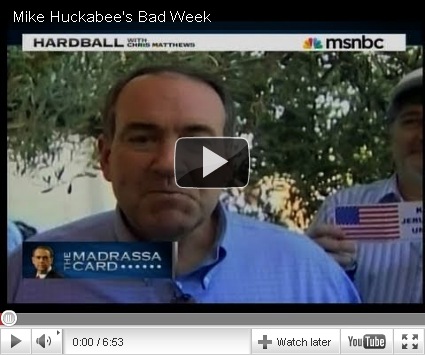
Mike Huckabee Is Full of … Doggie Pooh! And He’s Playing Dangerous Politics

We’ve all misspoken before. We’ve all said “yes” when we meant “no” or “salt” when we meant “pepper” or “fifty-seven” when we meant to say “fifty” or “Sally” when we meant to say “Becky” or whatever. A simple mistake like that is simply part of what it is to be human. And if the misstatement has consequences, usually a simple, “Oops, I made a mistake; I apologize,” is sufficient to rectify the situation.

So, if my friend asks if I liked a particular book and I say “yes” when I meant “no”, then that was a simple misstatement. An accident, if you will. But when I follow up my “yes” with a detailed explanation of why I liked the book, talking about the characters and their motivations, then my simple “yes” must have been something more; after all, if I really didn’t like the book, then why would I talk about the reasons that I did like the book? To claim that my “yes” was simply a misstatement would be … well … a lie. It’s hard to claim as a misstatement something that you say and then offer supporting information about.

Which leads me to Fox News Contributor, likely Republican Presidential Candidate, and general right-wing blowhard Mike Huckabee (emphasis added).

I’m sure you’ve heard by now that last week, in an appearance on a right-leaning (or far right, depending on the source) radio program, Huckabee said that President Obama was raised in Kenya:

HOST: Don't you think it's fair also to ask him, I know your stance on this. How come we don't have a health record, we don't have a college record, we don't have a birth cer — why Mr. Obama did you spend millions of dollars in courts all over this country to defend against having to present a birth certificate. It's one thing to say, I've — you've seen it, goodbye. But why go to court and send lawyers to defend against having to show it? Don't you think we deserve to know more about this man?

HUCKABEE: I would love to know more. What I know is troubling enough. And one thing that I do know is his having grown up in Kenya, his view of the Brits, for example, very different than the average American. When he gave the bust back to the Brits —

HOST: Of Winston Churchill.

HUCKABEE: The bust of Winston Churchill, a great insult to the British. But then if you think about it, his perspective as growing up in Kenya with a Kenyan father and grandfather, their view of the Mau Mau Revolution in Kenya is very different than ours because he probably grew up hearing that the British were a bunch of imperialists who persecuted his grandfather.

HOST: He despises the west, he despises the Brits, and I think he could take it all out on Israel and that's why he despises Israel. He's not too thrilled with our history either. But let me just try to get an answer from you. Would you say to him, or at least ask him in a debate, why did you go to court and spend millions of dollars on lawyers to prevent from having to show your birth certificate. If you have one and it's there, why not show it?

HUCKABEE: The only reason I'm not as confident that there's something about the birth certificate, Steve, is because I know the Clintons [inaudible] and believe me, they have lots of investigators out on him, and I'm convinced if there was anything that they could have found on that, they would have found it, and I promise they would have used it. 

When people pointed out to Huckabee that President Obama was not, in fact, raised in Kenya, Huckabee claimed that it was a simple “slip of the tongue” and that he meant to say Indonesia:

On Monday, while on Steve Malzberg's radio show on New York's WOR Radio, I was asked about the President Obama's birth certificate issue. In my answer, I simply misspoke when I alluded to President Obama growing up in ‘Kenya’ and meant to say Indonesia.

As I have stated on page 1 of my new book 'A Simple Government' and in numerous interviews with dozens of reporters — I don't believe there is an issue with Barack Obama's birth certificate. However, I do believe there are serious issues with the President's policies, and I have been openly opposed to the President's world view.

I'm not surprised the NY Times chose to sensationalize this story. In fact, the New York Times, the AP, and other news organizations ran with the “sensationalized story” despite being specifically told by Steve Malzberg himself that they were incorrect in their assessment of the sound bite. You just can't help but laugh when my simple slip of the tongue, becomes a huge story — and a certain Presidential candidate claiming to visit all 57 states, gets widely ignored.

But that explanation simply doesn’t hold water.* Why? Because Huckabee didn’t just say, “President Obama was raised in Kenya” when he meant to say “President Obama was raised in Indonesia.” Nope. Huckabee said it not once, but twice. And, more importantly, Huckabee then offered an analysis of what it meant to President Obama’s worldview having been raised in Kenya.

[H]is perspective as growing up in Kenya with a Kenyan father and grandfather, their view of the Mau Mau Revolution in Kenya is very different than ours because he probably grew up hearing that the British were a bunch of imperialists who persecuted his grandfather

And note that the explanation of the impact on President Obama’s worldview is not some kind of generic “raised outside the US” or “raised in a third world country” discussion. Huckabee’s discussion of President Obama’s upbringing was quite specific with regard to events in Kenya and young Barack Obama’s relationship with his father and grandfather. And that discussion is absolutely false. Obama only met his father once after his father left young Obama and his mother. He never met his paternal grandfather. And he didn’t even visit Kenya until he was in his 20s. Huckabee could have spoken about President Obama being “raised” (if living somewhere for 4 or 5 years can be considered being “raised” there) in Indonesia and having been exposed to Islam as a child. That discussion would at least have had some basis in reality (though the extent to which President Obama was exposed to Islam [he attended a Catholic school, not a madrassa] can be debated). But that wasn’t what Huckabee talked about. Rather, he talked, quite specifically, about Kenya, about President Obama’s father and grandfather, about the Mau Mau revolt, and about how that impacted President Obama’s views about Britain and colonialism (and note that British colonialism has absolutely nothing to do with Indonesia, which had been a Dutch colony).

So when people pointed out that Huckabee’s explanation of having “misspoken” didn’t make sense, Huckabee doubled down and continued to lie, this time going even further. Huckabee went on to explain that he misspoke in saying Kenya when he meant Indonesia, but that the analysis that he gave was consistent with the explanation in his new book (he’s apparently making all of these public appearances to get people to waste some of their money and line his pockets). He quite specifically told Bill O’Reilly that in his book, he says that Obama grew up in Indonesia (emphasis added):

If I'd read from my own text, page 183 of my book, I clearly said he grew up in Indonesia. It was a verbal gaffe.

You can see where this is going, can’t you? Of course. You see, apparently Huckabee is simply too stupid to think that someone might, just might, you know, actually look at the text of his book to see what he actually wrote (or perhaps Huckabee didn’t really write the book and doesn’t really know what’s in it…). Well, Media Matters decided to look at page 183 of Huckabee’s book:

huckabee-book-183

Oops. There’s a lot in there about Kenya (including quotes from a British newspaper), but I don’t see Indonesia mentioned at all. Not once. Of course, people who realized this noted that Huckabee was once again lying. So appearing on yet another radio program did he retract the comments about his book? Of course not. He reiterated that his “misstatement” was consistent with what he said on page 183 (emphasis added):

I made a verbal gaffe. Here's what I did.  I was quoting, actually, from page 183 of my book, A Simple Government. In that chapter, I talk about that Barack Obama has a different sort of perspective because of his unique background.

Now, look, all of us have a perspective based on who we are. I have a perspective having grown up in Hope, Arkansas, the son of a fireman. That has marked me, and given me a different perspective than someone who grew up in Manhattan.

So what I said was, that as a kid — and here was my gaffe. And it was my mistake and I corrected it immediately when I realized I said it. I said as a kid who grew up in Kenya, and I meant Indonesia, which is spelled out clearly in my book, word for word, but I did mention that his father and his grandfather were Kenyan. And I quoted directly.

Of course, observant readers might be thinking to themselves, “Well, gee, maybe he just got the page wrong; maybe Huckabee talked about Indonesia elsewhere in the book.” Guess what. Media Matters searched the Kindle edition of Huckabee’s book and did not find the word Indonesia, Indonesian, Jakarta, or the name of the neighborhood in which Obama lived while in Indonesia).

I guess if we want to understand Huckabee just to be saying that everything he says about Kenya and how President Obama’s worldview would have been impacted had he been raised in Kenya is true, then I suppose we could say that Huckabee wasn’t really lying; instead he was just making shit up and saying that real facts don’t actually matter as much as the bullshit narrative because the real facts might demonstrate that the bullshit narrative is wrong.

Writing for Salon, Justin Elliott manages to distill Huckabee’s “analysis” of the derivation of President Obama’s worldview to this:

So a fleshed-out version of Huckabee's theory would go like this: Obama's grandfather hated the British because he was (supposedly) tortured in prison under the colonial regime a few years before the Mau Mau uprising. Therefore, President Obama must take a different view of the Mau Mau uprising — in which his family played no part — than Huckabee, who apparently supports the brutal measures used by the British to defeat the rebellion. And because of all that, Obama replaced a bust of Winston Churchill — who himself wanted a peaceful solution to Mau Mau — with a bust of Abraham Lincoln.

One more point worth mentioning. Why is Huckabee even talking about President Obama’s childhood in the first place? I note that he doesn’t spend time talking about President Obama being raised for the majority of his childhood in Hawaii by a single white mother. Might that have impacted President Obama’s worldview, perhaps just a little? Huckabee talks about President Obama’s Kenyan father and who President Obama barely knew and the grandfather he never met, yet Huckabee spends no time talking about how President Obama’s worldview might have been shaped by his white grandparents who were actively involved in his upbringing — a military veteran and a bank executive from Kansas (Huckabee is from next door in Arkansas). Huckabee doesn’t mention President Obama’s academic prowess that led to scholarships to Occidental, Columbia, and Harvard. But in other discussions he does mention madrassas (even though young Obama did not attend a madrassa). And Huckabee repeats a long-debunked tale about President Obama offending the British by returning the Churchill bust. I mean, think about it: Huckabee is claiming that Obama’s having been raised in Kenya Indonesia for 4-5 years under the influence of his father and grandfather gave rise to Obama’s worldview while completely ignoring that the rest of Obama’s childhood was spent in the United States with his white mother and white grandparents and attending top quality universities in the United States.

So ask yourself why any of this is important to Huckabee or the audience that he’s talking to? Might any of it have to do with the fact that … gasp … President Obama looks different from Huckabee and most of those who support him? If we talk about President Obama’s Kansas roots, his white mother, his white grandparents, or his upbringing in Hawaii, then he doesn’t seem quite so … um … foreign and scary, does he? But by highlighting words like “anti-colonial” or, worse yet, making reference to the “Mau Mau Revolution” (come on, be honest, when you hear the term “Mau Mau” the image that comes to mind is scary African men with machetes and spears, right?) then Huckabee is clearly casting President Obama as something very foreign, even un-American. Add to the that Huckabee’s suggestion that Obama attended an Islamic madrassa (it was actually a Catholic school, but remember that facts are optional), and the impression that Huckabee’s intended listener is left with is that President Obama may be a lot of things, but an American just like them is clearly not part of that impression.

In politics, the term “dog whistle” is an oft-used phrase that describes simple words that have a particular meaning to a particular group of voters for whom those words are intended (and quite often, those same words will sound innocuous to voters outside the intended audience). And usually, dog whistle politics have a strong, underlying racial component. Huckabee’s discussion of President Obama’s upbringing in Kenya (or even Indonesia) is just that sort of dog whistle politics. He’s talking to the far right, to the Tea Party. He’s telling them that President Obama isn’t like the rest of us, that he isn’t as American or patriotic as they are, that he isn’t white like them. This is the kind of divisive, race-based politics that is — or at least should be — anathema to our system.

A few other tangentially related points. In addition to lying, it’s worth noting that Huckabee also gets his history wrong (not to mention mixed up). For one thing, last time I checked, America was founded by a group of anti-colonialists. I seem to recall this little thing called the American revolution in which a bunch of colonists sought to break their ties with their colonial masters in England. Apparently, in Huckabee’s world, white anti-colonialism should be respected and glorified while black African anti-colonialism (with the same colonial master, it should be noted) is … ooh … scary. Moreover, remember that whole bit about President Obama resenting Winston Churchill because of the Mau Mau revolt (or some such mumbo jumbo)? Yeah, well guess what. Historian David Anderson (in that same Salon article) notes:

To portray the Obama family as being part of Mau Mau is stir-fry crazy. Let me explain why: The Obama family come from western Kenya, which is about as different from Nairobi and the Kikuyu area as Utah is from New York City. And it's almost as far way. They come from an area where there was no rebellion, there was no Mau Mau. So while his father and his grandmother may well have been nationalists — I'm sure they were — they weren't directly involved in the Mau Mau rebellion.

The other thing is, if you've read anything about Churchill, you'd know that, although he was the head of the government at the time of the Mau Mau rebellion, he was trying as best he could to get the British in Kenya to negotiate and to end the fighting. Churchill was not supporting or condoning the violence. He is actually one of the few British politicians who comes out of this smelling of roses.

So, had President Obama been raised in Kenya by his father and grandfather, he might have had fond thoughts of Churchill. Thus, it is not even clear that if President Obama had been raised in Kenya he’d have the sort of anti-colonial, anti-British worldview that Huckabee ascribes to him on the basis of a lie. Of course, even raising the issue of the Churchill bust is part of yet another lie, too.

[T]he decision to return the Churchill bust to the British — it had been presented by former Prime Minister Tony Blair to Bush on loan — had been made before Obama even arrived.

"It was already scheduled to go back," [White House curator William] Allman said.

And according to Newsweek:

Intended as a symbol of transatlantic solidarity, the bust was a loaner from former British prime minister Tony Blair following the September 11 attacks. A bust of Abraham Lincoln — Obama's historical hero — now sits in its place. A White House spokesperson says the Churchill bust was removed before Obama's inauguration as part of the usual changeover operations, adding that every president puts his own stamp on the Oval Office.

So the return of a bust of Churchill, loaned personally to President Bush, that was removed prior to Obama’s inauguration and replaced with a bust of Lincoln, somehow gives credence to the notion that President Obama harbors ill will toward Britain because of events that happened in Kenya in the ’50s and ’60s to the father Obama barely knew and the grandfather he never knew, even though Churchill might have been the “good guy” in those events. When your analysis is based not on facts but on lies, half-truths, or just incorrect facts, that analysis isn’t worth much.

Furthermore, note how Huckabee responded to some of the points raised by the radio host. When the host claims “He [President Obama] despises the west, he despises the Brits, and I think he could take it all out on Israel and that's why he despises Israel. He's not too thrilled with our history either” how does Huckabee respond? Does he come out and say, “No, that’s not fair; I disagree with President Obama’s policies but he doesn’t hate the west or despite the Brits and Israel?” No. Huckabee simply lets those statements stand. To me (and I suspect to many listeners, both supporters and opponents), Huckabee’s silence, his failure to take issue with those statements, is tacit agreement or approval.

And when the host invites Huckabee to go full-scale birther and brings up President Obama’s birth certificate, does Huckabee push back and say, “But President Obama has produced a birth certificate; the birther conspiracy is stupid and wrong?” Nope. Instead, Huckabee says (my emphasis): “The only reason I'm not as confident that there's something about the birth certificate, Steve, is because I know the Clintons [inaudible] and believe me, they have lots of investigators out on him, and I'm convinced if there was anything that they could have found on that, they would have found it, and I promise they would have used it.” You see, Huckabee can’t really distance himself from the birthers; that might cost him right-wing, Tea Party support. Instead, Huckabee says the “only reason” that he is “not as confident” in the birther conspiracy theories is because Hillary Clinton would have found evidence that Obama wasn’t born in the US. Yet to Huckabee — and his supporters — facts and truth simply don’t matter as much as the story created on the basis of nothing more than lies and false suspicions.

Anyway, should Huckabee decide to run for President, we all need to remember this incident for it demonstrates the complete lack of character (not to mention candor) that Huckabee exhibits. If he’s willing to lie this brazenly and repeatedly on an issue as small as this one, what can we expect of him on important and difficult matters? But at least we know why Fox News keeps him around; apparently his worldview is as much “facts optional” and “lies are true” as the rest of Fox News and its stable of reporters and not-yet Presidential candidates. It doesn’t matter if the attack on President Obama or a Democratic policy is based in lies or truth, sound policy or no policy at all. No, the only thing that matters is attacking President Obama, even it the attack is based on pure bullshit.

For a roundup of all of this, please check out this video compilation from Media Matters (note that I came across it after I’d nearly completed this post):

-----

*I want to briefly touch on Huckabee’s comparison of his “misstatement” to President Obama’s famous slip of the tongue regarding having visited 57 states. To me, that is just the kind of real misstatement that the term “slip of the tongue” describes. To equate that statement to Huckabee’s, would have required President Obama to follow up his reference to 57 states by listing places like East Virginia, West Dakota, Ontario, and some of the other “extra” states that he’d visited. But that isn’t what happened. Obama didn’t follow up his misstatement with support for his misstatement. Nope. But that is what Huckabee did. Again and again. Obama made a mistake; Huckabee lied and then lied about lying.

Labels: ,

Bookmark and Share


Friday, March 4, 2011

School Vouchers — Why I Oppose Them

One of the issues currently before the Indiana General Assembly (and which is included in the list of grievances that has caused House Democrats to leave the state in order to deny Republicans a quorum) is a school voucher program (dubbed “school scholarships” in the statutory language). I realized that I haven’t directly expressed my thoughts on vouchers in previous posts on this blog. Well, allow me to rectify that omission: I am firmly opposed to school vouchers.

OK. Now that I’ve got that out of the way, let’s go back and look at the issue in a bit more detail. First, if you’re interested in reading the proposed legislation, it is set forth in Indiana House Bill 1003. Unfortunately, this is another one of those bills that is very difficult to read due to the numerous cross-references and the way that these sorts of bills are formatted. So let me just quote the digest of the bill (prepared by Indiana’s Legislative Services Agency):

School scholarships. Increases the school scholarship tax credits that may be awarded for donations to a scholarship granting organization. Allows scholarship granting organizations to grant scholarships to families with income that is not more than 200% of the amount required for the individual to qualify for the federal free or reduced price lunch program. Provides scholarships to low income students to pay the costs of tuition and fees at a public or private elementary school or high school that charges tuition. Prohibits a scholarship granting organization from limiting the availability of scholarships to students of only one participating school. Provides for a supplemental distribution to public schools equal to the difference between the amount distributed as choice scholarships and the amount that would have been distributed to public schools to educate the children receiving choice scholarships. Requires fair admissions policies for schools eligible for choice scholarships. Limits the choice scholarship granted to a student in grade 1 through 8 to $4,500 per school year. Provides consequences for nonpublic schools who receive: (1) consecutive low category designations for school performance and improvement; and (2) a distribution of choice scholarships. Provides for any savings from the choice scholarships to be used for tuition support for schools. Makes conforming changes.

But even that is a lot of mumbo jumbo. So let me boil it down even further. The proposed bill would allow students to get money from the state (in the form of a “school scholarship” — also known as a voucher) to attend a private school. The money would come from the money that would otherwise go to the public school system that student would have attended if the student did not enroll at the private school. The student would be eligible for the voucher if the student’s family’s income was less than $97,000 for a family of four (give or take; the amount is 200% of the amount required for an individual to qualify for the free or reduced lunch program which, as of 2009 was $47,712 per year for a family of four). And the voucher could not exceed $4,500 per year for grades 1-8. There’s more, but that should give you the general idea.

So, with that in mind, let’s examine why I oppose vouchers.

First, let’s consider the following provisions from Indiana’s Constitution (emphasis added):

Article 8, Section 1: Knowledge and learning, general diffused throughout a community, being essential to the preservation of a free government; it should be the duty of the General Assembly to encourage, by all suitable means, moral, intellectual scientific, and agricultural improvement; and provide, by law, for a general and uniform system of Common Schools, wherein tuition shall be without charge, and equally open to all.

Article 1, Section 6: No money shall be drawn from the treasury, for the benefit of any religious or theological institution.

See any problems yet? First, my guess is that the vast majority of private schools that might receive voucher funds are faith-based. Just thinking about the Indianapolis area, I can think of numerous religious schools but only a small handful of secular private schools (Park Tudor, University High School, and International School of Indiana). Yet the voucher program would take funds from public schools and essentially transfer those funds to private religious institutions. As I understand it, the drafters of the bill try to get around this by having the funds given to an intermediary scholarship organization which, in turn, gives the funds to the parent to give to the school (or some such). But the end result is the same: Money collected from taxes is paid to religious schools to educate Hoosier children who could otherwise be educated in public schools.

Next, let’s think about those private schools in comparison to public schools. First, unlike public schools, private schools are not obligated to accept any student that walks in the door. So if a private school wants to turn away certain kids, it can certainly do so. And in the case of religious schools, I believe that means that the school could turn away kids not of that religious denomination. (If I’m not mistaken, the school could not turn away a child due to race or certain other criteria.) The private schools can also turn away students that they believe may be harder to educate, whether because of a learning disability, an unstable or unsupportive home, lack of good English skills, or any other non-discriminatory reason. In other words, the private schools can “skim” the best students and leave the more difficult students for the public schools. When you consider that the private schools don’t (I don’t think) have to accept special needs students, then this situation is exacerbated even further.

Private schools also are not obligated to teach up to state (or federal) standards. If a private school wants to teach creation as fact, that all Muslims are evil, that Jews killed Christ, that women should be barefoot and pregnant, that the Earth is flat and is circled by the planets, or that 2+2 = a rhinoceros, nothing is stopping them from doing so. Moreover, the teachers in the private school (again, as I understand it) need not be licensed by Indiana. I don’t think that these sorts of problems are particularly problematic as they relate to the highly regarded private schools, but who knows about the smaller, parochial schools or the new parochial schools that might be established to take advantage of voucher programs. I can certainly imagine churches starting new, small schools to educate kids as the church believes best at the lowest cost possible with the payments to come from the voucher system. And I can just hear the howls of protest that might arise if a local Muslim organization started a Islamist madrasa and sought the use of vouchers to help students attend and become radicalized.

At least when it comes to public schools, the curriculum is determined (or at least influenced by) elected representatives. Thus, we all have some kind of input into what our children are being taught. In the case of private schools (and religious schools in particular), there is likely little or no input into the curriculum (other than, perhaps, from the families of the kids that attend that particular school; but, for example, in the case of Catholic schools, how much input to parents have in the curriculum?), notwithstanding that with vouchers, the cost to educate the children would be paid, at least in part, by all of us.

Next consider that private schools don’t have to provide transportation to and from the school. Parents who are unable to transport their child to the private school will, therefore, be unable to make use of the voucher program (for what good is the tuition if the child can’t get to the school). By contrast, I believe that most public schools must provide transportation to all but a limited number of students.

On a similar note, it is very important to recognize that an underlying concept of the benefit of vouchers is built on a bit of a fraud. Proponents argue that vouchers give low income students a chance to attend a private school, a chance that right now is usually limited to children of wealthy families. First, that argument ignores the scholarships already available to low income students from the private schools themselves. More importantly, given that the voucher is not 100% of the cost of tuition (remember, in the case of the proposed bill in Indiana, the limit is $4,500), the family will need to find a way to make up the difference in the tuition funding. Keeping that $4,500 figure in mind (and remember that it is a maximum; many students would qualify for less), consider the following schools and their respective tuitions (information taken from the website for each school on March 2, 2011):

  • Park Tudor (8th grade): $16,980
  • Brebeuf Jesuit (high school only): $13,500
  • St. Luke’s Catholic School (8th grade, non-parishioner): $5,790
  • Hasten Hebrew Academy of Indianapolis (8th grade): $8,894
  • International School of Indiana (8th grade): $13,250
  • Heritage Christian (8th grade): $8,756

I’m sure that there are plenty of other schools and I’m sure that some of them are less expensive (I’d be curious to know what the smaller, less well-known parochial schools charge). But of the six schools that I checked, a low income parent who wanted to send a child to the least expensive school would still have to come out of pocket at least $1,300 (plus find a way to provide transportation to the school). I can’t see any feasible way for a low-income family to afford to send their child to Park Tudor or the International School of Indiana just because they get a voucher from the State of Indiana. How could that working, single mother living downtown pay the additional $12,500 and arrange transportation to the school (keeping in mind how atrocious Indianapolis’ public transportation system is).

We can also look at the issue from a slightly different perspective. Let’s take the hypothetical Columbia School System which has 1,000 students and a budget of $4,500,000 ($4,500 per student). (Note that I’m making up my numbers and used round numbers to keep the example simple; I don’t know what the real numbers are.) Most of the classes in the Columbia School System have 30 kids per class. So Columbia School System has to employ about 34 teachers plus special needs, gym, art, music, and other specialized teachers. Of course, the Columbia School System also has to pay for school buses, administrative expenses (including, perhaps, nurses and guidance counselors), and facilities upkeep. There is also a private school in Columbia: The God Is Great Academy. It has 50 students who each pay $10,000 per year in tuition (for an annual budget of $500,000). The private school has smaller class sizes (say 10 per class room). It doesn’t have any buses and doesn’t have a special needs program. The school is largely staffed by parents who volunteer and the principal is also the assistant pastor at the church that owns the school.

Now, let’s presume that the voucher bill passes and 10 kids decide to leave the Columbia School System and transfer to The God Is Great Academy and let’s presume that each of them is entitled to the full $4,500 full voucher. The Columbia School System has lost $45,000 from its budget, but probably won’t be able to reduce any teaching or administrative positions (a few classes will simply have 29 instead of 30 kids). They’ll still need the special needs teacher and gym teacher and librarian and nurse. So the Columbia School System now has $45,000 less to do virtually the same thing that it was doing before. On the other hand, The God Is Great Academy just gained $45,000 which is a large bump to its budget. And given that the $4,500 per kid that The God Is Great Academy received from the state isn’t enough to cover the full tuition of those kids, the parents will have to kick in another $5,500 each. So, in essence, the budget for The God Is Great Academy increased by $100,000 (20%). After subtracting the cost of a new teacher, there is still a lot of extra money for The God Is Great Academy to do something else with that money (whether buy new football uniforms or hire a full time pastor or buy new books explaining why evolution is wrong). The educational mission of the private school has been significantly enhanced while the situation of the public schools has not changed significantly, other than a reduction in the available funds needed to do virtually the same job. And don’t forget that the kids who were able to leave the public school had the means to do so (whether in terms of the extra tuition or transportation or the academic prowess to be accepted in the first place); however, the public school continues to need to educate special needs students and those who don’t have the means or academic prowess to go to a private school. So, it can be argued that the task of educating students in the public school became just a bit more difficult.

Now, let’s add an extra wrinkle to the previous example. Remember those 50 kids who were already attending The God Is Great Academy? Well, suppose that some of them were also eligible for vouchers (perhaps the families have previously received scholarships through the church). See, that’s one of the things that proponents of vouchers often forget to mention: Many of those who would use a voucher to send their child to a private school are already paying for the child to attend the private school! So if 10 of those 50 kids who were already enrolled were eligible for vouchers, the situation at The God Is Great Academy wouldn’t change at all, but the parents of those 10 kids would see a savings of $4,500 each. Not bad. On the other hand, the budget of Columbia School System (where those 10 kids would have gone if not enrolled in a private school) would be reduced by another $45,000, but this time, there would be absolutely no reduction whatsoever in the student body population or the responsibilities of the school.

And do you suppose that some schools, especially those with lower tuitions, might just use the availability of vouchers to “game” the system and increase the tuition for those using voucher funds so that the full $4,500 is used?

One red herring argument in support of vouchers worth mentioning: Some people argue for vouchers on the basis of “double taxation” (or some similar phraseology). The argument is essentially that parents who send their children to private schools are paying for that school and still paying for the public school that they’re not using. Thus, they contend, they’re being taxed for a service that they’re not using and paying a second time to educate their child. Why is this a red herring? Several reasons. First, it is important to recognize that the parent chose to pay to send the child to a private school. If the parent elected not to pay that tuition, the public school would still be available. Second, by that line of reasoning, people without children or people whose children have finished school should also be exempt from paying taxes that go towards the public schools. But by that reasoning, the blind or illiterate shouldn’t pay taxes that go to libraries, people without drivers licenses shouldn’t pay taxes that go to road repairs or police presence on the roads (i.e., to catch speeders or reckless drivers), people who don’t use public parks shouldn’t pay the taxes for the upkeep of those parks, people whose houses never catch on fire shouldn’t pay for fire protection, people who don’t want the country to enter into a particular war shouldn’t pay taxes to support that war effort, and the list goes on and on and on. Our system of government doesn’t base taxes solely on the services that people use (though we do have special taxes linked to special expenditures like gasoline and cigarettes); rather, we pay taxes to support things that our we — through our elected representatives — deem to be a public good. And given that education has its own article in the Indiana Constitution suggests that Hoosiers certainly view education as a public good. Thus, the argument that some people ought not have to pay to educate other people’s children in public schools is wholly without merit.

I guess, though, that when I step back and look at the whole issue of vouchers, the principal objection that I have goes back to the church-state implications. I have a major concern with my tax dollars being diverted from public education to pay for private faith-based education. That is not what the drafters of either the US Constitution or Indiana’s Constitution had in mind; rather, I believe that they intended precisely the opposite and I think that they would have objected to vouchers and agreed that vouchers run afoul of the language that they created to keep church and state separate.

If you have another reason that you oppose vouchers, let me know. And if you support vouchers, let me know you’re reasoning, too. I know that I’m certainly not an expert in the subject and I’d love to learn more and have the opportunity to discuss (and write about) the subject further.

Labels: , ,

Bookmark and Share


Newer›  ‹Older