Wednesday, April 30, 2008

Voter ID Law Is Bad for Democracy (Update 6)

I still haven't had a chance to work my way through the Supreme Court's opinion in the voter ID case, but I did want to mention the editorial "Supreme vote of approval protects balloting system" in today's The Indianapolis Star. Allow me to (briefly?) take issue with several points made by the Star's editorial staff:
The U.S. Supreme Court's decision to uphold Indiana's voter ID law is a step forward in protecting the integrity of the voting process. It's also a victory for good sense.

First, I'm not sure that I understand how the law is a "step forward in protecting the integrity of the voting process" when there was absolutely no evidence whatsoever in the history of the State of Indiana of any voter fraud that this law would prevent. Second, I'm not sure that taking time to pass laws and then litigate them all the way to the Supreme Court in order to prevent a non-existent problem makes good sense. Third, I don't think that the law is a step forward when it does not address the types of voter fraud that have been documented.

Providing an ID is a common requirement of modern life, from cashing a check at a grocery store to picking up prescription drugs at a pharmacy. Asking a voter to flash an ID before participating in one of the most important responsibilities befalling a citizen is a reasonable safeguard against those who would violate the public's trust through voter fraud.

Let me first quote my thoughts on this argument from my post Voter ID Law Is Bad for Democracy (Update 2):

Voting is different; it is not the same as flying on a plane, renting a video, or even opening a bank account. Voting is an essential function -- perhaps, the essential function -- of a citizen in a democracy. Minor inconvenience might be acceptable in certain situations, but not situations that go to the very heart of the functioning of the democracy and certainly not when that inconvenience is caused, not for the purpose of preventing an abuse that is not occurring, but rather to disenfranchise certain voters who are more likely to vote for candidates of a particular ideology.

I'm all for reasonable safeguards, but when they are being applied to core constitutional rights and to the very framework upon which our democracy rests, then those "reasonable safeguards" must really address the perceived problems (i.e. voter fraud) without unreasonably disenfranchising the most vulnerable citizens. Given that there is no evidence of in person voter fraud (which the law addresses) and there is evidence of other types of fraud (for example, in absentee balloting) that the law does not address, then I don't think that the voter ID law is a "reasonable safeguard" at all.

Indiana's voter registration rolls, until recently, were grossly inaccurate, carrying the names of deceased residents, former voters who had moved out of state, and duplicate names of people who were registered in more than one county. The opportunity for fraud was clearly evident.

While the above is a true statement, it misses one very critical point: Indiana's voter ID law will not address any of these issues (other than preventing a deceased voter from showing up and voting). A voter who has moved could still show up and vote as could a voter registered in multiple counties. And, given that the law does not address absentee balloting which is much more prone to fraud (and is where past examples of fraud have occurred), it seems that we should still be concerned rather than pacified by the current law. For that matter, what is to stop someone with a fraudulent ID from registering to vote in the first place?

It's also hard to argue that the law has discouraged people from voting; voter registration in Indiana has surged in the past two years. More people than ever are participating in the process.

This statement is simply idiotic. I wonder why voter registration has "surged". Could it be because the race between Sen. Obama and Sen. Clinton is drawing record voting turnout in primaries throughout the nation? Could it have anything to do with public dissatisfaction with incumbent legislators at all levels of government and/or dissatisfaction with the Governor? Could it have anything to do with the continued war in Iraq, property taxes, gas prices, health care costs, or any of the other issues confronting Hoosier voters? And, just because voter registration has "surged", how do we know that the law has not discouraged or disenfranchised voters? That many new voters may plan on going to the polls does not somehow balance out the hardships that may now prevent others from going to the polls. And, if the number of potential voters who are disenfranchised is low, does that mean that they simply aren't important enough to worry about? Are we really telling them that because they are few in number their votes are somehow less important?

If our General Assembly was truly interested in the integrity of the voting process and the functioning of democracy, it would pass voting rights legislation that would make it easier for citizens to vote (keeping the polls open longer would be a great start) while addressing the real problems in the voter registration process and record keeping. Or, if the General Assembly is intent on keeping the voter ID law, then perhaps we could pass legislation to simplify the process of obtaining an appropriate government ID without cost to taxpayers. But, I don't think that Republicans in the General Assembly are interested in anything more than increasing their own turnout while decreasing Democratic voter turnout.

Somehow we keep forgetting that voting is the core function of the citizenry in a democracy. Around the world, people kill and die for the right to vote. Here in America, we take voting for granted to such an extent that we don't seem overly concerned when we deprive some of our own of that very right when we do so in the false name of "integrity".

Labels: ,

Bookmark and Share


Tuesday, April 29, 2008

Voter ID Law Is Bad for Democracy (Update 5)

In the first weeks after I started this blog, one of the issues that I wrote about repeatedly was Indiana's Voter ID law that was being challenged before the United States Supreme Court (see Voter ID Law Is Bad for Democracy, and Update 1, Update 2, Update 3, and Update 4 to that post). Well, on April 28, the Supreme Court issued a fractured ruling; unfortunately, however, the challenge to the Voter ID law was denied and Hoosiers going to the polls on May 6 will be required to show a government issued photo ID in order to vote.

I haven't yet had the time (or mental fortitude) to read the opinion (actually, there are 4 opinions: one by Justice Stevens joined by Chief Justice Roberts and Justice Kennedy, one by Justice Scalia joined by Justice Thomas and Justice Alito, one by Justice Souter joined by Justice Ginsburg, and one by Justice Breyer). For anyone interested, the opinions can be downloaded from the Supreme Court's website.

I may have more to say after I read all of the opinions, however, one portion of Justice Breyer's dissenting opinion is worth noting:

For one thing, an Indiana nondriver, most likely to be poor, elderly, or disabled, will find it difficult and expensive to travel to the Bureau of Motor Vehicles, particularly if he or she resides in one of the many Indiana counties lacking a public transportation system. See ante at 6-7 (Souter, J., dissenting) (noting that out of Indiana's 92 counties, 21 have no public transportation system at all and 32 others restrict public transportation to regional county service). For another, many of these individuals may be uncertain about how to obtain the underlying documentation, usually a passport or a birth certificate, upon which the statute insists. And some may find the costs associated with these documents unduly burdensome (up to $12 for a copy of a birth certificate; up to $100 for a passport). By way of comparison, this Court previously found unconstitutionally burdensome a poll tax of $1.50 (less than $10 today, inflation adjusted). See Harper v. Virginia Bd. of Elections, 383 U.S. 663, 664 n. 1, 666 (1966); ante, at 30 (Souter, J. dissenting). Further, Indiana's exception for voters who cannot afford this cost imposes its own burden: a postelection trip to the county clerk or county election board to sign an indigency affidavit after each election.
The other thing that I find most troubling about this law is that it imposes burdens upon citizens who show up to vote on election day, even though Indiana does not have any cases of in person voter fraud, yet the statute does not apply to absentee voting (where there is a history of voter fraud) or do anything to address problems such as voters appearing on the voting rolls in more than one county. If Indiana's Republican legislators were truly interested in the "integrity" of the voting process (recall that the legislation passed on a strictly party-line vote), then they would address the real problems with the electoral process. The fact that they have only imposed burdens to address a wholly non-existent problem while leaving real problems intact is, at least to me, prima facie evidence that the law is not justified.

Hopefully, after the elections this November, a Democratic majority in the Indiana General Assembly will be able to send a Democratic Governor a bill that repeals Indiana's absurd and undemocratic voter ID law.

Just a few comments on the issue from other notables:

The press release from the Indiana Democratic Party (which was a plaintiff in the lawsuit):

Indiana Democratic Party Chair Dan Parker expressed disappointment today in response to the Supreme Court upholding Indiana's restrictive voter identification law, but pledged that work will continue to protect the rights of Hoosiers to vote.

"Nothing has been settled on this issue, and we will carry on our fight to remove any unnecessary barriers that stand between the citizens of this state and the ballot box," Parker said. "While the Republican Party seeks to make it more difficult for hundreds of thousands of Hoosiers to exercise this most fundamental right, we are dedicated to ensuring that every voter in this state be given the full, fair opportunity to have their voice be heard in the democratic process."

"It is unfortunate that Indiana is being asked to wait until additional disenfranchisement occurs in order to fix this flawed legislation, but this will not stop the Democratic Party from continuing to stand up for those who need a voice," he added.
Contrast the Democratic position to the statements of Indiana's Republican Secretary of State, Todd Rokita, a vocal proponent of the voter ID law (and a defendant in the lawsuit) in his press release:

Today, the United States Supreme Court ruled 6-3 to uphold Indiana’s Voter ID law. Indiana Secretary of State Todd Rokita, Indiana’s Chief Election Officer and the Respondent in the case vigorously defended Indiana’s law.

“Today, Indiana won the national battle for voter protection and state’s rights. Across the country, leaders are thanking Hoosiers for raising the bar in protecting voters and improving the integrity of the election process,” stated Indiana Secretary of State Todd Rokita. “I expect many states to follow our lead.”

Many states across the nation have waited for the Court’s opinion on the two consolidated cases, Indiana Democratic Party v. Todd Rokita and Crawford v. Marion County Election Board. States like Mississippi and Texas have attempted to model their Voter ID proposals after Indiana’s law in an attempt to improve election accuracy.

“Indiana’s ID law is about accuracy - are we going to demand accuracy through integrity in our election process? The answer from the Supreme Court echoes that of the American people. Yes, we want accurate elections that protect each individual’s vote.” stated Indiana Secretary of State Todd Rokita.

The photo ID law has been tested and successfully passed the scrutiny of the courts in the past. First, by U.S. District Court Judge Sarah Evans Barker in 2006 and then upheld by the Seventh Circuit Court of Appeals which ruled 2-1 in favor of upholding Indiana's Photo ID law in 2007.

Over the last three years, the Indiana Secretary of State’s Office has maintained an aggressive plan to inform Hoosiers of the Voter ID requirement as part of a $1.25 million in voter outreach and education. This year, Secretary Rokita increased primary outreach spending, focusing on the photo ID requirement and tailoring the outreach to new voters.”

“As we have with the past seven elections in our state, we will continue to work with local election officials to inform citizens of the ID requirement,” stated Secretary Rokita. “Our office has increased our outreach efforts by almost 50% during this busy primary season. It is my hope that those who spent energy in fierce opposition will spend equal amounts of energy helping us continue to inform Hoosiers of this common-sense requirement.”
The press release from David Orentlicher (a candidate for Indiana's 7th Congressional district) who is also a law professor:

David Orentlicher criticized the decision of the United States Supreme Court today to uphold the Indiana voter ID law.

"This was a bad decision—a big step backward for voting rights law. Indiana disenfranchises voters who have ID's that are valid but that don't meet the highly restrictive requirements of the voter ID law. Students at the University of Indianapolis, for example, cannot use their student ID's to verify their identity at the polls. Moreover, the law fails to address the real area of concern with respect to voter fraud.

As the Supreme Court acknowledged, voter fraud has occurred with absentee voting, and the voter ID law does not apply to absentee voters.The Indiana voter ID law really was designed to suppress voter turn-out, and it is unfortunate that the Supreme Court has upheld the law," Orentlicher stated.

In response to the Supreme Court's decision, Sen. Obama (quoted from "Obama calls voter ID ruling 'wrong'"):

[S]aid he was disappointed today in the new Supreme Court decision that has upheld Indiana's voter ID law, calling it "wrong," and emphasizing that the law could suppress turnout among minorities and poorer voters.

"I am disappointed by today's Supreme Court decision upholding Indiana's photo identification law -- one of the most restrictive in the nation," Obama said in a written statement.

He referenced his decision to file an amicus brief when Indiana's voter ID law was first challenged, saying he did it because he believed that "it places an unfair burden on Indiana residents who are poor, elderly, disabled, or members of minority groups."

Obama pledged to ensure that all voters have "unfettered access to the polls" on May 6th, and added that he was "encouraged that the Court has not complete closed the door to future challenges to state voter ID laws that create discriminatory barriers to the right to vote."

Finally, when looking around the web to see if I could find comments from Sen. Clinton, Sen. Obama, or Sen. McCain (I wasn't able to find anything from Sen. Clinton or Sen. McCain), I came across the following statement that Sen. Obama gave last November about the Indiana voter ID:

“Voting is our most basic right and one of our most important responsibilities as Americans,” said Senator Obama. “Any law that creates discriminatory barriers to the exercise of this fundamental right should be immediately revoked – including the Indiana voter identification requirement. This law is unconstitutional, and should be struck down by the Supreme Court. More than forty years after the 24th Amendment was ratified, we must continue to ensure that all Americans, including our country’s most vulnerable citizens, have equal, unfettered access to the polls in every state.”
I also found a speech that Sen. Obama gave on the floor of the Senate in 2006 when the United States Senate was debating a national voter ID law:

Thank you very much, Mr. President. Let me just echo Senator Kennedy's strong opposition to the amendment that is offered by the Senator from Kentucky.

There is no more fundamental right accorded to United States citizens by the Constitution than the right to vote. The unimpeded exercise of this right is essential to the functioning of our democracy. Unfortunately, history has not been kind to certain citizens in protecting their ability to exercise this right.

For a large part of our nation's history, racial minorities have been prevented from voting because of barriers such as literacy tests, poll taxes and property requirements. We've come a long way. That was clear a few weeks ago when Democrats and Republicans, members of the Senate and the House stood on the Capitol steps to announce the introduction of a bill to reauthorize the Voting Rights Act. That rare and refreshing display of bipartisanship reflects our collective belief that more needs to be done to remove barriers to voting.

Right now, the Senate is finishing a historic debate about immigration reform. It's been a difficult discussion, occasionally contentious. It's required bipartisan cooperation. After several weeks and many, many amendments, we're less than an hour away from voting for cloture. Considering our progress and the delicate balance we're trying to maintain, this amendment could not come at a worse time.

Let's be clear. This is a national voter ID law. This is a national voter ID law that breaks the careful compromise struck by a 50-50 Senate four years ago. It would be the most restrictive voter ID ever enacted, one that could quite literally result in millions of disenfranchised voters and utter chaos at the state level.

Now, I recognize there's a certain simplistic appeal to this amendment. Why shouldn't we require people to have a voter ID card when they vote? Don't we want to make sure voters are who they claim to be? And shouldn't we make sure non-citizens aren't casting ballots to change the outcome of elections?

There are two problems with the argument: number one, there's been no showing that there's any significant problem with voter fraud in the 50 states. There certainly is no showing that non-citizens are rushing to try to vote: this is a solution in search of a problem.

The second problem is that historically disenfranchised groups - minorities, the poor, the elderly and the disabled - are most affected by photo ID laws. Let me give you a few statistics, overall 12% of voting age American do not have a driver's license, most of whom are minority, new U.S. citizens, the indigent, the elderly or the disabled. AARP reports that 3.6 million disabled Americans have no driver's license. A recent study in Wisconsin this year found that white adults were twice as likely to have driver's licenses as African Americans over 18. In Louisiana, African Americans are four to five times less likely to have photo IDs than white residents.

Now, why won't poor people be able to get photo IDs or Real IDs? It's simple. Because they cost money. You need a birth certificate, passport or proof naturalization and that can cost up to $85. Then you need to go to the state office to apply for a card. That requires time off work, possibly a long trip on public transportation assuming there's an office near you. Imagine if you only vote once ever two or four years, it's not very likely you'll take time off work, take a bus to pay $85 just so you can vote. That is not something that most folks are going to be able to do.

The fact of the matter, Mr. President, is that this is an idea that has been batted around not with respect to immigration but with respect to generally attempting to restrict the approach for people voting throughout the country. This is not the time to do it.

The Carter-Baker commission in 2002-2004 said fraudulent votes makeup .000003% of the votes cast. That's a lot of zeros. Let me say it a different way. Out of almost 200 million votes that were cast during these elections, 52 were fraudulent. To put that into some context, you are statistically more likely to get killed by lightning than to find a fraudulent vote in a federal election.

Mr. President, this is not the appropriate time to be debating this kind of amendment. We've got a lot of serious issues with respect to immigration. I would ask that all my colleagues reject the amendment so we can move on to the important business at hand. Thank you, Mr. President.
While I still haven't made up my mind as to who I plan to vote for on May 6, Sen. Obama's statement and speech on voting rights are certainly worth considering.

Labels: ,

Bookmark and Share


Friday, April 25, 2008

Political Terrorism Alive and Well in Carmel

This evening my wife and I had the misfortune to learn that terror on the basis of political viewpoint is apparently alive and well in Carmel, Indiana. A suburban community known as an idyllic place for families, a community where misguided parents want the city to adopt "decency" ordinances, a neighborhood where families gather around bonfires on Halloween and Friday nights in the summer, is also a city where those with a "different" political viewpoint may be subject to vandalism and acts intended to terrorize.

At around 10:30 tonight, I was in the basement reading and my wife was in the bedroom watching TV when we were both startled by a very, very loud crashing or banging noise. From the basement, it sounded as if something very large had fallen to the floor. I ran upstairs to find my wife very distraught saying that something had banged into the front door several times. At first, I thought it might have been an animal or a bird. We looked out the front windows, but didn't see anything or anyone. Then I noticed on the floor in front of the door was the magnet that we keep on the door to keep notes or family photos. The magnet is very, very strong and is actually hard to pull off of the door. Thus, whatever hit the door causing the magnet to fall must have done so with significant force.

My suspicion then fell on neighborhood kids out for a simple prank. The only problem with this solution is that there are very few older kids in our neighborhood and, based on the sound my wife heard (not to mention the force to knock down the magnet), I don't think that it could have been a younger child.

My wife called the police to see if they'd had any other reports of this kind of activity. They hadn't, but said that they would send a patrol car to drive around the neighborhood. In the meantime, I decided to go outside (with my 95 pound German Shepherd for company).

I didn't find anything on or around our door, so whatever (or whoever) hit the door, must have left quickly. Then, I realized what had happened.

A few days ago, we put up a "Hoosiers for Hillary" sign in our front yard (Note: I'm actually still undecided, but I have no problem showing that I want a Democrat to be the next President). So far, ours has been the only Clinton or Obama yard sign that I've seen in Carmel (and I've seen way too many signs for Dan Burton). Anyway, as the dog and I walked out toward the street, I discovered that our sign was gone. It was there when we got home from the movie earlier this evening. I looked around the yard and in the bushes nearby, but the sign was gone. So now I knew.

Yes, it may have been a simple prank. "Gee, let's scare the Democrats." But, in actuality, this childish prank is really far more sinister than that. It appears to have been politically motivated (why else choose our house; why else steal that particular yard sign?) and the loud banging on the door, fairly late at night, could serve no purpose other than to frighten those inside. There is a word for using the tactic of inducing fear to make a political point: terrorism. Sure, there was no bomb or gunfire or even violence; but that isn't what terrorism is about. Terrorism is about scaring -- terrorizing -- the "enemy". Is the act of trying to frighten us really that much different (though admittedly far less severe in scope and tone) than burning a cross in a front yard or painting a swastika on the side of a building?

Perhaps I'm overreacting; maybe it's because my wife was scared. Maybe it's because she has a rare illness that, when triggered, can send her into anaphylactic shock, and one of her most severe triggers is stress. Maybe it's because I have young children who could have been frightened (but thankfully, both seem to sleep through just about anything, even last week's earthquake). Maybe it was just kids, with no real malice and no real forethought. But maybe not. I'd hate to think that I live in a community where people really believe Ann Coulter and think that I'm a traitor because I'm a Democrat. I'd hate to think that I live in a city where people think that it's funny to try to frighten those with opposing political viewpoints. And I'd hate to think that one of my neighbors might be responsible for this conduct. But I suspect, knowing some of the people who live around me, that this wasn't just kids acting on their own.

For a long time I've suggested that our political culture of demonizing the political opposition and of referring to a political opponent or someone with a different political viewpoint as the "enemy" was a dangerous road and a slippery slope. I've often argued that it was a short jump from this sort of behavior to political violence, especially when talk radio tells people that, because of my political beliefs, I am the enemy and a traitor to America. I'm afraid that perhaps my fears have been justified. Politically motivated vandalism or "pranks" are simply one step down that dangerous road from name-calling toward violence.

If that is the current state of affairs in Carmel -- in America -- then we should all be scared.

Labels: ,

Bookmark and Share


Wednesday, April 23, 2008

My First Chance to See a Presidential Candidate (update)

This afternoon I stood in the sun for a few hours to hear Sen. Hillary Clinton. She gave what was clearly a well-crafted, well-rehearsed, oft-given stump speech, but it was a good stump speech. She was a very engaging speaker and she has the ability to make you feel as if she is talking directly to you. Substantively, she spoke about virtually all of the issues; rarely did she go into great depth or detail, but she did provide enough ideas, both in terms of what she wants to do and in terms of how to do it, to give the listener a good idea of what to expect if she is elected.

She never mentioned Sen. Obama by name (and only referred to him indirectly a few times). When she referred to Sen. McCain and the crowd booed, she cautioned that Sen. McCain was a friend and an American who we should all be proud of, but noted, respectfully, that his ideas were wrong.

While I still have not made up my mind, I will say that I was very, very impressed by Sen. Clinton and I liked much (if not all) of what she had to say. Most people who have been following the campaign have probably already heard most of what she had to say, but there is something different about hearing it in person; there is a different kind of vibe and energy. Plus, I couldn't help but get excited about the core concept of democracy at work. Here was a person who wants to be President standing in the middle of a group of citizens, some supporters, some undecided, telling them what she would do if elected and asking for their support. That is what democracy is supposed to be about.

I'm still stunned that Indiana gets to play a role at all in choosing the nominees. After all, in my post "Obama, Huckabee, and Iowa...Oh My! - Yawn..." (just my 4th post after starting this blog, way back in early January 2008), I bemoaned the fact that, come May, the candidates would have been chosen and Indiana would once again be left out. I am so thrilled to have been wrong (at least that one time; I try not to make a habit out of it...).

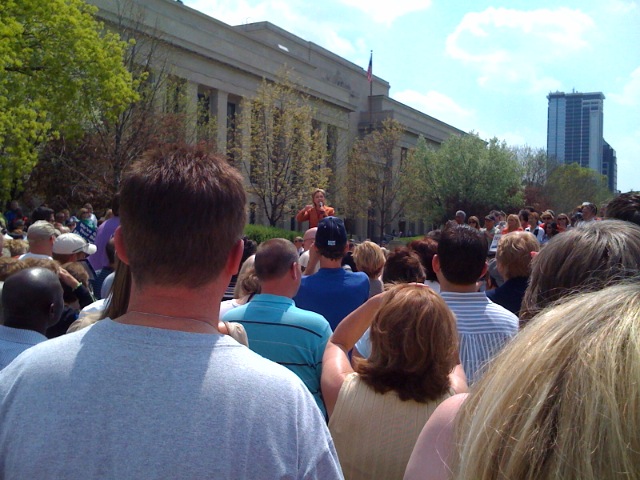
One quick note about the photo (taken on my iPhone). As you can see, I was about 30 feet away from Sen. Clinton, but I was able to move closer as her speech continued. The plaza in which the event took place (American Legion Mall) is part of group a campus of museums, monuments, memorials, and public parks that extends for five blocks in downtown Indianapolis. It is an area of which Indianapolis is, rightly, quite proud. Also, in the distant background of the photo is the building in which I work; it is still being repaired following massive storm damage in August 2006. On the left side of the building is the new curtain wall and on the right is the sheet metal erected in replace the windows and curtain wall that were destroyed in the storm.

Labels:

Bookmark and Share


Tuesday, April 22, 2008

My First Chance to See a Presidential Candidate

Click here to RSVP

Indiana's primary is fast approaching and -- finally! -- I'll have a chance to see one of the presidential candidates speaking here in Indianapolis. Sen. Hillary Clinton is speaking on Wednesday, April 23, 2008 (tomorrow) at Legion Mall. The event is scheduled for 11:00 AM to 2:00 PM (but I have no idea when Sen. Clinton will actually be speaking).

I've been a political junkie for a long, long time, and this will be my first opportunity to see a candidate. In 1984, as a freshman at Northwestern, I had the chance to see Geraldine Ferraro (the Democratic vice presidential candidate) speak. She received what can only be described as one of the most polite rounds of applause in the history of political campaigns. And, as a senior in high school, I had the chance to see President Reagan speak. But this will be my first chance to see a viable candidate speak and I'm looking forward to the experience.

Labels:

Bookmark and Share


Monday, April 21, 2008

What to Believe About John McCain?

Recently, several people have sent me a chain email with the title "10 things you should know about John McCain (but probably don't)". I've seen enough chain emails over the years to recognize that some are legitimate, but far more are, at best, junk, or at worst, more nefarious. So, I decided to check with the source. It appears that the genesis of this email is MoveOn.org. While I agree with some of the positions espoused by MoveOn.org, I have had some concerns about some of the things that have come from that organization. Furthermore, I'm not naive enough to think that, just because a particular political organization says something is true, then that something is, in fact true.

Nevertheless, with those caveats aside, it is worth reprinting the list of things that voters "should know" about John McCain (at least according to MoveOn.org). I'm not reprinting them solely for the purpose of attacking McCain or his supporters; rather, my purpose is to offer McCain's supporters (or the candidate himself?) an opportunity to rebut these allegations and to offer those who may not know much about Sen. McCain an opportunity to learn a bit more. So, if you support Sen. McCain (or the Republican platform), take a minute to review these allegations and let me know if they are accurate or not; but, if you do rebut the allegations, please offer some evidence to support your position (as MoveOn.org has offered citations and link in support of the allegations). (Note that I've modified the original post by moving the citations to immediately follow each allegation.)
  1. John McCain voted against establishing a national holiday in honor of Dr. Martin Luther King, Jr. Now he says his position has “evolved,” yet he’s continued to oppose key civil rights laws. “The Complicated History of John McCain and MLK Day,” ABC News, April 3, 2008; “McCain Facts,” ColorOfChange.org, April 4, 2008.
  2. According to Bloomberg News, McCain is more hawkish than Bush on Iraq, Russia and China. Conservative columnist Pat Buchanan says McCain “will make Cheney look like Gandhi.” “McCain More Hawkish Than Bush on Russia, China, Iraq,” Bloomberg News, March 12, 2008; “Buchanan: John McCain ‘Will Make Cheney Look Like Gandhi,‘” ThinkProgress, February 6, 2008.
  3. His reputation is built on his opposition to torture, but McCain voted against a bill to ban waterboarding, and then applauded President Bush for vetoing that ban. “McCain Sides With Bush On Torture Again, Supports Veto Of Anti-Waterboarding Bill,” ThinkProgress, February 20, 2008.
  4. McCain opposes a woman’s right to choose. He said, “I do not support Roe versus Wade. It should be overturned.” “McCain says Roe v. Wade should be overturned,” MSNBC, February 18, 2007.
  5. The Children’s Defense Fund rated McCain as the worst senator in Congress for children. He voted against the children’s health care bill last year, then defended Bush’s veto of the bill. “2007 Children’s Defense Fund Action Council® Nonpartisan Congressional Scorecard,” February 2008; “McCain: Bush right to veto kids health insurance expansion,” CNN, October 3, 2007.
  6. He’s one of the richest people in a Senate filled with millionaires. The Associated Press reports he and his wife own at least eight homes! Yet McCain says the solution to the housing crisis is for people facing foreclosure to get a “second job” and skip their vacations. “Beer Executive Could Be Next First Lady,” Associated Press, April 3, 2008; “McCain Says Bank Bailout Should End 'Systemic Risk,'” Bloomberg News, March 25, 2008
  7. Many of McCain’s fellow Republican senators say he’s too reckless to be commander in chief. One Republican senator said: “The thought of his being president sends a cold chill down my spine. He’s erratic. He’s hotheaded. He loses his temper and he worries me.” “Will McCain’s Temper Be a Liability?,” Associated Press, February 16, 2008; “Famed McCain temper is tamed,” Boston Globe, January 27, 2008.
  8. McCain talks a lot about taking on special interests, but his campaign manager and top advisers are actually lobbyists. The government watchdog group Public Citizen says McCain has 59 lobbyists raising money for his campaign, more than any of the other presidential candidates. “Black Claims McCain’s Campaign Is Above Lobbyist Influence: ‘I Don’t Know What The Criticism Is,‘” ThinkProgress, April 2, 2008; “McCain’s Lobbyist Friends Rally ‘Round Their Man,” ABC News, January 29, 2008.
  9. McCain has sought closer ties to the extreme religious right in recent years. The pastor McCain calls his “spiritual guide,” Rod Parsley, believes America’s founding mission is to destroy Islam, which he calls a “false religion.” McCain sought the political support of right-wing preacher John Hagee, who believes Hurricane Katrina was God’s punishment for gay rights and called the Catholic Church “the Antichrist” and a “false cult.” “McCain’s Spiritual Guide: Destroy Islam,” Mother Jones Magazine, March 12, 2008; “Will McCain Specifically ‘Repudiate’ Hagee’s Anti-Gay Comments?,” ThinkProgress, March 12, 2008; “McCain ‘Very Honored’ By Support Of Pastor Preaching ‘End-Time Confrontation With Iran,’” ThinkProgress, February 28, 2008.
  10. He positions himself as pro-environment, but he scored a 0—yes, zero—from the League of Conservation Voters last year. “John McCain Gets a Zero Rating for His Environmental Record,” Sierra Club, February 28, 2008.

Only a few of these allegations are, by themselves, of the "disqualifying" variety; however, taken as a whole, these allegations, if true, suggest that John McCain would truly be bad for the United States.

One of my reasons for highlighting these allegations is the concern that has been growing recently following discussions with others about the fall election. Numerous people have said, point blank, that while they want to vote for a Democrat in the fall, if the candidate is Barack Obama, they will vote for McCain, while a similar number of people have said the exact same thing in reference to Hillary Clinton. Perhaps these statements are being made "in the heat of battle" as the Democratic candidates continue to bash each other and Sen. McCain gets a veritable free pass until after the conventions. Or, perhaps, it is simply that people have not really stopped to learn more about John McCain, his positions, and his personality. I hope that's all it is; I sincerely hope that, come the November election, people will consider the candidates on the basis of all of the information and not on snap judgments made during the primary process. But I also hope that those people who say, even though they want a Democrat as President, that they will vote for Sen. McCain instead of Sen. Obama/Sen. Clinton, will take some time now to learn more about Sen. McCain before so glibly making pronouncements about their intent in the general election, especially in the weeks leading up to Indiana's own primary which may help decide who will be the Democratic candidate.

Labels: ,

Bookmark and Share


Friday, April 18, 2008

Problems With Indiana's Primary Voting System

On May 5, 2008 [correction: May 6, 2008], I, along with other citizens of Indiana, will have the chance to go to the polls to vote in our State's primary election. For the first time in a long time, Hoosier votes may actually help decide who the Democratic presidential nominee is. That's good. Unfortunately, another major problem continues to plague Indiana's primary system and my Congressional district (the 5th) is the perfect example.

Indiana supposedly has an "open" primary. On primary election day, a voter can choose whether to vote on a Democratic or Republican (or, I suppose, Libertarian) ballot. The voter tells the poll workers which ballot to load in the voting booth and that ballot determines which candidates may be chosen. It appears that when Indiana says that its primary is "open" what it really means is that from year to year a voter can determine party affiliation for primary voting purposes. But, in fact, the primary is not as "open" as this designation might appear.

Indiana's 5th Congressional district is presently represented (quite badly) by Rep. Dan Burton, who is widely regarded as one of the worst Representatives in Congress. This is the man who shot a pumpkin to see if Hillary Clinton could have murdered Vince Foster and who missed crucial national security votes because he was on a golf junket (in fact, he has missed every Congressional vote between 2001 and 2007 that occurred during the Bob Hope Pro-Am golf tournament in which Burton is a regular participant). Yet, Rep. Burton continues to be elected year after year, in one of the most heavily Republican districts in the country.

So what's the problem? This year presents the perfect example. In November, the Republican nominee will likely win the 5th Congressional district seat with roughly 80% of the vote. I'm not sure if the district is really 80% Republican or if Democrats just don't bother to show up. Nevertheless, because of the huge disparity in party affiliation, the real election takes place in the primary when voters determine which Republic candidate will win ... er ... run in the fall. This year, Rep. Burton is actually confronted by a legitimate challenger. Dr. John McGoff is clearly a conservative Republican and, while I would certainly prefer a Democrat to represent me in Congress, I would also clearly prefer Dr. McGoff to represent me instead of Rep. Burton, if for no other reason than I believe that Dr. McGoff has more integrity than Rep. Burton. However, I can't make that choice. Why not? Because I also want to select between Hillary Clinton and Barack Obama.

When I go into the voting booth, I will have to choose either a Republican ballot or a Democratic ballot; I cannot choose a ballot listing all available candidates for the particular elected office. So, if I want to choose a presidential candidate (and I do want my voice to be heard in selecting either Sen. Obama or Sen. Clinton), then I have to choose a Democratic ballot. But if I choose a Democratic ballot, then my choices for Congress will be limited to the Democratic challengers who will be slaughtered in November. In other words, I have to vote for a sure loser and don't have the opportunity to really select who will represent me in Congress.

Now, some may say that this is fair; after all, shouldn't it be Republicans who choose who will represent them in the fall election? While this sounds right, intuitively, that logic falls short for several reasons. First, let's remember that the State of Indiana, not the parties, are conducting and financing this election. If the parties wanted to set their own rules and determine who could vote, they could do so, but, in such an event, the State should have nothing to do with the election (including paying for it or using State officials). That is not the situation in Indiana.

Moreover, this approach tends to increase the viability of candidates that position themselves to the extremes, rather than those who moderate their views. Why? Simple: A moderate voter, one whose viewpoints are toward the center of the political spectrum, will have to choose which party to register with to vote for that party's candidates, but in so doing, will not be able to choose candidates of the other party who might also appeal to that voter. For example, say that 4 people are running for Congress, a liberal Democrat, a moderate Democrat, a moderate Republican, and a conservative Republican. And, let's say that 4 people are running for Governor (with the same breakdown of positions). Clearly the liberal Democrats will vote for one of the Democratic candidates and the conservative Republicans will vote for one of the Republican candidates. But moderate Democrats and moderate Republicans are stuck. What if the moderate Democrat prefers the moderate Democrat for Congress but the moderate Republican for Governor? That isn't an option. So, in that example, the moderate Republican gubernatorial candidate can't get the support of moderate Democrats (or moderate Republicans who may prefer the moderate Democrat Congressional candidate) and, in this way, the more liberal and conservative candidates are likely to get increased support while the support in the middle is split (or simply not available).

This year, many moderate Republicans in the 5th District may choose to vote in the Democratic primary because they want a Democrat (or don't want John McCain) to be the next President (I know two people who fit this description precisely). Yet those moderate Republicans, many of whom will likely vote for no other Democrats in the fall, will not have their voices heard in the selection of the Republican candidate for Congress who will, in all likelihood, represent them after the November election.

As another concrete example, consider last spring's Mayoral and City Council primary election. I wanted to choose a Democratic candidate for City Council (both for my district and for the at large seats). But I also wanted to vote for the incumbent Republican Mayoral candidate, Jim Brainard. So, I had to decide whether to vote on the Democratic ballot or Republican ballot. I chose the Republican ballot so that I could vote for Mayor Brainand. Even though I usually consider myself a Democrat, I wanted Mayor Brainard to beat the other Republican candidate and the Democratic candidate and, in fact, I voted for Mayor Brainard last fall. But, once again, by choosing the Republican ballot, I was not able to make my voice heard as to which candidates I preferred for the Democratic City Council election.

Voters should choose candidates, not parties.

Another problem with Indiana's approach is that it, essentially, renders many votes totally worthless. As I mentioned previously, this fall, the Republican Congressional nominee will almost certainly win in the 5th District. So, on May 5, I can vote for the Democratic Congressional candidate of my choice, knowing that the chosen candidate has, essentially, no chance of winning in the fall (which is one of the reasons that no viable Democratic candidates seek the office). So what was the value of my vote? By contrast, again as I mentioned before, I would much rather be represented by Dr. McGoff than Rep. Burton (even if I disagree with Dr. McGoff on most of the issues) so, if I had the option, I would likely vote for Dr. McGoff; after all, the Republican primary is, for all intents and purposes, the election.

In areas with vibrant two-party systems, where the outcomes differ from year to year, this issue may be somewhat less important (then again, I can certainly see an argument for the contrary viewpoint). However, in areas like Carmel, where the primary election is almost always determinative of the fall result (why do we even bother to vote in November?), then forcing a voter to pick party affiliation does not truly serve the interests of the candidates, the voters, or democracy.

It seems to me that on primary election day, I should be able to walk into a voting booth without having to tell the election officials, many of whom are my neighbors, which party I am supporting. If I want them to know who I support I can, but it shouldn't be a requirement before I vote. I don't have to tell them who I'm voting for, so why do I have to tell them which party I'm supporting? Then, once in the voting booth, I should be able to choose the candidate that I prefer for each office. If I want a Democratic President, a Republican Congressman, and a Democratic Governor, I should be able to make that choice.

Labels:

Bookmark and Share


Thursday, April 17, 2008

Debate for Indiana's 7th Congressional District

On Thursday, May 1, 2008, just a few days before Indiana's primary, most of the candidates seeking to represent Indiana's 7th Congressional district will participate in a debate at the Jewish Community Center in Indianapolis, Indiana. Full details are included on the event's flyer.

I've been privileged to be involved with the planning and organization of this debate. I look forward to hearing what the candidates have to say (even though I don't live in the 7th Congressional district...). Please join us for the debate if you are able and, if you come, please come with an open mind and any questions that you'd like to hear the candidates address.

Labels:

Bookmark and Share


Wednesday, April 16, 2008

Sorry About the Lack of Substantive Updates

I just realized that I haven't posted any substantive entries in a few weeks. Don't worry; I haven't given up on this whole blogging thing. Between spring break and a lovely bout of bronchitis, I haven't had much time or inclination to tackle serious issues. I'll try to get back on my game soon (which ought to be somewhat easy as we get closer to the Indiana primary).

Bookmark and Share


LibraryThing: "A Gentleman's Game" & "Private Wars"

I have updated my LibraryThing catalog with reviews of A Gentleman's Game [Queen & Country #1] and Private Wars [Queen & Country #2], both by Greg Rucka. What can I say? Being sick in bed for a few days while my family was out of town gave me some time to read.

I'm currently reading World Without End (the sequel to Pillars of the Earth) by Ken Follett.

Labels:

Bookmark and Share


Friday, April 11, 2008

LibraryThing: "Soon I Will Be Invincible" & "The Boy in Striped Pajamas"

I have updated my LibraryThing catalog with reviews of Soon I Will Be Invincible by Austin Grossman and The Boy in the Striped Pajamas by John Boyne.

I'm currently reading A Gentleman's Game [Queen & Country #1] by Greg Rucka.

Labels:

Bookmark and Share


Padawan Lily vs Darth Vader

I'm back from vacation (well, at least in body, if not in spirit, quit yet), hence the lack of updates over the last 10 days or so. Anyway, one quick item from vacation as my 8-year-old daughter became a Padawan (a Jedi apprentice for those of you not "in the know" on these things) and faced down Darth Vader. That's her in the "pink helmet" being encouraged by her Jedi Master.

Labels:

Bookmark and Share


Wednesday, April 2, 2008

Indiana Limits Freedom of Speech Where the Content Might Be Harmful to Minors (update 2)

Last week, I wrote about Indiana's idiotic new law that requires new businesses to register with the Indiana Secretary of State before selling "sexually explicit materials" (and query why the law only applies to new businesses and not all businesses...). In that initial post, I elected to focus primarily on the freedom of speech and censorship concerns raised by the statute. Over the weekend, I was discussing the statute with some friends and realized that the statute was actually even more problematic than I had realized.

When I wrote initially, I elected to ignore § 24-4-16.4-2(a)(2). To the extent my purpose was to analyze the freedom of speech and censorship concerns, then that decision was correct. However, failing to consider the implications of (a)(2) means that I ignored a whole host of other problems with the statute and vast numbers of other types of businesses that will be required to register before selling "sexually explicit material".

First, let's take another look at the part of the definition of "sexually explicit material" contained in (a)(2):

(2) that is designed for use in, marketed primarily for, or provides for:
(A) the stimulation of the human genital organs; or
(B) masochism or a masochistic experience, sadism or a sadistic experience, sexual bondage, or sexual domination.
The problem is the use of the disjunctive "or" in the introductory provision of (a)(2). If the word "and" had been used, then the definition would have been much more narrowly tailored and would have only applied to products or services that, essentially, exist solely for the purpose of sexual gratification. Whether it is wise to require purveyors of such merchandise to register with the state is a question for another day. Instead, let's consider what the use of the word "or" really means for the definition of "sexually explicit material".

Consider, for a moment, a piece of rope. Clearly, rope is not designed for use in or marketed primarily for any of the types of conduct described in (A) or (B). But, ask yourself whether that piece of rope "provides for" any of that type of conduct? While I'm certainly no expert on the subject, in popular culture depictions of bondage, rope is a key ingredient. So, if rope can provide for sexual bondage, then rope is a "sexually explicit material" and a business selling rope must register. Thus, it would appear that virtually every new hardware store and home supply store must register under the statute.

Next, consider some of the little massage aids sold at stores like Brookstone or The Sharper Image. While they may not be marketed "primarily for" the uses described in (A) and (B), it is at least arguable that they were "designed for use in" and can clearly "provide for" stimulation of human genital organs. (Don't believe me? Take a look at the SoftTouch Acuvibe Body Massager available at Brookstone.) Thus, Brookstone, The Sharper Image, and many sporting goods stores will need to register.

How about toy handcuffs? I guess that will pick up Toys 'R' Us and other toy stores. What about a whip? So much for businesses catering to equestrians (and probably costume shops, too). Fraternities and sororities may have to look for another vendor from which to buy their paddles (do fraternities and sororities still use paddles?) And I hate to even think about all of the jewelers who will have to register because of some of the places that their ... um ... er ... earrings (?) can be hung (is that the correct verb?). And I've seen enough bad jokes in movies to know what cucumbers and bananas can be used for... So I guess grocers need to register too (of course, if they sell KY or maybe even Vaseline, then they were probably registering already, right?).

In fact, it would appear that (B) may even interfere with religious liberty issues; after all, as I understand it, in some religious sects various types of self-mortification and masochism are essential (or at least optional) demonstrations of faith. So, for example, a religious supply store that sold something that the faithful might use in a masochistic way (at least in the eyes of a prosecutor) would have to register.

When it comes right down to it, it is not hard to imagine how virtually any object could "provide for" stimulation or a sado-masochistic/bondage experience. Thus, it is hard to see how any new store could get away with not registering under this statute.

I know, I know, none of this is what the General Assembly meant. Yet, don't you think, when it comes to something as important as, perhaps, the law, the legislature could get it right and say precisely what they mean? Why adopt a statute that will snare the unintended or invite constitutional scrutiny and litigation? Why not examine the issue carefully and work to craft appropriate and narrowly tailored litigation that serves to target the perceived problem and nothing else?

Again, if the word "or" had been replaced by "and" then the scope of the products and services falling within the bounds of the law would be much more narrow. But, as so often happens in the Indiana General Assembly, haste and a desire to "protect" the public has led to the adoption of a poorly thought out, unconstitutional statute that may cause many legitimate businesses concerns but which will probably have little, if any, impact, with regard to stopping the "problem" that the statute sought to address; after all, the business selling "adult" products usually advertise that quite prominently, so will likely not be deterred from having to register. Heck, they may even view the registration as a badge of honor: "Look here: The State of Indiana recognizes that we sell sexually explicit materials! Come check out our new selection of ___ [insert your favorite sexually explicit product here]!" So innocent and honest booksellers and toy stores and hardware vendors worry about running afoul of the law while "adult" stores will happily pay the $250 and start selling their products. What a wonderful world.

Labels:

Bookmark and Share


Tuesday, April 1, 2008

LibraryThing: "The Book of Fate" and "Old Man's War"

I have updated my LibraryThing catalog with reviews of The Book of Fate by Brad Meltzer and Old Man's War by John Scalzi.

I'm now reading Soon I Will Be Invincible by Austin Grossman. The book came highly recommended...

Labels:

Bookmark and Share


Thursday, March 27, 2008

Indiana Limits Freedom of Speech Where the Content Might Be Harmful to Minors (update)

Yesterday, I posted the essay "Indiana Limits Freedom of Speech Where the Content Might Be Harmful to Minors". Apparently, I am not the only one with concerns about the new law requiring business to register with the state if they will sell "sexually explicit" materials. In today's The Indianapolis Star there are not one, but two editorials voicing concern and opposition to this new law.

First, on the main editorial page, the editorial staff of The Indianapolis Star offers the opinion "Bad law for a good cause invites volumes of worry" (although it should be noted that I used the example of the Sports Illustrated swimsuit edition in my blog yesterday...). The editorial makes several good points, one of which is worth repeating:
[B]usiness people who wish to avoid trouble may feel pressured to pay their $250 and sign up, in effect incurring a fine and a public black mark for purveying words and pictures.

That's censorship. It's also the sort of feel-good governance the elected class can't seem to resist or dares not oppose in the face of public distress over morals and commercial blight.

Also of interest in the editorial was the statement from Governor Daniels' spokesperson:
The spokesperson for Gov. Mitch Daniels says he signed the bill because it
sailed through both chambers of the legislature and he wasn't aware of any
complaints, even though booksellers say they asked him for a veto.

So, as I read that explanation, Gov. Daniels doesn't bother to think independently about a bill before he signs it into law; if it passed the General Assembly by a wide margin, it must be a good law. I think that we should expect our Governor to bring some independent thought and critical analysis to any action that he takes, especially something as important as signing a bill into law.

In addition to the editorial from the editorial staff, columnist John Ketzenberger also wrote about the new law in the Business section in "'Adult' law is too broad to be workable". The point to take away from this editorial is the idea that the State doesn't intend to actively enforce the law.

The problem, however, as I read the law, is that it is not up to the Secretary of State to decide who to prosecute; rather, that would be up to a county prosecutor. Moreover, prosecution is not triggered by the act of registration with the Secretary of State, but rather, the act of selling "sexually explicit" materials without having registered. Thus, if a zealous, conservative prosecutor (or a zealously conservative prosecutor or, perhaps, even a zealous liberal prosecutor) were to walk into a new bookstore or grocery store and see a copy of the Sports Illustrated swimsuit edition (let alone something more "scandalous" like, say Playboy), then that prosecutor could commence an action against the seller of that material for failing to register (a Class B misdemeanor). The prosecutor should know who is registered because the law requires the Secretary of State to notify the county of registrants in that county. In other words, this becomes just another crime on the books that may or may not be enforced from county to county (and which, don't forget, may be interpreted differently from county to county, as well, on the basis of differing community standards).

So, in essence, we have an unconstitutional law targeting a narrow problem that snares an overly broad class of businesses that may or may not be enforced and which the Governor signed into law simply because it "sailed" through the General Assembly. Government at its finest, no?

Labels: ,

Bookmark and Share


Wednesday, March 26, 2008

Indiana Limits Freedom of Speech Where the Content Might Be Harmful to Minors

I'm not quite sure how I missed it during the recently completed legislative session, but the Indiana General Assembly adopted, and the Governor signed into law, a bill that is a direct affront to the Constitutional protections of freedom of speech and of the press. I first became aware of House Enrolled Act 1042 in the article "Booksellers incensed over sexual content law" by Tim Evans in today's The Indianapolis Star. The new law requires anyone who "intends to offer for sale or sell sexually explicit materials [to] register with the secretary of state the intent to offer for sale or sell sexually explicit materials and provide a statement detailing the types of materials that the person intends to offer for sale or sell." Indiana Code § 23-1-55-2. After registration, the Secretary of State must notify the appropriate officials in the county where the business is located. At the time of registration, the registrant must pay a $250 fee. (It is interesting to note that this fee is three times greater than any other fee to be collected by the Secretary of State under pursuant to Indiana Code § 23-18-12-3.)

So what exactly is "sexually explicit material"? House Enrolled Act 1042 also addresses that with the the addition to the Indiana Code of § 24-4-16.4-2 which provides:

(a) As used in this chapter, "sexually explicit materials" means a product or service:

  (1) that is harmful to minors (as described in IC 35-49-2-2), even if the product or service is not intended to be used by or offered to a minor; or

  (2) that is designed for use in, marketed primarily for, or provides for:

    (A) the stimulation of the human genital organs; or

    (B) masochism or a masochistic experience, sadism or a sadistic experience, sexual bondage, or sexual domination.

(b) The term does not include:

  (1) birth control or contraceptive devices; or

  (2) services, programs, products, or materials provided by a:

    (A) communications service provider (as defined in IC 8-1-32.6-3);

    (B) physician;or

    (C) public or nonpublic school.

For the sake of argument (and to limit the scope of this discussion), I'll ignore (a)(2) for the moment, although I'm not sure why the government really cares what people want to do in the privacy of their own homes (and query, whether a person selling this time of material over the Internet must register...). Instead, I'll limit the discussion to (a)(1) and products or services that are "harmful to minors ... even if the product or service is not intended to be used by or offered to a minor".

So what does Indiana Code § 35-49-2-2 says is "harmful to minors"?

A matter or performance is harmful to minors for purposes of this article if:
(1) it describes or represents, in any form, nudity, sexual conduct, sexual excitement, or sado-masochistic abuse;
(2) considered as a whole, it appeals to the prurient interest in sex of minors;
(3) it is patently offensive to prevailing standards in the adult community as a whole with respect to what is suitable matter for or performance before minors; and
(4) considered as a whole, it lacks serious literary, artistic, political, or scientific value for minors.

Please understand that I'm not suggesting that any of the foregoing is good for minors; however, I am a bit troubled by the government -- rather than parents -- deciding that these matters are harmful to minors. Moreover, I can think of many other matters or performances that are far more harmful to minors, such as depictions of drug or alcohol use, violence, racism, sexism, xenophobia, and other similar things. Just consider for a moment that the State of Indiana is worried about minors seeing nudity (unless it has "serious" artistic merit...and query who, precisely, makes that decision) but does not say anything about minors seeing examples of drug and alcohol use throughout popular culture, not to mention the extreme violence that permeates the media (forget about Die Hard or Saw; just watch an episode of Tom & Jerry!). Watch a hip hop video on MTV or an episode of CSI or listen to some of the proponents of the recently defeated immigration legislation to see examples of things that are far more harmful to minors than depictions of sex. And has anyone every met a teenager (still a minor) who did not have a prurient interest in sex? Even sex education classes cause many a whisper and giggle, and the American Pie movies didn't make tons of money because of their metaphysical observations on the human condition.

I'm also troubled by the reliance upon "prevailing standards in the adult community" as a touchstone for determining what is harmful to minors. What troubles one adult may not trouble another adult. And why should material that is acceptable to minors in some places be unsuitable for a minor in another place? Just witness the recent attempt to adopt a "wholesomeness" ordinance in Carmel (where I live) because some uptight women were offended by the window displays at Victoria's Secret. Should my access to literature have any basis on what those women view as "decent"?

Unfortunately, this is a discussion for another day. The point of reflecting on what is "harmful to minors" is to see how that relates back into the new registration requirement. Recall that the definition of "sexually explicit materials" means products or services that are "harmful to minors ... even if the product or service is not intended to be used by or offered to a minor" (emphasis added). In other words, if material might be harmful to a minor, even if not is not offered or sold to minors, the person offering that material must register with the State of Indiana.

Consider a few examples:

  • A book store that sells bestsellers (which most of the literary elite would probably say do not contain serious literary merit) which portray sexual acts (how many romance novels don't portray sexual acts) must register before it can sell those books; as one bookseller quoted in The Indianapolis Star article noted: "the law could potentially cover 'just about any coming-of-age novel and books on health, hygiene and human sexuality'".
  • A movie theater that plays R-rated movies that contain nudity might have to register, even though minors cannot attend those films (without a parent).
  • A video store that rents or sells many PG-13 (let alone R or NC-17) films would have to register (just think about many "teen comedies" like Porky's or American Pie); recall, that it doesn't matter whether the movies will be sold to minors or not, only that they are available.
  • A marital counselor who sells books to her adult, married clients regarding sexual techniques and positions, might have to register before she could sell those materials.
  • Have you ever walked into a Spencer's Gifts store in the mall?
  • What about the Sports Illustrated swimsuit edition? After all, it certainly "describes or represents" nudity and sexual excitement.
  • A liquor store (into which a minor may not enter) must register before it can sell Playboy.

Is that what we really want? Is that right? I understand the idea of requiring the local "adult" book store or the business that provides lingerie "shows" to undergo some kind of regulation, but most communities use zoning laws for that sort of regulation. And, while it appears that those are the types of businesses that this law is aimed at, it uses a shotgun approach that targets far too wide and captures far too many business and far too much content and material.

And now we finally come to the real problem with the law: It is unconstitutional. It is worth looking at the often-ignored Indiana Constitution, not just the United States Constitution.

No law shall be passed, restraining the free interchange of thought and opinion, or restricting the right to speak, write, or print, freely, on any subject whatever: but for the abuse of that right, every person shall be responsible. (Indiana Constitution Article 1, Section 9)

and

Congress shall make no law ... abridging the freedom of speech, or of the press .... (United States Constitution, Amendment I)

Yet this new law will do precisely what those provisions seek to prevent. It will restrain the free interchange of thought and opinion because it will require businesses to self-censor to avoid being tagged as purveyors of sexually explicit material. Moreover, it will require business to pay a fee to the state solely on the basis of the content of material that may be legally sold. How many people might refuse to shop at a bookstore or video rental store that is known to sell "sexually explicit materials"? And what if a local government decides to enact zoning regulations that prohibit business that sell sexually explicit materials. Just imagine a community with no bookstores or theaters because some material might be harmful to minors in the opinion of some adults in the community.

Why is it that we as a society are so worried about our children being exposed to sex, but we don't seem to have a problem exposing them to violence. We are reluctant to let them to hear one of George Carlin's "seven dirty words", but we don't have a problem letting them hear hate speech from their religious leaders. We don't want them to learn how to practice safe sex (and I don't mean just abstinence), but we don't have a problem teaching scientifically inaccurate material if it will prevent sex. We don't want them to drink, but we don't mind letting them see beer commercials everywhere they look. We don't want them to have sex, but we don't mind when American Idol or Monday Night Football is interrupted with advertisements for Viagra, Cialis, and their ilk (and have you tried to explain to an 8-year-old what erectile dysfunction is?). We don't want the government to trample on our rights, but we don't mind asking the government to trample on the rights of "others".  We don't want our children to be exposed to "sexually explicit materials", but we are loathe to pass laws that will be effective in keeping those children away from guns. We want our children to learn to think for themselves, so long as they think the right things...

Let's keep the government out of deciding what kind of books and movies and magazines can be sold. Let's not start down the slippery slope of censorship, whether by government, community, or self-censorship to avoid governmental regulation. Let's not force booksellers and video rental stores and other businesses to register with the government on the basis of content that is protected by the Indiana and United States Constitutions.

I understand that many people disapprove of obscenity and pornography; that's fine. But in a state and nation with protections for freedom of speech, press, and expression, the disapproval of some should not be the basis for the government to limit what content others may have access to. There is (probably) nothing wrong with limiting materials that is available to minors (especially if the parents have access to that material to share with their children at the parents' discretion), but it is absolutely wrong to limit an adult's access to that material on the basis of whether that material might be "harmful to minors", especially when that limitation is based solely on sexual content and completely ignores the other societal matters that are far more harmful both to minors and adults (guns and drugs, for example).

Ask your elected representatives to honor the concepts of freedom of speech and freedom of the press; ask them to step back from government censorship; ask them to repeal this law next session.

Labels: ,

Bookmark and Share


Wednesday, March 19, 2008

Obama Talks Race

Yesterday, Sen. Barack Obama gave a much talked about speech on race in America. So far, I haven't had a chance to hear the entire speech, just fairly extensive sound bytes (of the NPR variety, not the TV news variety). From what I've heard, Sen. Obama rejected some of the comments from his Pastor, but did not reject the man himself. Sen. Obama also talked about some of the concerns that are raised in the African American community and recognized some of the concerns still held in the white community.

So here are the questions:
  1. Will Sen. Obama's open discussion of African American concerns combined with criticism of the more extreme statements of Rev. Wrigbht satisfy the white community or will the public airing of those concerns push whites away from Obama's candidacy?
  2. Will Sen. Obama's discussion of white concerns help draw new white supporters to his candidacy or will discussion of those concerns seem like pandering and push more whites away?

What do you think?

Incidentally, I found the entire text of Sen. Obama's speech at The Huffington Post.

Labels: ,

Bookmark and Share


More on President Bush's Interference With EPA Ozone Regulations

Several days ago, in my post "Recap of Interesting News Items" I discussed President Bush's meddling with EPA regulations concerning ozone emissions. Reader John Walke, the Clean Air Director/Senior Attorney for the Natural Resources Defense Council posted a comment in which he mentions his own blog article "Science Decider in Chief". It appears from reading Mr. Walke's post that the newspaper story from which I got my information barely scratched the surface of the actions and issues.

Please take a few moments to read Mr. Walke's thoughts on the subject. Then, if you believe that President Bush's actions were inappropriate, take a few minutes and call your Congressman and tell them what you think.

Labels: ,

Bookmark and Share


Tuesday, March 18, 2008

Senator Lugar's Thoughts on FISA

A month or three ago, I contacted my Senators (Sen. Evan Bayh [D] and Sen. Richard Lugar [R]) to tell them that I was troubled by the insistence of the Bush administration in including retroactive immunity to the telecommunications industry in the reauthorization and amendment of anti-terrorist legislation. (I previously discussed this issue in "If We Scare People Enough, Maybe They'll Be Willing to Sacrifice the Bill of Rights"). When I spoke to the staffers for my Senators, I explained that I thought that discussion of retroactive immunity should be considered separately from legislation that was designed to keep America safe.

Yesterday, I received a response from Sen. Lugar:
Thank you for contacting me to share your thoughts about the Protect America Act of 2007 and reform of the Foreign Intelligence Surveillance Act of 1978 (FISA).

On August 5, 2007, President Bush signed into law the Protect America Act of 2007. This Act provided the Director of National Intelligence, for six months, increased authority to monitor communications of foreign terrorist targets. Congress is working to find consensus on a way to move forward with a possible long-term extension. Retroactive immunity for certain telecommunications providers and privacy issues will be an important part of these discussions. I will continue to closely follow consideration of this matter with your concerns in mind.

Protecting American citizens from harm is the federal government's most important responsibility. As a United States Senator, I take that responsibility very seriously. I believe we can wage a successful war on terrorism without sacrificing the liberties bestowed upon us by the Founders.

Thank you, again, for contacting me.

It is worth noting that on February 12, 2008, both Sen. Lugar and Sen. Bayh voted against a proposed amendment that would have stripped the retroactive immunity provisions from the FISA Amendments Act of 2007. No Republicans voted for the amendment and Sen. Bayh was one of 18 Democrats who voted against the amendment.

Now that the House of Representatives has passed legislation without the immunity provisions, it will be interesting to see how my Senators vote on this issue in the future.

Labels: ,

Bookmark and Share


Supreme Court Hears 2nd Amendment Case

Today the United States Supreme Court will hear oral arguments in a case that goes to the heart of the 2nd Amendment to the United States Constitution. The essential issue before the Court is whether the 2nd Amendment provides an individual the right to keep and bear arms and whether the government (in this case, the city of Washington D.C.) can severely restrict the type of arms (i.e. handguns) that can be owned by citizens.

I have my own thoughts on the 2nd Amendment and gun control legislation (see if you can guess where I stand...) and I could probably write fairly extensively on those thoughts. Instead, I wanted to post just a few brief (well, brief-ish) notes about the issues.

Obviously, before any opinion can be reached, the key starting point must be the text of the Constitution itself. Sadly, far too many people think that they know what various provisions of the Constitution say without actually reading the full language. So here is the 2nd Amendment to the United States Constitution (all 27 words):
A well regulated militia, being necessary to the security of a free state, the right of the people to keep and bear arms, shall not be infringed.

So what exactly does the 2nd Amendment mean? That is the issue before the U.S. Supreme Court today.

All too often, when people talk or think about the 2nd Amendment, they quote the second clause of the Amendment without regard to the first clause. However, ignoring the first clause is a flawed way of reading the text of the Amendment; after all, if the first clause has no meaning, then why was it included? It is instructive to note that of the Bill of Rights, only the 2nd Amendment includes a preamble or explanatory language; all of the other Amendments in the Bill of Rights simply enumerate what laws cannot be passed or rights cannot be infringed. Thus, the first clause of the 2nd Amendment must mean something.

And if the first clause does not mean anything, then what precisely does the second clause itself really mean? After all, it says that the right "to keep and bear arms, shall not be infringed". Does that mean that laws prohibiting assault rifles (machine guns) are unconstitutional? Does that mean that laws prohibiting convicted felons from owning guns are unconstitutional? Does that mean that laws limiting access to high explosives are unconstitutional? Does that mean that laws prohibiting carrying a gun into a school are unconstitutional? Do we really want a society where people walk around "packing heat"?

I think that it is also worth thinking about the 2nd Amendment with some degree of temporal context that is not as relevant for other provisions of the Constitution. For example, speech is speech and religion is religion, whether in 1791 or 2008. But the weapons of 2008 bear little resemblance to the weapons with which the Founding Fathers were familiar. Do you think that George Washington or Thomas Jefferson could even contemplate an automatic pistol that holds 18 armor-piercing bullets with a rate of fire of 25 rounds per minute and an effective range in excess of 100 feet, let alone an AK-47 , Uzi, MAC-10, night-vision scope, laser targeting, rocket propelled grenade, or Stinger anti-aircraft missile? Compare today's guns to those available when the 2nd Amendment was written, when a soldier had to manually load each round into his gun (don't forget about adding black powder) and then shoot a small round lead bullet (that certainly wasn't going to penetrate Kevlar body armor) for a fairly short distance without too much accuracy. In other words, the world has changed and the 2nd Amendment has not. It is also worth noting that the meaning of "cruel and unusual punishments" has changed with time (no more drawing and quartering, hanging, or beheading), so why shouldn't the meaning of "keep and bear arms" change with the times, as well?

There really appear to be two things driving much of the anti-gun control rhetoric (other than blind allegiance to the 2nd Amendment): protection from criminals and protection from government. I want to address these (briefly) in reverse order.

Some people have argued that the government should not "take away" their guns because then the government could "take over" (this appears to be one of those black helicopter/new world order sort of fears). First, does anyone really believe that our government (which, let's face it, can barely manage to keep the government semi-functional) really intends some kind of coup to destroy "freedom" (although I might argue that the Bush administration, with programs like warrantless wiretapping and imprisonment of American citizens as "enemy combatants" does have some eerie similarities to some of these fears)? And, assuming for a moment that such a plan was in the works, does anyone really believe that individual gun owners will be able to stop M1 tanks, F-18s, Blackhawk helicopters, nuclear submarines and aircraft carriers, Predator drones, and soldiers as well-trained and well-equipped as ours?

As to public safety and the right of people to defend themselves in their homes, the right to have a weapon does seem like a good idea. We've all heard the refrain that if the government takes away our guns, only criminals will have guns. But, the last time I checked, the police had guns too. Moreover, if we put an end to the availability of guns (even just handguns, I suppose), then, after a time, it will become more and more difficult for criminals to get those guns. Just look at how little criminal gun violence exists in other developed countries that do have stricter gun control laws. And don't forget the number of children who die each year playing with the guns that their parents purchased to protect their home. The guns may have protected the homes from burglars, but they certainly did not protect the families from innocent and curious children.

Personally, I think that tighter government regulation of guns (together with efforts to get handguns out of the hands of criminals) will do far more to protect me and my family than would owning a handgun myself.

Well, those are just a few of my thoughts on the subject. Now, it all appears to be in the hands of the Supreme Court. Unfortunately, I don't have high expectations.

For some additional information, please see "High Court Starts Case Challenging D.C. Gun Ban" by Nina Totenberg (NPR's legal affairs reporter).

Labels: ,

Bookmark and Share


Newer›  ‹Older