Friday, February 1, 2013

Just How Paranoid Are Some Indiana Legislators? Beware the Agenda 21 Boogeyman!

There have always been conspiracy theories and there have always been those who believe in them. But it seems that during Democratic presidential administrations, the penchant for belief in conspiracy theories grows exponentially. When you add in the Internet and cable television, the ease with which these conspiracy theories are transmitted means that many, many more people are exposed to them. Add to that certain high profile conspiracy mongers (most notably Glenn Beck) and the likelihood that these conspiracy theories become mainstream or accepted as “truth” becomes almost assured. When elected officials or legitimate, mainstream candidates voice these conspiracies, we’ve entered into a new, facts-free, world of danger because legislation based on conspiracy, rather than truth, evidence, and logic, is not legislation that will really be in the best interests of … well, anybody.

Which brings me to Agenda 21.

I’m sure that you’ve heard of Agenda 21 by now. Right? It’s almost impossible to listen to anything coming from the Tea Party or the far right without hearing about Agenda 21. It has become the “New World Order” or “black helicopter” conspiracy of the 21st Century (which, by the way, is what the 21 stands for…). Here are just a few examples of how conspiracy-minded people on the right talk about Agenda 21:

According to TeaParty911:

If you were to hear that in the very near future the United States will have no privately owned property, no air conditioning, no dams, no paved roads, no way to correct rivers for flood control, no golf courses, no pastureland used for grazing, would you believe it?

These are all mandates of a United Nations program called Agenda 21 which was born in Rio de Janeiro in 1992. All delegates watched as four men, holding poles attached to an “Ark of Hope” which contained this Agenda 21 document! Within its pages are a substantial attack on the American Declaration of Independence and our Constitution. The primary target for the changes proposed in 1992 is the United States of America. 

From Morphcity:

It is the blueprint for depopulation and total control, under the banner of saving the environment.  It is like the head of a beast that has thousands of tentacles, originating from the United Nations.

From Freedom Advocates:

It is about controlling the natural resources. If the resources are controlled, the people are controlled. The screws are already tightening on us. Does it make any sense that we must use poisonous, difficult to dispose of, fluorescent lighting in kitchens now? These things should be a personal choice. No doubt in time the use of all natural resources will be highly regulated.

Of course, as in the old Soviet Union, not everyone will be required to live the peasant lifestyle. Those who play along will be rewarded. But the reward will only be a temporary one. It comes down to “the end justifies the means”. The “useful idiots” will be in for a big surprise when they realize the noose they helped to tie will be placed around their own necks.

Maybe you’d prefer the John Birch Society (sorry, I refuse to provide a link to this organization):

Basically it’s the UN’s plan to establish control over all human activity, including man’s reputed contribution to climate change. The UN is at the hub of a global network working to submerge the independence of all nations in a world government controlled by the elites, and JBS calls for the U.S. to get out of the U.N.

And who can forget Glenn Beck? He has made the Agenda 21 conspiracy a prime focus of his shows, to the point of even writing a novel positing what will happen after the implementation of Agenda 21. Here’s how Amazon describes the book:

Just a generation ago, this place was called America. Now, after the worldwide implementation of a UN-led program called Agenda 21, it’s simply known as “the Republic.” There is no president. No Congress. No Supreme Court. No freedom.

There are only the Authorities.

Citizens have two primary goals in the new Republic: to create clean energy and to create new human life. Those who cannot do either are of no use to society. This bleak and barren existence is all that eighteen-year-old Emmeline has ever known. She dutifully walks her energy board daily and accepts all male pairings assigned to her by the Authorities. Like most citizens, she keeps her head down and her eyes closed.

Until the day they come for her mother.

“You save what you think you’re going to lose.”

Woken up to the harsh reality of her life and her family’s future inside the Republic, Emmeline begins to search for the truth. Why are all citizens confined to ubiquitous concrete living spaces? Why are Compounds guarded by Gatekeepers who track all movements? Why are food, water and energy rationed so strictly? And, most important, why are babies taken from their mothers at birth? As Emmeline begins to understand the true objectives of Agenda 21 she realizes that she is up against far more than she ever thought. With the Authorities closing in, and nowhere to run, Emmeline embarks on an audacious plan to save her family and expose the Republic — but is she already too late?

Read some of the reviews of the book by Beck’s acolytes or fans and you’ll see a frightening tendency for them to blur the understanding of fact and speculative fiction and to thank Beck for warning them about the evils and horrors of Agenda 21.

Does that give you an idea of how some people view Agenda 21. And, before I go any further, are you inclined to believe those hyperbolic, paranoid descriptions? Good. Because I think that writer Lloyd Alter got it just right when he described Agenda 21 as the “Tea Party Theory of Everything”. The description from the Southern Poverty Law Center’s Spring 2012 Intelligence Report also puts the Agenda 21 conspiracy into appropriate context:

In the last several years, an obscure United Nations accord called Agenda 21 has emerged as something of a unified field theory for the antigovernment movement. On its face, Agenda 21 does nothing but provide countries and communities with a set of principles to grow smartly — a plan, in short, to fight overpopulation, pollution, poverty and resource depletion.

But for a far-flung network of antigovernment extremists who have risen up to attack it, the nonbinding document that was approved 20 years ago at the UN’s Earth Summit in Rio de Janeiro is not really about preserving the planet at all. Between the lines, they argue, lies a blueprint for the “New World Order.”

…

For a growing cast of far-right hardliners, Agenda 21 is a sort of Trojan horse, a totalitarian scheme with a green environmental mask, lying in wait to destroy America as we know it.

How such an arcane UN document that defines the concept of “smart growth” and environmental sustainability became so controversial, even though it gives the UN no enforcement powers, has a lot to do with the work of a tight cadre of antigovernment “Patriot” activists whose fears are rooted in right-wing lore about a New World Order, a kind of authoritarian one-world government. Figures such as Tom DeWeese, head of the American Policy Center, Phyllis Schlafly, founder of the anti-feminist Eagle Forum, and John Bush, with Texans for Accountable Government, have in recent years crisscrossed the country to put on seminars and conferences that strike terror into those inclined to believe conspiracy theories about powerful global elites plotting to install a socialistic global government. The John Birch Society, an archconservative group formed during the Red Scare of the 1950s, regularly assails Agenda 21 with the fervor it once reserved for communists.

Under Agenda 21, these activists argue, the expansive American way of life, in which everyone can aspire to the dream of owning a house with a big yard and two cars in the driveway, will be replaced by one in which increasing numbers are crammed into urbanized “pack ’em and stack ’em” apartment complexes, and forced to use mass transportation and live according to a collectivist ethos. Once the UN’s radical utopia is achieved, gun ownership will be forbidden and the UN will raise an army intent on terrorizing the populace in the name of social order and equality, sustainability and smart growth — all words that anti-Agenda 21 activists believe signal the true intent of the UN’s plan.

(For those who are unfamiliar with the Southern Poverty Law Center — and I encourage you to become familiar with the group — it is a nonprofit civil rights organization dedicated to fighting hate and bigotry, and to seeking justice for the most vulnerable members of society. The group keeps tabs on hate groups, including white supremacists, survivalists, and other similar organizations.)

So, who do you want to believe, Glenn Beck, the John Birch Society, and Tea Party 911 — or the Southern Poverty Law Center?

If you’re interested, why not do what most of those who are so terribly afraid of Agenda 21 probably have not done: Go read it yourself. The entire Agenda 21 document is available online (and has been for a long time). As you’ll see, it has a lot of feel good language about making the world a better place, providing for sustainable development, and for helping developing nations develop without trashing the planet in the process. And please remember that Agenda 21 was signed by that known ultra-liberal treehugger George H.W. Bush. Let me just point you to one important statement from the Introduction to Agenda 21 (emphasis added):

The agreements, which were negotiated over two and half years leading up to the Summit and finalized in Rio, are presented here in final form. While they lack the force of international law, the adoption of the texts carries with it a strong moral obligation to ensure their full implementation.

Yet the paranoid fear-mongers are obsessing over the power of Agenda 21 and the United Nations to curtail American constitutional freedoms. Never mind that Agenda 21 doesn’t even have the force of international law, for even if it did, no treaty can trump our Constitution. Yes, we can enter into treaties which have the force of law (after ratification by the Senate), but those treaties can never reduce the rights protected by the Constitution. The Supreme Court has held that on several occasions, yet the far right paranoid fringe always seems to forget this salient point (just look at the refusal of Republican senators to vote to ratify a UN treaty on people with disabilities or the fear that a UN treaty to reduce international gun trafficking would allow the UN to take guns away from Americans). But at least in those cases, we were talking about treaties that would have the force of international law. Agenda 21 doesn’t even rise to that level.

And please don’t think that this fear of Agenda 21 is limited to the far right doomsday preppers living in their fallout shelters. In 2010, Dan Maes, the Republican candidate for Governor in Colorado, cited Agenda 21 as the reason for his opposition to a plan for Denver to make rental bikes available throughout the city.

Republican gubernatorial candidate Dan Maes is warning voters that Denver Mayor John Hickenlooper’s policies, particularly his efforts to boost bike riding, are “converting Denver into a United Nations community.”

“This is all very well-disguised, but it will be exposed,” Maes told about 50 supporters who showed up at a campaign rally last week in Centennial.

Maes said in a later interview that he once thought the mayor’s efforts to promote cycling and other environmental initiatives were harmless and well-meaning. Now he realizes “that’s exactly the attitude they want you to have.”

“This is bigger than it looks like on the surface, and it could threaten our personal freedoms,” Maes said.

He added: “These aren't just warm, fuzzy ideas from the mayor. These are very specific strategies that are dictated to us by this United Nations program that mayors have signed on to.”

Believe it or not, opposition to and fear of Agenda 21 isn’t limited to candidates for state office. Nope. Here is a paragraph from “We Believe in America: Republican Platform 2012” (page 45; emphasis added):

Under our Constitution, treaties become the law of the land. So it is all the more important that the Congress — the Senate through its ratifying power and the House through its appropriating power — shall reject agreements whose long-range impact on the American family is ominous or unclear. These include the U.N. Convention on Women’s Rights, the Convention on the Rights of the Child, the Convention on the Rights of Persons with Disabilities, and the U.N. Arms Trade Treaty as well as the various declarations from the U.N. Conference on Environment and Development. Because of our concern for American sovereignty, domestic management of our fisheries, and our country’s long-term energy needs, we have deep reservations about the regulatory, legal, and tax regimes inherent in the Law of the Sea Treaty and congratulate Senate Republicans for blocking its ratification. We strongly reject the U.N. Agenda 21 as erosive of American sovereignty, and we oppose any form of U.N. Global Tax. We oppose any diplomatic efforts that could result in giving the United Nations unprecedented control over the Internet. International regulatory control over the open and free Internet would have disastrous consequences for the United States and the world.

Which brings me to Indiana and Senate Bill 134 introduced by Sen. Dennis Kruse (yes, the same Indiana Senator who wants children to recite The Lord’s Prayer and require federal law enforcement officials to get the consent of country sheriffs before making arrests for federal crimes):

Chapter 4.5. Prohibition Against Implementation of United Nations' Agenda 21 Policies
    Sec. 1. As used in this chapter, “Agenda 21” refers to the policy recommendations originating in, or traceable to, the program adopted by the United Nations in 1992 at its Conference on Environment and Development.
    Sec. 2. As used in this chapter, “Agenda 21 organization” refers to a nongovernmental or an intergovernmental entity accredited or enlisted by the United Nations to assist in the implementation of Agenda 21.
    Sec. 3. As used in this chapter, “governmental entity” refers to any of the following:
        (1) The state of Indiana.
        (2) An agency of the executive, judicial, or legislative department of the state.
        (3) A political subdivision (as defined in IC 36-1-2-13).
        (4) Any other entity established by Indiana law.
    Sec. 4. A governmental entity may not do any of the following:
        (1) Adopt or implement any:
            (A) Agenda 21 policy recommendation that deliberately or inadvertently infringes on or restricts private property rights without due process; or
            (B) other international law or ancillary plan of action that contravenes the Constitution of the United States or the Constitution of the State of Indiana.
        (2) Enter into any agreement with, expend any sum of money received from, or pay any money to, an Agenda 21 organization.
    Sec. 5. An action described in section 4 of this chapter is void.

Obviously, Sen. Kruse must believe in the Agenda 21 conspiracy theories; why else would he introduce a bill like this one?

So let’s take a quick look at Sen. Kruse’s bill, the meat of which is contained in Section 4. He doesn’t want Indiana (or an agency or city) to implement an Agenda 21 policy recommendation that “infringes or restricts private property rights without due process.” Where to start. First, how about the fact that Agenda 21 doesn’t have policy recommendations that restrict private property rights (though there are apparently suggestions that certain private property usage aren’t healthy for a sustainable environment, such as strip mining, polluting, or … well, I think you get the idea). More importantly, no matter what Agenda 21 might recommend, neither the State of Indiana nor an agency or city would have the right to restrict private property usage without due process. Why not? Because of the Constitutions (both the United States Constitution and the Indiana Constitution). In other words, Senator Kruse is worried that Agenda 21 would require Indiana to do things that Agenda 21 does not require and which Indiana would already be prohibited from doing were they required. Just in case those precautions against doing something that can’t be done aren’t enough, Sen. Kruse also wants to be sure that Indiana doesn’t implement other international laws that contravene the Constitutions (hmm, why limit that to international law and not laws that, for example, would directly violate the First Amendment or the Supremacy Clause, like those introduced by Sen. Kruse this year?) because, you know, we always adopt laws from the UN or other countries that violate our own Constitutions, right?

And then we get to the prohibition on entering into agreements with, spending money received from, or paying money to an Agenda 21 organization. Thus, if an “Agenda 21 organization” wanted to help Indianapolis develop a bike share program for downtown, the city would prohibited from accepting that money because, you know, doing so would inevitably lead toward the new world order and the UN subjugation of America. Or something. I think.

What is it about the wide world outside their insular communities that so frightens so many Republicans?

I mean, you really have to think about the fears that Sen. Kruse must have in order to feel the need to introduce this bill. More importantly, though, is the simple fact that his belief in the paranoid Agenda 21 conspiracy theories demonstrates that he lives in an alternate reality world not governed by evidence and logic. Add to that the fact that we have a legislator worried about the United Nations forcing us to violate the Constitution at the same time that he is introducing legislation that would do just that!

How can we allow ourselves to be represented by elected officials who base their legislative activities around paranoid conspiracies … and who, at the same time, voluntarily seek ways to violate the Constitution?

For more information on Agenda 21 and the conspiracy theorists causing the paranoid hyperventilation about it, please see the article “Exposing the Influence Behind the Anti-Agenda 21 Anti-Sustainability Agenda” by Lloyd Alter.

Labels: , ,

Bookmark and Share


Thursday, June 28, 2012

Pascal’s Wager (Climate Change Edition)

Hmm. I wrote this a few weeks ago and just noted that I never actually posted it… Anyway, with the temperature expected to his 105° today, it seems the perfect time…

Back in the 17th Century, philosopher Blaise Pascal posited the notion that there was more to be gained by wagering on the existence of G-d. He concluded that a rational person should live life as if G-d exists. Essentially, the premises was that if G-d exists and you live your life accordingly, then you will reap rewards in the afterlife. If G-d does not exist, there will be no downside to having lived a good life. On the other hand, if you were to live a “bad” life, again there would be no downside if G-d doesn’t exist but there would (so the theory goes) be a huge downside if G-d did exist.

Of course, there are some tremendous logical problems with Pascal’s Wager (as this argument has come to be known), but that isn’t the point of this post.

Instead, I want to suggest a similar premise but in the realm of climate change. And yes, I know that I’m not the first to have tied these two concepts together.

So let’s start by looking at the possibilities: First, either the climate is changing … or it isn’t. And second, we either try to do something about it … or we don’t. Whether you “believe” in climate change or not really isn’t the question; rather, the question is what you (we) choose to do that matters.

To analyze the interplay of these possibilities, let’s start with the premise that climate change is, indeed, a great big hoax. In that case, the choice to do nothing will obviously have no negative consequences. If I make no effort to prevent something that isn’t going to occur anyway, then my failure won’t make that event that wasn’t going to occur suddenly become real.

What if we decide to do something about climate change, even though it’s a hoax? Well, then I guess it’s possible that we’ll waste lots of resources and money trying to find solutions to a non-existent problem, although it does stand to reason that at last some of those resources expenditures will result in beneficial developments (more fuel efficiency, for example). So it seems that the only real downside to trying to prevent this “hoax” from coming true would be an drain on resources and capital. (And as an aside, to those who suggest we shouldn’t do something about a non-existent problem, I’d ask them about their support for laws to prevent non-existent voter fraud…)

But what if climate change isn’t a hoax? What if it’s real and the consequences that the scientific community have been warning about are real, too? Well, if we put those resources and expenditures into trying to stop climate change (or reduce its effects), then perhaps we’ll succeed; perhaps we’ll actually be able to prevent climate change that will alter the planet in potentially irreversible ways. And that would certainly be good, wouldn’t it?

Finally, what if climate change is real … and we decide to do nothing. What if the planet really does warm significantly and sea levels rise? If, in 100 years, the east and west coasts are both under water, how much money would it, in hindsight, have been worth spending to stop that result? If the change in temperatures turned the American breadbasket into infertile, hostile soil such that we had to become an food importer, would we be kicking ourselves at not having had the foresight to try to prevent that situation from coming to pass? If more and more severe storm systems begin to cause more and more significant damage to both people and infrastructure, would we bemoan that we hadn’t tried to do something to prevent changes to our planet?

As I see it, if we do nothing and climate change is a hoax, then everything’s just peachy. If we do something and climate change is a hoax, then we’ve (maybe) wasted resources. But if we do something and climate change is real, then perhaps we can prevent catastrophe. If we do nothing and climate change is real, then catastrophe is almost certain.

You pick. Are you willing to take the risk that climate change is a hoax and therefore elect for us to do nothing? That’s fine … if you’re right. But if you’re wrong, if climate change is real, then where will that leave us? Where will that leave our children and our grandchildren? Are you so certain that climate change is a hoax that you’re willing to do nothing at the possible risk to the lifestyle — or even life! — of your children and grandchildren?

For a similar analysis, please take a few minutes and watch this video explanation:

Labels:

Bookmark and Share


Friday, October 8, 2010

When Politicians Are Forced to Answer Yes/No Questions

How many times have you watched a political debate and felt exasperated because the candidates wouldn’t answer the actual question posed to them? And how many times have you wished that candidates would answer simple yes/no questions with a simple “yes” or “no” without dissembling and trying to obfuscate their response? Well earlier this week, some voters in Indianapolis had a chance to see what happens when candidates are pressed to answer hard questions with a yes or no. And the results, I believe, say much more about each of the candidates than many of their detailed answers to more complicated questions.

On Wednesday, October 6, 2010, the Indianapolis Jewish Community Relations Council hosted a candidate forum. Candidates for the Indiana General Assembly from many districts in and around downtown and the north side of Indianapolis were invited to participate. Thirteen did so. Each of the candidates was given a chance to make a brief opening statement before questions were asked. Unfortunately, because of the number of candidates and the need to give each an opportunity to respond, there was only time for three detailed and substantive questions (how to address Indiana’s fiscal crisis, health care, and immigration).

But after those three questions were asked and answered, the forum moved on to the “Lightning Round”. Before beginning the Lightning Round, the moderator Dr. Judy Failer, professor of Political Science and American Studies at Indiana University, explained to the candidates that they were expected to give “yes” or “no” answers and she even had them practice saying “yes” and “no” before she asked the questions (which had been submitted by members of the audience). Below are videos of four of the five questions (the fifth question asked the candidates if they’d support taxing services to raise funds for education). I apologize for the quality; this was my first time using my iPhone to try to take this kind of video for the web (you may want to turn up the volume to hear better).

The candidates (from left to right) are:

Senate District 29:

Sen. Mike Delph (R), incumbent

Robin Shackleford (D)

House District 86:

Rep. Ed Delaney (D), incumbent

Kurt Webber (R)

House District 88:

Rep. Brian Bosma (R), incumbent, current minority leader

Dr. John Kunzer (D)

House District 92 (note that the Democratic candidate was scheduled to attend, but canceled following the death of his father several days earlier):

Rep. Phil Hinkle (R), incumbent

Jason Sipe (L)

House District 94:

Clint Fultz (R)

Rep. Cherish Pryor (D), incumbent

House District 97:

Rep Mary Ann Sullivan (D), incumbent

House District 99:

Rep. Vanessa Summers (D), incumbent

House District 96:

David Dessauer (R/L) [I’m not sure if Mr. Dessauer is a Republican or Libertarian; he had not RSVP’d for the event and showed up about 15 minutes late and asked to participate]

So on with the questions:

Question #1: Do you believe in evolution?


Question #2: Would you require a woman who is raped to carry the fetus to term?


Question #3: Is global warming real and man made?


Question #4: Do you support civil unions?


I guess that I’m not terribly surprised by the answers to the questions regarding evolution and global warming (though I was a bit taken aback by Kurt Webber’s insistence that his beliefs on these subjects didn’t matter and by the fact that several candidates used responded “I don’t know” to the question of global warming). The suggestion that these issues aren’t meaningful at the state legislative level is nonsense; after all, state legislators can be actively engaged in pollution regulation and carbon control at the state level and are also very much involved in establishing the curriculum for state schools. And for a incumbent legislator to suggest that global warming is “a figment of man’s imagination” tells me precisely how that legislator views science.

And I was somewhat relieved to see that several candidates who weren’t Democrats did support civil unions, though none of the incumbent Republicans did so (including Rep. Bosma who, if the Republicans win control of the House, will become Speaker again). And note that the question was not same-sex marriage, but simply civil unions. So those three Republican incumbents would deny homosexuals the right not only to marry, but also to enter into some kind of lesser union. I’d really like to hear them explain how same-sex marriage, let alone civil unions, threatens their marriages.

But the question (and answers) that absolutely stunned me was whether the candidate would require a woman who is raped to carry the fetus to term. Just think about that proposition for a moment. Short of murder, rape probably the most heinous, vicious crime that can be committed against a person. And yet every single incumbent Republican (with one “pass” – but remember that he said “life begins at the moment of conception to explain his “no” on the evolution question) and each of the Republican candidates, would require a woman who is raped to carry her rapist’s fetus to term. I can’t begin to imagine the anguish that a woman would feel going through pregnancy, knowing that the fetus was the product of a rape. Every time the fetus kicks, the woman would be reminded of the rape. And when the baby is delivered, what emotion would be preeminent? What of the woman’s husband, knowing that the child is not his, but that of someone who assaulted his wife? And what are we to do with the baby, once delivered? I’m sure that the callous would simply say, “if you don’t want it, put it up for adoption,” but I’m sure those same people are the ones who aren’t willing to appropriate sufficient funds to care for those children and probably would oppose a same-sex couple from adopting the product of a rape. Oh, and I note that all of those Republicans are men.

I understand that abortion can be a complex and controversial issue, but the fact that so many Republicans have veered so far to the right that they are no longer even interested in exceptions for rape (and what about incest?) tells me quite a bit of what I need to know to understand the worldview of these candidates.

Keep these answers in mind when you go to the polls in November.

Labels: , , , , ,

Bookmark and Share


Thursday, May 13, 2010

What Price Should BP, Haliburton & Transocean Pay?

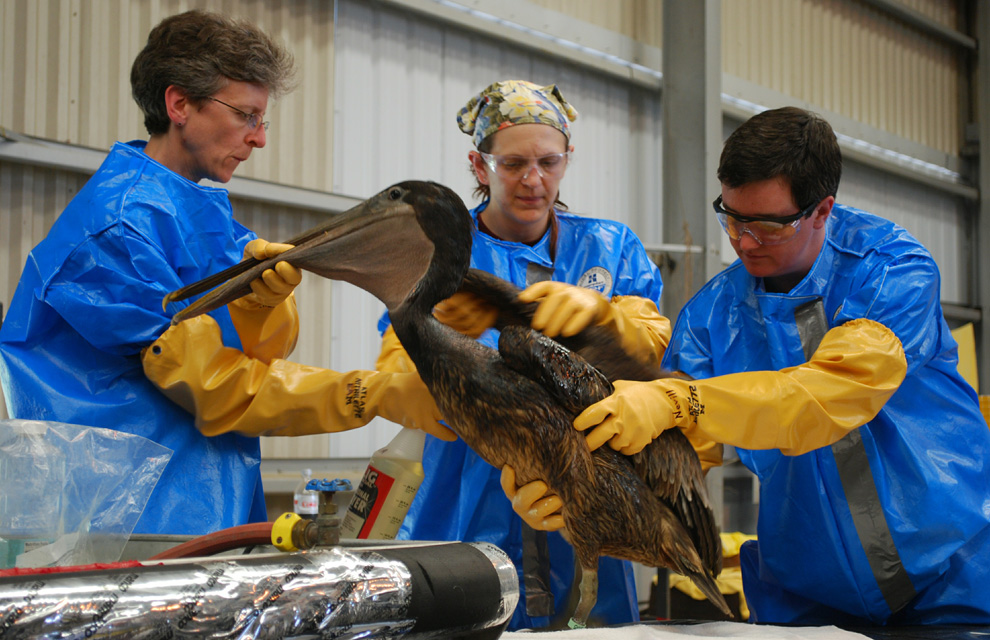
Take a few minutes and look at these photos from the Boston Globe of the oil spill in the Gulf of Mexico. As you look at these photos (go to the Globe’s website for even more photos), stop and think to yourself what you think should be the appropriate cost to and punishment against BP, Haliburton, and Transocean. Don’t forget: This was preventable.

Can any punishment adequately address this degree of damage? At bare minimum, any executive of the companies that caused this should spend a very, very long time in a very, very dirty prison cell, writing handwritten letters of apology to every fisherman, coastal resident, and anyone else adversely affected by this environmental disaster.

Oh, one more thing. Every single person who stood at a protest or a political rally and chanted “Drill, Baby, Drill” should be on their hands and knees on the Gulf Coast cleaning the feathers of sea birds or scrubbing the skin of dolphins with their own toothbrush. And Sarah Palin should be at the front of their line. Gee, I wonder if her “Ain’t Alaska Pretty” reality show will talk about the fact that more than 20 years later, Prince William Sound has still not fully recovered from the Exxon Valdez spill?

Labels: ,

Bookmark and Share


Monday, May 10, 2010

Belief vs. Science: Quick Observations

Scientists believe* that life on Earth, including humans, has evolved from primitive organisms to the modern, complex forms of life with which we are familiar. Some, however, believe that a deity or “intelligent designer” created humans; they do not believe in evolutionary biology.

Scientists believe* that the Earth is about 4.5 billion years old. They’ve reached this determination on the basis of radiometric age dating and other scientific methodologies. Some, however, believe that the Earth was “created” about 6,000 years ago.

Scientists believe* that human actions are causing global climate change. Some either do not believe that the Earth is experiencing climate change or suggest that it is "natural” and not caused by human action.

Scientists believe* that vaccines do not cause autism. Some believe that these scientists are wrong.

Scientists believe* that small microorganisms called viruses or bacteria cause certain illnesses. Some believe that illness is caused by impure thoughts or evil humors or an angry deity.

Scientists believe* that medications help fight illnesses. Some believe that prayer fights illnesses.

Scientists believe* that earthquakes and the eruption of volcanoes are caused by shifts and the Earth’s tectonic plates and underlying geology. Some believe that earthquakes and the eruption of volcanoes are the acts of an angry deity.

Scientists believe* that hurricanes are a natural phenomena that is part of the planet’s global climate and weather pattern. Some believe that hurricanes, like earthquakes, are the acts of an angry deity.

Scientists believe* that the Earth is a sphere that orbits the Sun. Some believe that the Earth is flat and that the Sun orbits the Earth.

So, in which category do you fall? Do you agree with science? Or do you reject science? And, when we look generally at those who reject the scientific beliefs set forth above, what similarities do we note and what conclusions can we draw? Just askin’…

-----

*Yes, I know that scientists are not unanimous in these beliefs. But there is certainly an overwhelming scientific consensus supporting these positions.

Labels: , ,

Bookmark and Share


Friday, May 7, 2010

Is This the Best That Republican Climate Change Deniers Can Do?

Yesterday, the Select Committee on Energy Independence and Global Warming of the House of Representatives held a hearing on “The Foundation of Climate Science”. According to the press release that announced the hearing, one purpose of the hearing was “to address the claims of deniers head-on”. To that end, the witnesses called by Committee Chair Rep. Edward D. Markey (D-Massachusetts) included the following:

  • Dr. Lisa Graumlich, Director, School of Natural Resources and the Environment, University of Arizona, and member of the “Oxburgh Inquiry” panel
  • Dr. Chris Field, Director, Department of Global Ecology, Carnegie Institution of Washington, and co-chair of “Impacts, Adaptation and Vulnerability” portion of new IPCC report due in 2014
  • Dr. James McCarthy, Professor of Biological Oceanography, Harvard University, past President and Chair of the American Association for the Advancement of Science, co-chair of “Impacts, Adaptation and Vulnerability” portion of IPCC report published in 2001
  • Dr. James Hurrell, Senior Scientist, National Center for Atmospheric Research, contributor to IPCC reports

Who did the Republicans select to offer testimony in opposition to Dr. Graumlich, Dr. Field, Dr. McCarthy, and Dr. Hurrell? The Republicans called Lord Christopher Walter Monckton, 3rd Viscount Monckton of Brenchley. I wanted to take a moment to provide a bit of background on Lord Monckton. And remember, this is who the Republicans chose to testify at the hearing (and the only person they chose).

First, it is important to understand that though he is called Lord Monckton, he is not, in fact, a member of Britain’s House of Lords (though he has been known to suggest otherwise). More importantly, recall that Lord Monckton is testifying in opposition to a group of scientists. But Lord Monckton is not a scientist; he is a journalist and Classics major. Ah, but that is only the tip of the proverbial melting iceberg.

Indeed, Lord Monckton really is a bit of a crackpot. After all, who else would refer to environmentalist students engaged in peaceful (though inappropriate) protests as “Hitler Youth” and then, when questioned on that reference, would not only stand firm in his claim but go so far as to say that the number of people killed by the “misplaced belief” in climate change is greater than the number of people killed by Hitler. He even claims that “coal and oil are just as clean as any other form of energy”. Here’s the video:

Lord Monckton continued to stand by his statement. After being confronted by a student protestor who took umbrage at being called a “Hitler Youth” and said to Lord Monckton, “As a Jew I'm not really sure how I should take that”, Lord Monckton simply replied: “I'll tell you how you should take it. You should take it”. Classy guy, hm? Of course when asked about his “Hitler Youth” comment by Associated Press – you know, the comment that he acknowledges making in the video above – Lord Monckton denies having said it (claiming instead the comment came from “three Germans and a Dane in the audience"). Of course, the fact that there is video of him saying it, not once, but twice, is apparently meaningless. Then again, as I’ve demonstrated in the past, to modern right, facts are meaningless.

(For the record, I don’t condone protests like this one that prevent a speaking from speaking. That is not the way to get the point across. But that isn’t the point of this post.)

So Lord Monckton is clearly a climate change denier who has no trouble with calling those with whom he disagrees “Hitler Youth”. OK. Fine. But guess what? He’s also a birther. At a tax day tea party protest, Lord Monckton (um, if he’s a British “climate expert” why was he speaking at an American tax protest?) opened his speech by saying, “America! Land of opportunity! You can be born in Kenya and end up as president of the United States!” Lord Monckton previously told a Wisconsin Republican county group that President Obama is a “monster”.

Finally, and I think that I’ve saved the best for last, here is what Lord Monckton had to say about HIV/AIDS in a 1987 article in The American Spectator (unfortunately, only available to subscribers):

.... there is only one way to stop AIDS. That is to screen the entire population regularly and to quarantine all carriers of the disease for life. Every member of the population should be blood-tested every month ... all those found to be infected with the virus, even if only as carriers, should be isolated compulsorily, immediately, and permanently.

So, with all of this in mind, one does have to ask of the Republicans who chose Lord Monckton to be their witness at yesterday’s hearing: Is this the best you can do? Or, said differently, is this a person with whom you really want to be associated?

Oh, one more thing: As to the actual issue of climate change and Lord Monckton’s views (with a little bonus revisiting of some of the foregoing), here are some great smackdowns from Peter Sinclair:

Yikes.

Labels: ,

Bookmark and Share


Tuesday, December 1, 2009

Apparently I’m Not Eligible to Run for Office as a Republican; How About You?

So the Republican National Committee is considering a “purity test” to determine which candidates will get party support in the 2010 elections. For those who’ve missed this, here is the full text of the resolution (sponsored by Indiana über-conservative James Bopp):

Proposed RNC Resolution on Reagan’s Unity Principle for Support of Candidates

WHEREAS, President Ronald Reagan believed that the Republican Party should support and espouse conservative principles and public policies; and

WHEREAS, President Ronald Reagan also believed the Republican Party should welcome those with diverse views; and

WHEREAS, President Ronald Reagan believed, as a result, that someone who agreed with him 8 out of 10 times was his friend, not his opponent; and

WHEREAS, Republican faithfulness to its conservative principles and public policies and Republican solidarity in opposition to Obama’s socialist agenda is necessary to preserve the security of our country, our economic and political freedoms, and our way of life; and

WHEREAS, Republican faithfulness to its conservative principles and public policies is necessary to restore the trust of the American people in the Republican Party and to lead to Republican electoral victories; and

WHEREAS, the Republican National Committee shares President Ronald Reagan’s belief that the Republican Party should espouse conservative principles and public policies and welcome persons of diverse views; and

WHEREAS, the Republican National Committee desires to implement President Reagan’s Unity Principle for Support of Candidates; and

WHEREAS, in addition to supporting candidates, the Republican National Committee provides financial support for Republican state and local parties for party building and federal election activities, which benefit all candidates and is not affected by this resolution; and

THEREFORE BE IT RESOLVED, that the Republican National Committee identifies ten (10) key public policy positions for the 2010 election cycle, which the Republican National Committee expects its public officials and candidates to support:

(1) We support smaller government, smaller national debt, lower deficits and lower taxes by opposing bills like Obama’s “stimulus” bill;

(2) We support market-based health care reform and oppose Obama-style government run healthcare;

(3) We support market-based energy reforms by opposing cap and trade legislation;

(4) We support workers’ right to secret ballot by opposing card check;

(5) We support legal immigration and assimilation into American society by opposing amnesty for illegal immigrants;

(6) We support victory in Iraq and Afghanistan by supporting military-recommended troop surges;

(7) We support containment of Iran and North Korea, particularly effective action to eliminate their nuclear weapons threat;

(8) We support retention of the Defense of Marriage Act;

(9) We support protecting the lives of vulnerable persons by opposing health care rationing and denial of health care and government funding of abortion; and

(10) We support the right to keep and bear arms by opposing government restrictions on gun ownership; and be further

RESOLVED, that a candidate who disagrees with three or more of the above stated public policy position of the Republican National Committee, as identified by the voting record, public statements and/or signed questionnaire of the candidate, shall not be eligible for financial support and endorsement by the Republican National Committee; and be further

RESOLVED, that upon the approval of this resolution the Republican National Committee shall deliver a copy of this resolution to each of Republican members of Congress, all Republican candidates for Congress, as they become known, and to each Republican state and territorial party office.

Chief Sponsor:
James Bopp, Jr. NCM IN
Sponsors:
Donna Cain NCW OR
Cindy Costa NCW SC
Demetra Demonte NCW IL
Peggy Lambert NCW TN
Carolyn McLarty NCW OK
Pete Rickets NCM NE
Steve Scheffler NCM IA
Helen Van Etten NCW KA
Solomon Yue NCM OR

I don’t want to waste time discussing whether a purity test is a smart idea or a bad idea; hey, it’s their party. But I do want to take on each of the ten themes expressed in the test itself.

(1) We support smaller government, smaller national debt, lower deficits and lower taxes by opposing bills like Obama’s “stimulus” bill;

OK. I get that Republicans were opposed to the stimulus bill. The problem is, I don’t recall hearing many Republican ideas to help prevent the economy from taking a nose dive into a true depression. One thing that Republicans don’t seem to grasp right now is that there is a huge difference between being opposed to something and offering up a viable alternative. Think of it this way: If you suggest eating Chinese for dinner, I could say, “Gee, I don’t feel like Chinese; why don’t we go for Italian, instead.” From there, we could have an open and honest debate about which would be a better meal choice. On the other hand, if I was a Republican, my response would be more like this: “Gee, I don’t feel like Chinese (after all, they’re communists!); so we’ll just skip dinner tonight.”

I also fail to understand the constant mantra about “smaller government” as if by simply making government “smaller” we make it better. I’m less worried about the size of the government than I am with the effectiveness of that government.

As to the national debt and deficits, I seem to recall these going up, not down, under a Republican administration. It seems that Republicans are firmly opposed to debt and deficits except for debt and deficits that they like. Finally, I’d like to be certain what Republicans mean when they say “lower taxes”; lower taxes on whom? The wealthiest Americans who can easily afford to pay a bit more from the money that they’re parking in illegal offshore bank accounts? Why is it that I doubt that “lower taxes” means repeal of regressive taxes like sales tax.

(2) We support market-based health care reform and oppose Obama-style government run healthcare;

First, does that mean that Republicans will support an end to the anti-trust exemption for insurance companies? After all, an anti-trust exemption doesn’t really seem consistent with market-based insurance reform. Second, when Republicans talk about “Obama-style government run healthcare” does that mean that they oppose Medicare, Medicaid, the VA, and military healthcare? Those programs are, of course, all government run. What about the insurance provided to members of Congress? Finally, what type of reform do Republicans support? Remember that the plan offered by Senate Republicans didn’t prohibit exclusion based on pre-existing conditions (among a host of other failings). We’ve had a largely “market based” system (with anti-trust exemptions) for years and look where that’s gotten us. And how exactly do Republicans plan to handle the millions of uninsured Americans? Insuring a measly 3 million additional Americans over 10 years (while leaving 30-50 million uninsured) doesn’t really seem to be a solution to the problem. Then again, so long as the “solution” is merely opposition and obstruction…

(3) We support market-based energy reforms by opposing cap and trade legislation;

I wonder how many Republicans can actually explain what cap and trade legislation means. And, for that matter, I wonder how many of the Republicans who oppose cap and trade also believe that global warming is a myth. The funniest part of this is that cap and trade is a market-based reform. That is the whole idea; allow the market to put a value on the right to pollute and provide cost incentives for reducing emissions. And again, note that as usual, what Republicans oppose is spelled out clearly (Obama’s stimulus bill, Obama-style government run healthcare, cap and trade) but what Republicans support is much, much more nebulous (smaller and market-based). Again, it is easy to be opposed to a particular, narrowly-defined policy; it is much more difficult to articulate an alternative.

(4) We support workers’ right to secret ballot by opposing card check;

In all honesty, I don’t know enough about card check to really get into this discussion. I will note, however, that it seems strange, in the entire universe of issues for Republicans to focus on, that card check makes the top ten.

(5) We support legal immigration and assimilation into American society by opposing amnesty for illegal immigrants;

This point is one of the most insidious of all of the points on the Republican purity test. Why? Did you note that Republicans don’t just support legal immigration, but also support assimilation? In other words, Republicans are telling immigrants to come in legally, but once here, they had better jettison their cultural (and religious?) heritage and assimilate into American society. And why is that I suspect that the Republican version of “American society” is the same thing as Glenn Beck’s “white culture”?

In addition, I’m not quite sure how supporting legal immigration and assimilation is accomplished “by opposing” amnesty. What does one have to do with the other? More importantly, what precisely is the Republican plan to deal with illegal immigration and the illegal immigrants who are already here? Again, they oppose a particular policy (amnesty) without offering a solution to the existing problem.

(6) We support victory in Iraq and Afghanistan by supporting military-recommended troop surges;

First, who doesn’t support “victory in Iraq and Afghanistan”? Do Republicans really think that either President Obama or Democrats support “defeat”? It seems to me that the real question is the definition of “victory”. More importantly, I find it quite odd that when the Republican purity test finally gets around to specific things that Republicans are supposed to support, the focus is on a particular strategy advocated by the military. The last time I checked, the military was overseen by civilian leadership. It is important to remember that the issues being looked at by military planners are almost exclusively military. We don’t ask or expect military planners to look at diplomatic consequences of a particular policy, the cost to implement that policy (what about that support for a smaller national debt…?), the cost in lives or impact upon military families (I suppose that the military might factor this in to the calculation, but I don’t really know), or the desire of the American electorate to engage in the particular military operation. I suspect that generals recommended attacks on the Soviet Union during the Cold War, but we allowed civilian leadership to decide what was in the best interest of the country. So too should civilian leadership decide what is in the best interests of America when it comes to Iraq and Afghanistan. If that means a surge, then so be it; but the decision needs to be made on the basis of all known information and should take into consideration all relevant matters, not just the matters relevant to the battlefield itself. Military strategy options should be developed by military planners but decisions regarding those strategic options should be made on the basis of national interest, not just military necessity.

(7) We support containment of Iran and North Korea, particularly effective action to eliminate their nuclear weapons threat;

This one leaves me a bit puzzled. First, the use of the word “containment” harkens back to the Cold War and fears of Soviet expansion. I suspect that the real issue being “supported” is limits on the ability of North Korea or Iran to export nuclear technology or terrorism. And again, who doesn’t support those ends? Do Republicans really think that President Obama or Democrats oppose “containment” of Iran or North Korea? More problematic is the phrase “effective action to eliminate their nuclear weapons threat”. What precisely does this mean. Again, I doubt that anybody supports ineffective actions. The real question, of course, is what action would be effective? So, for example, are harsh sanctions “effective”? Maybe I’m wrong, but when I read this particular point of the purity test, I take it to really be referring to military action as the “effective action”. Maybe I’m wrong. But if not, I’m troubled by the idea that Republicans are being asked to support a military action without necessarily considering either alternatives or consequences. Forget Iran for the moment; what would be the consequences of the use of force against North Korea? Do we really want to elect leaders who want war on the Korean peninsula?

(8) We support retention of the Defense of Marriage Act;

I’m not going to take the time in this particular post to explain why I oppose the Defense of Marriage Act (and why I believe it might be unconstitutional) or to explain why I support same sex marriage (or at least domestic partnerships that have all of the benefits and obligations of marriage). Instead, I’ll simply note that of the items that Republicans apparently view as the litmus test for whether a candidate is worthy, opposition to same sex marriage counts for 10%. I still don’t understand how the issue of whether a loving, committed couple can be allowed to enjoy the benefits of “marriage” can rise to this level of importance. And, for the record, I note that those states that have allowed same sex marriage have neither imploded, been struck by wave after wave of natural disasters, nor sunken into the bowels of the earth; moreover, I note that in those states the institution of heterosexual marriage remains alive and well.

(9) We support protecting the lives of vulnerable persons by opposing health care rationing and denial of health care and government funding of abortion; and

I’m glad that Republicans oppose health care rationing. I’m curious to know how they plan to stop insurance companies from continuing to ration care or, for that matter, how they intend to stop the effective rationing for those people who can’t afford health insurance. Republicans also oppose the denial of health care. That seems like a pretty clear blanket statement; yet last time that I checked, Republicans were set against health care for illegal immigrants (remember Rep. Joe Wilson’s “you lie” moment?). And recall, once again, that the Republican health care reform proposal did not prevent insurance companies from denying coverage based on pre-existing conditions.

With regard to the funding of abortions, first I note that it is a blanket opposition. There is no nuance or exception for matters of rape, incest, or life of the mother. “Gee, sorry, that you’re gonna die ma’am, but if you can’t pay for the abortion on your own, we can’t help you!” Talk about compassionate conservatism. I also have a problem with enshrining certain types of moral issues into federal funding policies. Why, for example, are Republicans opposed to funding abortion but not drugs for erectile dysfunction or hair replacement? More importantly, why are Republicans opposed to funding abortion but not opposed to funding the death penalty, wars, torture, and illegal wiretaps? If every issue to which a large group of voters objected on moral grounds were excepted out of government funding, I suspect that very little would be funded (then again, I suppose that Republicans would view that as good, so long as the military was still fully funded). I also have a problem with the exception for abortion given that other religious traditions come to the issue of abortion with a different understanding and mindset. Thus, while the denial of funding may satisfy a conservative Christian worldview, it may also run directly contrary to a Jewish understanding of when abortion is acceptable. If my religious tradition has a different understanding of the issue, why should someone else’s religious understanding determine how federal spending impacts upon my religious beliefs? (For a more in depth discussion of religious views of abortion, see my post Keep Your Religious Doctrine Out of My State’s Laws from January 2008). I get that conservatives don’t want their tax dollars to pay for abortions; I don’t want my tax dollars to pay for torture. Republicans will do almost anything to protect the “unborn”; but once a child is born, don’t look to the Republicans for help or protection, no sir!

(10) We support the right to keep and bear arms by opposing government restrictions on gun ownership;

Like abortion, I’ve written before about my thoughts on gun control and the Second Amendment and I won’t belabor the point here. But I do want to point out the fact that the opposition to “government restrictions on gun ownership” is another blanket statement. There is no exception for children, the mentally ill, or felons (or terrorists for that matter) and there is no exception for assault rifles or armor piercing bullets or rocket-propelled grenades (or nuclear weapons…). So it would seem to me than any Republican who supports even modest gun control legislation would not pass the party’s proposed purity test.

And what happened to honoring the tenets of this recitals from the preamble of the proposed resolution:

President Ronald Reagan also believed the Republican Party should welcome those with diverse views

Somehow the notion of welcoming diverse views doesn’t seem to come through in the proposed purity test.

As a counterpoint to the Republican purity test, take a look at this purity test for Democrats proposed by Devilstower on Daily Kos:

(1) We support the rights extended to Americans extended under the Constitution. All the rights. For all Americans.

(2) We support thoughtful, pragmatic solutions that protect American lives, American standards, and American pocketbooks. This includes finding solutions that don't require bombing anyone.

(3) We support an America that has diversity in race, thought, background, and religion not out of some hazy idealism, but because it is our nation's greatest strength.

(4) We oppose torture in any form, in any place, at any time, for any reason.

(5) We support American business, and recognize that an unregulated market is an unfair market, an unstable market, and a market doomed to failure.

(6) We support American workers, and know that when workers are allowed to organize they make their jobs, their companies, and their nation stronger.

(7) We believe that the reputation of our nation is valuable and must be zealously guarded against those who place expediency ahead of law.

(8) We believe in spreading democracy and human rights to the rest of the world by vigorously upholding those ideals here at home.

(9) We believe that access to our government is not for sale. Not in the courthouse, not in the White House, and not in the legislature.

(10) We believe that the health of our planet is not a zero-sum game, not a game of "you go first," and not a game.

What is interesting is that I don’t necessarily completely agree with each and every point in this “purity test” either (for example, I’m very hesitantly willing to consider torture in a true ticking time bomb case). Nevertheless, I think that the ideals espoused by this purity test are certainly worth considering, at least as a comparison to the proposed Republican purity test. Read both sets of positions and then ask yourself in which version of our country would you rather live?

Finally, ask yourself whether a purity test like that proposed by the Republicans makes sense. Which would you prefer: (a) party that has pre-determined how its members must think and how they must vote on certain issues; or (b) a party that tells its members to think for themselves, honor their ideals and values, and represent the voters that elected them, rather than the party to which they belong.

Oh, one more thing, as long as I’m looking at purity tests and lists of values and ideals. Charles Johnson, the founder of the right-leaning blog Little Green Footballs has announced that he is parting ways with the right because of:

1. Support for fascists, both in America (see: Pat Buchanan, Robert Stacy McCain, etc.) and in Europe (see: Vlaams Belang, BNP, SIOE, Pat Buchanan, etc.)

2. Support for bigotry, hatred, and white supremacism (see: Pat Buchanan, Ann Coulter, Robert Stacy McCain, Lew Rockwell, etc.)

3. Support for throwing women back into the Dark Ages, and general religious fanaticism (see: Operation Rescue, anti-abortion groups, James Dobson, Pat Robertson, Tony Perkins, the entire religious right, etc.)

4. Support for anti-science bad craziness (see: creationism, climate change denialism, Sarah Palin, Michele Bachmann, James Inhofe, etc.)

5. Support for homophobic bigotry (see: Sarah Palin, Dobson, the entire religious right, etc.)

6. Support for anti-government lunacy (see: tea parties, militias, Fox News, Glenn Beck, etc.)

7. Support for conspiracy theories and hate speech (see: Alex Jones, Rush Limbaugh, Glenn Beck, Birthers, creationists, climate deniers, etc.)

8. A right-wing blogosphere that is almost universally dominated by raging hate speech (see: Hot Air, Free Republic, Ace of Spades, etc.)

9. Anti-Islamic bigotry that goes far beyond simply criticizing radical Islam, into support for fascism, violence, and genocide (see: Pamela Geller, Robert Spencer, etc.)

10. Hatred for President Obama that goes far beyond simply criticizing his policies, into racism, hate speech, and bizarre conspiracy theories (see: witch doctor pictures, tea parties, Birthers, Michelle Malkin, Fox News, World Net Daily, Newsmax, and every other right wing source)

And much, much more. The American right wing has gone off the rails, into the bushes, and off the cliff.

I won’t be going over the cliff with them.

I disagree with Charles Johnson on many issues, but I’ve always found him to be reasonable and fair minded. When he takes a position, he almost always backs it up. Ever since I came across Little Green Footballs during the Israel-Lebanon war in 2006, I’ve found his site to be a destination to see what the rational right is thinking. As Johnson has frequently noted over the last several months, too often what the right is thinking isn’t rational at all.

So anyway, it looks like I won’t be eligible to run for office as a Republican in 2010. Shucks.

Labels: , , , , , , , , ,

Bookmark and Share


Wednesday, March 19, 2008

More on President Bush's Interference With EPA Ozone Regulations

Several days ago, in my post "Recap of Interesting News Items" I discussed President Bush's meddling with EPA regulations concerning ozone emissions. Reader John Walke, the Clean Air Director/Senior Attorney for the Natural Resources Defense Council posted a comment in which he mentions his own blog article "Science Decider in Chief". It appears from reading Mr. Walke's post that the newspaper story from which I got my information barely scratched the surface of the actions and issues.

Please take a few moments to read Mr. Walke's thoughts on the subject. Then, if you believe that President Bush's actions were inappropriate, take a few minutes and call your Congressman and tell them what you think.

Labels: ,

Bookmark and Share


Friday, March 14, 2008

Recap of Interesting News Items

Several items in today's issue of The Indianapolis Star caught my eye and prompted me to offer at least a few (notice that I did not say "brief") thoughts on each:

Censorship

First, was the editorial "The trouble with judging a book by its cover" by Kathleen Parker about a student/employee at Indiana University Purdue University Indianapolis (IUPUI) who was apparently censured for reading a book about a confrontation between students and Notre Dame and the Ku Klux Klan in 1924. A co-worker who only saw the cover of the book thought that it was racially insensitive and should not be read in public and filed a complaint against the student/worker. IUPUI censured the student/worker for his choice of reading material. Then, just recently, IUPUI reversed its position and rescinded the censure because the University could not make a determination as to whether the reading material or the choice to read that material was "intentionally hostile". Today's The Indianapolis Star also has an article on this story that relays these same basic facts: "IUPUI withdraws reprimand of worker". For the record, it is worth noting that the issue may have been more about the student/employee's behavior toward other employees and less about the book, but, nevertheless, the letter of censure appears to be directed toward the choice of reading material:
We conclude that your conduct constitutes racial harassment in that you demonstrated disdain and insensitivity to your co-workers who repeatedly requested that you refrain from reading the book which has such an inflammatory and offensive topic in their presence.

Several things about this story prompted me to write. First, while I read the paper every day, this was the first time that I've heard about this story, even though it concerns events here in Indianapolis. (I admit that I might have missed it earlier, but it seems like the type of story that I would have noted.) Yet, the editorial is from a Washington Post columnist. How is it that this story was picked up by the national press and ignored here in Indianapolis? Second (and much more importantly), the very notion that a person's choice in reading material, especially historical reading material, could be racially insensitive borders on the ludicrous. I suppose that an employee reading a book extolling the virtues of the KKK or something similar might cross that line, but history is history and the mere fact that someone is interested in history should not subject that person to criticism for racial insensitivity. What is even odder is that the book appears to be an anti-racism book about the beginnings of the decline of the importance of the KKK in Indiana (a state with a government once dominated by the KKK). And finally, of all places for a complaint like this to have arisen, it would seem that a public university would be the least likely to challenge a student's reading material. I can recall reading some pretty strange things when I was a student (which, it should go without saying, does not necessarily mean that I approved of the text or ideas of that material; rather, reading that material was a part of the learning process). I can't fathom my university (and I attended a private school) telling me not to read something because someone else might be upset. While it may be acceptable for a private employer to intervene in how an employee acts during his breaks, it is troubling to think that a public university would intervene to such an extent that an employee who is also a student could not freely choose what to read.

I think that this entire matter, from the conduct of the student/employee, to the conduct of the employee(s) making the complaint, to the University's administrators who issued the letter of censure should be the subject of an investigation. If the student/employee engaged in conduct that was hostile or racially insensitive, then he should be punished, but that conduct must be more than reading a book others may disapprove of (especially if they don't really know what the book is about). Might the employee have been subject to sanction for reading the Koran if another employee was an Iraq war veteran or a 9/11 survivor? By the same token, however, if the complaining employee was not on firm ground in making his complaint, then that employee should be punished. And, most importantly, the author of the letter sanctioning the student/employee for his choice in reading material should, in all likelihood, be shown the door as it does not seem to be the role of anyone in a public university to criticize, let alone censure, a student for choosing to learn about history.

Environment & Presidential Authority

The next article that caught my eye was "Bush overrules EPA ozone rule" by Juliet Eilperin (The Indianapolis Star, March 14, 2008, page A5; for some reason not available on IndyStar.com). According to the article, the Environmental Protection Agency was prepared to issue new Clean Air regulations. Yet, before the EPA could do so, President Bush stepped in and, perhaps illegally, told the agency to weaken the regulations:
EPA officials initially tried to set a lower seasonal limit on ozone to protect wildlife, parks and farmland, as required under the law. While their proposal was less restrictive than what the EPA's scientific advisers had proposed, Bush overruled EPA officials and ... ordered the agency to increase the limit....

In the opinion of John Walke, clean air director for the National Resources Defense Council:
It is unprecedented and an unlawful act of political interference for the
president personally to override a decision that the Clean Air Act leaves
exclusively to EPA's expert scientific judgment.

Even US Solicitor General Paul Clement recognized that President Bush's action presented a problem, as the new rules "contradicted the EPA's past submissions to the Supreme Court".

But then this is not the first time that President Bush has ignored advisers. He has previously forced changes in a report on global warming that he disagreed with and changed generals in Iraq to get a general that advocated a strategy endorsed by the President. So, we shouldn't be surprised. But we should be troubled.

Immigration

Finally, for those of you who have been reading this blog over the last month or so know, I've expressed repeated concerns over Indiana's proposed immigration legislation. I am quite pleased to see that the bill (originally SB335 then amended into SB345) appears to be dead for the 2008 legislative session (see "Immigration bill appears dead"). Once again, I want to be clear: I am not necessarily opposed to immigration reform or to some of the broad concepts set forth in the draft legislation. However, as the cliche goes, the devil is in the details, and SB335 (and its offspring and siblings) had too many problems in the details (leaving aside such large details as constitutionality...) to be adopted as law.

I am sure that this issue will again be before our legislature next year; hopefully in the long session, without the property tax crisis dominating all other issues, and in a non-election year, the General Assembly will be able to give much more careful consideration to whether state-based immigration reform is appropriate and what form such reform should take. I've previously highlighted a number of concerns with the draft legislation (as, of course, have others). Perhaps if more of these concerns are understood and addressed, viable and appropriate legislation will be possible. But for now, I'm pleased to see that neither SB335 nor SB345 will become the law of the State of Indiana in 2008.

One final note on the defeat of the immigration legislation. Sen. Mike Delph, the bill's primary author and sponsor, has been the target of much criticism during the legislative process. The criticism directed at him with regard to the specifics of the bill or his appearance with a uniformed soldier to endorse the bill was appropriate; however, some of that criticism devolved into charges of racism which I don't believe were appropriate (although I do think that some supporters of the bill have been racially motivated). I disagreed with some of Sen. Delph's ideas, but I do not question that his motives were good and I do not think that his ideas were racially motivated.

That said, however, some of Sen. Delph's comments, quoted in today's The Indianapolis Star did bother me. According to "Immigration bill appears dead" by Dan McFeely, Sen. Delph said of the legislative process that lead to the "killing" of the immigration bill: "It's corruption. And you can quote me on that". Just as I'm sure Sen. Delph does not appreciate the charges of racism, I'm sure that legislators who had legitimate concerns with SB335/SB345 would not appreciate being charged with corruption. Frankly, I think that it is blatantly irresponsible of Sen. Delph to make such a charge without evidence. Political and policy disagreements do not corruption make. It appears that Sen. Delph believes that if he doesn't get his way, it must be because of corruption in the system. Perhaps, Senator, the bill died because many people had concerns with its provisions, not the least of which would be its constitutionality.

Sen. Delph is also quoted as saying "I think this has been a well-orchestrated effort, bipartisanly [sic] from both leaderships, to try to kill the bill .... Unfortunately, the will of the people is losing now and it's a shame." Again, while the effort to kill the bill may have been "well-orchestrated", there is nothing nefarious going on. While many people may have supported the bill, many others did not. The business community, the Chamber of Commerce, immigrant groups, and religious groups all expressed opposition or concern about the legislation. So, the suggestion that the leadership prevented "the will of the people" from becoming law is not based on real facts. Sen. Delph often cites his constituent survey and notes that 87% of his constituents favored his bill; however, it is worth noting first that his survey was conducted before the actual text of the bill was introduced and before anyone had a chance to comment on its flaws. Second the language of the survey is just the type of pre-determinative language that makes reliance upon survey results so dangerous:
Illegal immigrants' unfunded use of local government services adds to demands on local property taxes. Would you support or oppose a bill that would get tough on illegal immigration and those who profit from such activity.

I can't imagine anyone saying no to that sort of statement. The problem, of course, is that the basic premise of the "question" is, at least partially, false.

I look forward to participating in an open and honest discussion of these issues in the future. I hope that our legislators and concerned citizens will participate as well. But, I hope that such participation is done in good faith and with an open mind and without the name calling, racial overtones, and refusal to think about competing viewpoints that has plagued discussion of the issue this year.

Labels: , , , ,

Bookmark and Share


‹Older